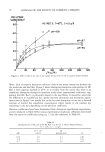
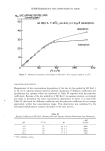
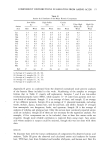
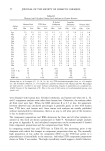
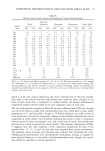
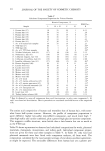
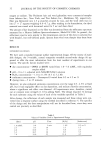
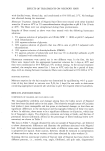
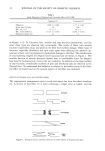
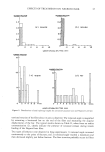
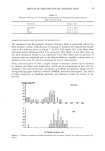
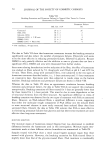
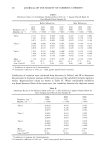
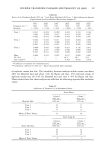
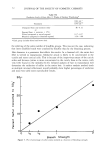
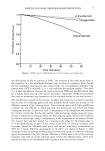
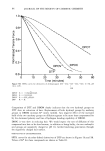
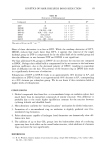
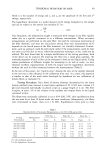
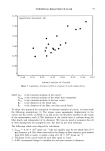
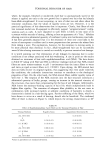
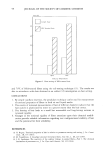
EFFECTS OF TREATMENTS ON NEGROID HAIR 49 Table VI Diameter Swelling (%) of Untreated, Superrelaxed, and Thioglycolate-Treated Negroid Hair in Formic Acid Treatment Formic Acid Untreated 47.8 _+ 10.6 SR 76.8 + 13.3 TGA 118.6 + 18.2 PREMATURE FAILURE AND THE EFFECT OF HUMECTANTS The mechanical and fractographic behavior of keratin fibers is profoundly affected by their moisture content. Distributions of extension to break for the Negroid hair sample used in this work are shown in Figure 5. At 65% RH, nearly 26% of the fibers show premature failure (breaking below 22% extension). Wet fibers, on the other hand, do not show premature failures to any significant level. This shows that the presence of moisture plays an important role in the fracture behavior, possibly causing stress re- laxation at the crack tip and thus reducing the rate of crack growth. From a practical point of view, a slight increase in moisture content can be achieved by treating the fibers with humectants, which can be incorporated in hair care for- mulations. Two such humectants, polyacrylic acid (PAA) and glycerin, along with the strong swelling agent dimethyl sulfoxide (DMSO), have been investigated. The effects of these treatments on breaking extension and premature failure are shown in Ta- ble VII. NUMBER FRACTION 0 8 16 24 32 40 65 %RH .14 .12 I I wet .10 .... , , , EXTENSION-TO- BREAK (%) Figure 5. Change of extension-to-break distribution for untreated Negroid hair fibers with relative hu- midity.

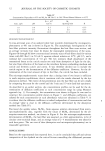
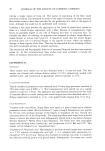
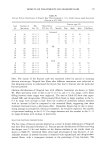
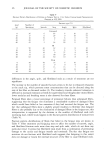
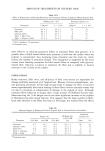
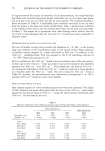
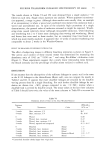
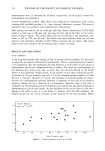
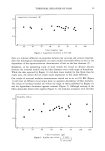
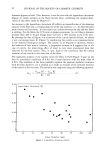
50 JOURNAL OF THE SOCIETY OF COSMETIC CHEMISTS Table VII Breaking Extensions and Premature Failures for Negroid Hair Treated in Various Humectants for Three Days Premature Failures Treatment Brk. Ext. (%)* (%) Untreated 29 --- 3 26 PAA (5%) 38 --- 2 2 Glycerin (30%) 38 + 3 6 Glycerin (30%) + 2 M urea 39 + 2 4 DMSO (10%) 33 --- 3 14 DMSO (10%) + PAA (5%) 38 + 2 4 * 95% confidence, 50 specimens. The data in Table VII show that humectant treatments increase the breaking extension significantly and also reduce the number of premature failures. Polyacrylic acid seems to be the most effective in reducing premature failures, followed by glycerin. Because DMSO is only partially effective and the addition to urea to glycerin does not have a significant effect, DMSO and urea were eliminated from further studies. Since most relaxing formulations involve reduction of the fiber, the effect of humectants was studied on fibers reduced by 5% thioglycolic acid (TGA) at pH 8.5 and 40øC for 30 min. These fibers, along with untreated fibers, were subjected to the two types of humectant treatment described earlier, i.e., 3 days continuous and 3 1-hour treatments on consecutive days. Specimens were then subjected to tensile stress on the Instron machine. Breaking extensions and premature failures are shown in Table VIII. Whereas the data in Table VII show an approximate correlation between breaking extension and premature failure, the data in Table VIII do not support this conclusion unequivocally. Breaking extensions of fibers treated for 3 days are generally lower than for those treated for 3 1-hour periods. This must be due to some degradation or loss of structural elements from the fiber structure. No significant difference in terms of breaking extension was observed for the two types of treatment with PAA on untreated fibers. However, on TGA-reduced fibers, a significant difference is seen, suggesting that either low molecular weight components of PAA diffuse into the reduced fibers or some structural element is more easily extracted from reduced fibers than from untreated fibers. Overall, the data in Table VIII indicate that PAA is more effective in eliminating premature failures than glycerin and that short-term treatments are more effective than long-term treatments. MOISTURE SORPTION The moisture regain of humectant-treated Negroid hair was determined to establish differences between the humectants used in this investigation. Moisture regain mea- surements made at three different relative humidities are summarized in Table IX. Samples treated with PAA show a trend toward higher moisture regain than those treated with glycerin. However, the breaking extension for PAA-treated fibers is slightly lower than that of the glycerin-treated fibers. PAA treatment is considerably
Purchased for the exclusive use of nofirst nolast (unknown)
From: SCC Media Library & Resource Center (library.scconline.org)