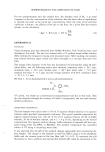
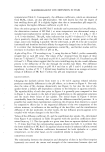
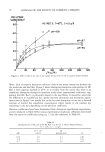
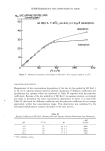
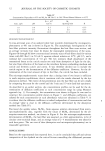
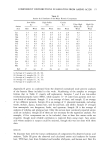
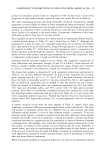
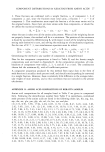
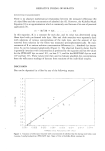
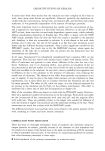
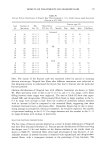
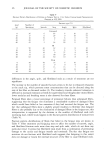
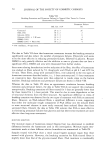
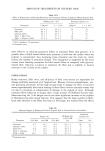
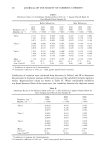
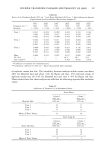
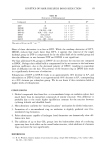
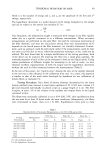
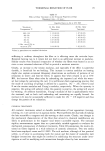
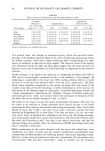
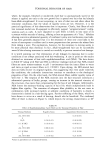
EFFECTS OF TREATMENTS ON NEGROID HAIR 51 Table VIII Effect of Humectants on Breaking Extensions and Premature Failures of Reduced (TGA) Negroid Hair Breaking Ext. (%)* Premature failures (%) Treatment 3 Days** 3 X 1 h** 3 Days** 3 X 1 h** Untreated 29 -+ 3 29 -+ 3 26 26 PAA (5%) 38 + 2 38 -+ 3 2 6 Glycerin (30%) 38 + 3 42 ___ 1 6 14 TGA + PAA (5%) 34 -+ 3 47 q- 3 10 4 TGA + Glycerin (30%) 43 - 4 52 -+ 5 10 16 * 95% confidence, 50 specimens. ** Treatment time. more effective in reducing premature failure in untreated fibers than glycerin. It is possible that in PAA-treated fibers more moisture is held near the surface where the polymer is concentrated, thus increasing stress relaxation near the crack tip, which reduces the number of premature failures. This assumption is supported by the trend toward lower breaking extensions for PAA-treated fibers as compared with glycerin- treated fiber. Glycerin is known to penetrate the fiber and is unlikely to localize moisture in the vicinity of the surface. CONCLUSIONS Kinky structure, fiber twist, and ellipticity of fiber cross section are responsible for damage problems associated with Negroid hair. Because of severe entanglements, rou- tine grooming procedures involve high enough loads to damage the fiber. It has been shown experimentally that tensile loading of these fibers involves torsional stresses that can lead to initiation or enhancement of damage in the regions of twist. Although untreated fibers subjected to fatigue show a large number of fibrillated fracture ends, fibers surviving the 11-kc fatigue test do not show significant increases in the number of fibrillated ends after tensile fracture. This suggests that the large number of fibril- lated ends observed in the fibers that failed in the fatigue test resulted from the effects Table IX Moisture Regain of Humectant-Treated Negroid Hair at Various Relative Humidities Premature Regain (%) Breaking Ext. Failures (%) at 65% RH Treatment 33% RH 44% RH 65% RH (%) 3 Day* 3 h* Untreated 8.7 10.3 15.3 29 q- 3 26 26 Glycerin (30%) 7.1 9.5 15.1 42 _+ 1 6 14 PAA (5%) 9.6 12.4 17.2 38 -+ 3 2 6 TGA + Glycerin 7.5 11.5 15.6 52 q- 5 10 16 TGA + PAA 10.7 11.8 15.9 47 q- 3 10 4 Treatment time.

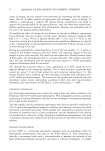
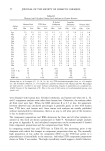
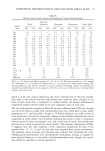
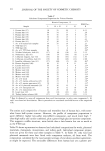
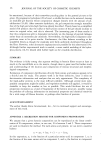
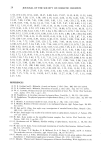
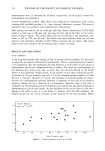
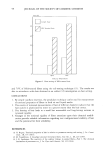
52 JOURNAL OF THE SOCIETY OF COSMETIC CHEMISTS of fatigue in combination with some preexisting damage. Treatment of the fibers with alkali or thioglycolic acid reduces the number of fibrillated ends, especially at high fatigue loads, and increases the number of smooth fractures. Premature failures result from preexisting damage in the fiber. Moisture content plays an important role in controlling the number of premature failures, suggesting that stress relaxation at crack tips may be involved. Treatment with humectants such as polyacrylic acid and glycerin have been found to be beneficial, PAA appearing to be more effective. There is some evidence that increase in moisture content may be re- sponsible for the reduction in premature failures in humectant-treated hair. Breaking extension data on humectant-treated fibers suggest that in PAA-treated fibers a larger amount of moisture is likely to be present near the periphery of the fiber where cracks exist. Thioglycolic acid pretreatments seem to enhance preexisting damage in the fibers, thus eliminating the beneficial effects of humectants. ACKNOWLEDGEMENT These studies formed one aspect of the work on the Textile Research Institute project "Properties of Negroid Hair," supported by Nicholas Laboratories, Inc. REFERENCES (1) J. Epps and L. J. Wolfram, Letter co the ediror, J. Soc. Cosmet. Chem., 34, 213 (1983). (2) Y. K. Kamarh, S. B. Hornby, and H.-D. Weigmann, Mechanical and fracrographic behavior of negroid hair, J. Soc. Cosmet. Chem., 35, 21-43 (1984). (3) J. Menkarr, L.J. Wolfram, and I. Mao, Caucasian hair, Negro hair and wool. Similarities and differences. J. Soc. Cosmet. Chem., 17, 769 (1966). (4) Y. K. Kamarh and H.-D. Weigmann, Fracrography of human hair, J. Appl. Po/ym. ScJ., 27, 3809- 3833 (1982). (5) J. Chao, E. Newsom, I. M. Wainwright, and R. A. Mathews, Comparison of the effects of some reactive chemicals on the proteins of whole hair, cuticle and cortex, J. So . Cosmet. Chem., 30, 401- 413 (1979).
Purchased for the exclusive use of nofirst nolast (unknown)
From: SCC Media Library & Resource Center (library.scconline.org)