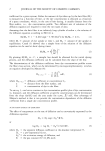
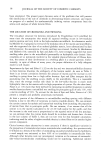
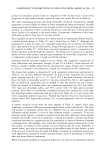
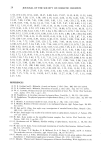
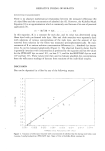
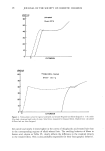
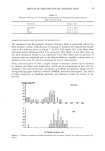
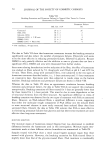
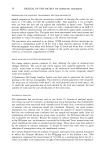
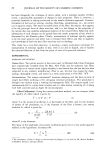
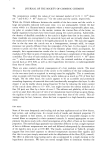
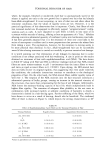
88 JOURNAL OF THE SOCIETY OF COSMETIC CHEMISTS has been frequently the technique of choice yields, with a minimal number of fibers tested, a reproducible assessment of changes in hair properties. There is, however, a potential drawback in relying exclusively on the tensile calibration approach. Cosmetic treatments of hair such as waving, coloring, bleaching, straightening, etc., are carried out in aqueous media. The water-accessible phase of the fiber, the matrix, thus appears to be the principal locus of these reactions, and it is the change in the properties of the matrix that may underlie subsequent behavior of the treated fibers. Relatively little information of such changes can be gained from the tensile properties of hair which is dominated by the filament phase. Clearly, measurement of torsional rigidity appears to be the most sensitive and direct way to evaluate these effects and thus to augment our knowledge of both the hair fiber reactivity and its rheology. This study has a two-fold objective: to develop a single-instrument technique for measurement of torsional rigidity of hair, both in air and in liquids, and to explore the torsional behavior of hair from the point of view of its practical relevance. EXPERIMENTAL MATERIALS AND METHODS Human Hair. Two prime sources of hair were used: (a) blended dark brown European hair commercially available from De Meo, New York and (b) authentic hair fibers from subjects of various racial origins whereby it was known that the hair had not been subjected to any cosmetic modification. Prior to use, the hair was cleaned by sham- pooing, thoroughly rinsed, and stored in a room maintained at 65% RH, 70øF. Instrumentation. The torsion instrument* measures damping and the force-to-twist of single hair fibers utilizing a free swinging torsional pendulum. The pendulum is brought into motion using a rotating electromagnetic field. The output signal is in- stantaneously fed to a strip chart recorder and to a data station consisting of a Cyborg 41A A/D converter and an Apple lie microcomputer. Fiber Calibration. Using the torsion pendulum method, one can compute either the rigidity of a fiber which is given by: I • = 8 •r 3 I L / T 2 ............ (I) where T is the period of oscillation, L is the length of the fiber, and I is the moment of inertia of the pendulum or, if the diameter of the fiber is known, the torsion modulus G, which is given by: I • 128 •r I L G - •r 2 D4 - T 2 D4 ............ (II) 16 where D is the diameter. The decay in the amplitude of successive oscillations gives rise to a very useful quantity defined as the logarithmic decrement (8): _ al 8 = 1 In--. ........... (III) (III) n a n * The instrument, similar in design to that described by Bogaty (1) was built by Mr. Marion DenBeste of DenBeste Products, Chicago, Illinois.

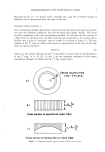
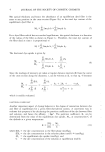
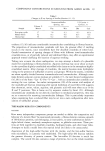
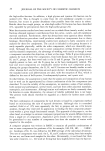
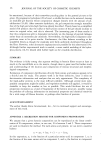
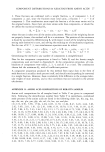
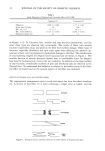
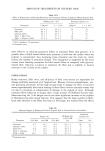
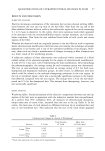
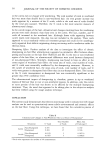
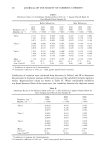
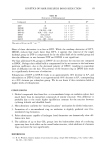
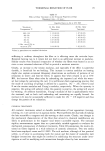
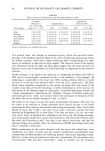
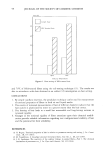
TORSIONAL BEHAVIOR OF HAIR 89 where n is the number of swings and a• and an are the amplitude of the first and n th swings, respectively. The logarithmic decrement is a useful measure of the energy dissipated in the sample and can be related to the torsion loss modulus G' by: G8 G' - . ........... (IV) Very frequently, the information sought is associated with changes in the fiber rigidity either due to a specific treatment or to a different environment. When successive measurements are performed on the same fiber, the need for continuous monitoring of the fiber diameter, and thus the inaccuracies arising from such measurements (as G depends on the fourth power of the fiber diameter), are virtually eliminated. Further- more, such an approach could be particularly useful if the measurements could be done not only in air but also in water, where the pendulum technique, so far, could not be utilized. We have found that by a simple modification of the testing procedure, both of the above can be attained. By inserting the fiber into a small glass capillary, the torsional properties of such a fiber can be evaluated in both air and liquid media. Using torsion pendulums of different weights for measuring in air and in water, we have obtained excellent reproducibility of both the torque and the logarithmic decrement without the need for fiber relaxation between the measurements (Table I). In the text of this report, the "rigidity ratio" denotes the ratio of the rigidity obtained in the test run to that obtained in the calibration (first run). In a sense, this approach is similar to that of the work index developed by Speakman for wet calibration of keratin fibers in extension (3). Testing Procedure. Hair fibers of known diameter (determined by the linear density method) were inserted in small glass capillaries (I.D. 0.565 mm, volume 4.9 ptL) and mounted individually on plastic strips at a gauge length of 2 cm. The fiber occupies, at most, 1% of the volume of the capillary and torques freely in the liquid contained within. The fibers were torsionally calibrated in air at 65% RH, 70øF, after equilibration from the wet state for at least 18 hours under the same conditions. Subsequently, the fibers were remeasured in water, then in 0.1 N HC1. Equilibration times prior to these Table I Reproducibility of Successive Measurements in Air (65% RH) and in H20 Testing Environment Fiber No. 1 Fiber No. 2 Fiber No. 3 Measurement No. T(sec) 8 T(sec) 8 T(sec) 8 Air (65% RH) 1 6.87 0.16 8.52 0.20 8.17 0.17 Air (65% RH) 2 6.88 0.17 8.48 0.20 8.12 0.18 Air (65% RH) 3 6.89 0.17 8.45 0.20 8.16 0.19 H20 1 9.81 0.40 17.77 0.47 16.00 0.56 H20 2 9.78 0.43 17.96 0.54 16.46 0.52 H20 3 9.93 0.43 17.98 0.47 15.78 0.52 T is the oscillation period. 8 is the logarithmic decrement.
Purchased for the exclusive use of nofirst nolast (unknown)
From: SCC Media Library & Resource Center (library.scconline.org)