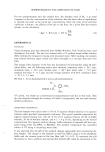
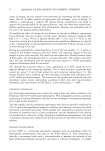
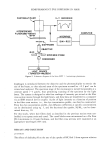
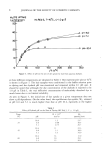
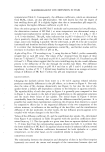
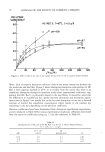
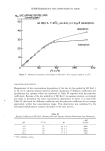
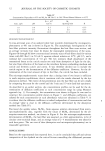
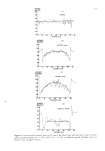
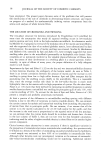
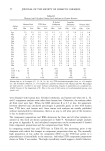
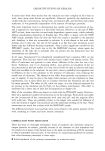
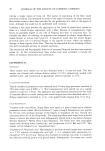
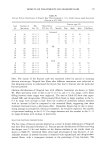
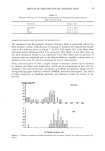
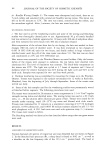
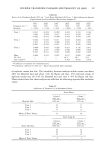
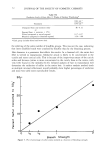
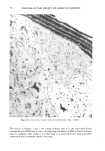
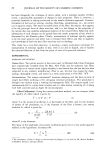
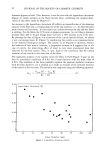
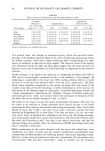
90 JOURNAL OF THE SOCIETY OF COSMETIC CHEMISTS measurements were 15 minutes and 18 hours, respectively, in the liquid in which the measurement was performed. Cosmetic Rlodification of Hair. Hair fibers were subjected to treatments with various commercially available products (i.e., hair coloring, bleaching, waving). The time of treatment was in accordance with manufacturers' instructions. Hair setting was carried out by winding individual fibers (conditioned at 65% RH) under 1 g load onto a 900 }xm rod, securing the free end of the fiber to the rod by means of Duco cement. The coiled fibers were set by heating in the laboratory oven either at 40 ø or 70øC for 30 min. The fibers were then removed from the rod and placed in the humidity chamber (at 65% RH) to monitor the set release. The values given in the text represent the set holding after 2 hours of release. RESULTS AND DISCUSSION HAIR DIAMETER It has long been known that styling of hair in general and the stability of a hair style in particular are greatly influenced by hair fineness. There is a growing body of evidence (1,4) suggesting that the explanation for this behavior is to be found in the nature of deformations which hair configuration has to endure. The latter are predominantly of the bending and torsion type and, as such, they are inversely related to the fourth power of hair diameter. Simply stated, in the absence of any other stabilizing factors, a fine hair of 50 }xm diameter has only 1/5 of the inherent styling stability of a hair that has a "normal" diameter of 75 }xm. The bending or torsional moduli are charac- teristics of a homogeneous material (whether a composite or not) and as an intensive property should not be a function of its dimension. However, hair is not only a composite on the ultrastructural level (filaments and matrix) but also shows histological inhomogeneity (cuticle and cortex). As the thickness of the cuticle layer (6 cells over- lapping each other to give a 3 }xm band) is invariant with the fiber diameter, the weight fraction of the cuticle increases as the diameter of the hair decreases. When 1.2 i.0 0.8 Torsion Hodulus dynes cm -2 1010 x ß ß ß ß ß ß ß I I I I I I 70 75 80 85 90 95 Fiber Diameter (•m) Figure 1. Torsionalmodulus of hair at 65%RH. I lOO

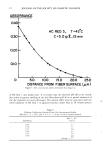
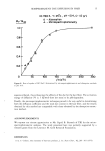
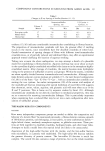
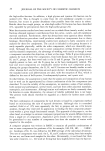
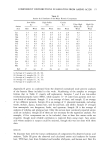
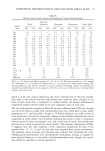
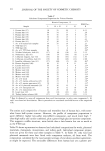
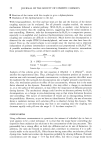
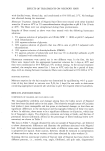
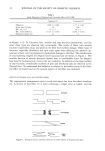
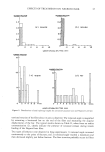
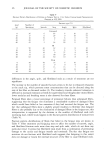
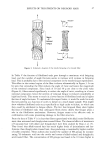
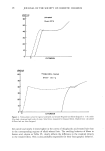
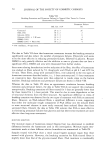
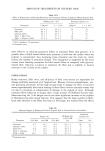
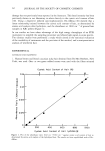
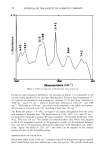
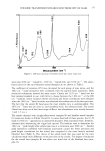
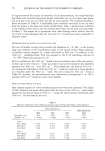
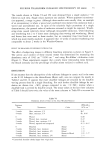
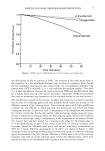
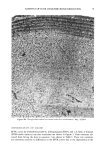
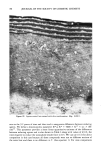
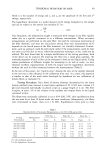
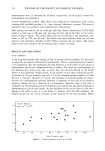
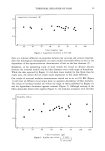
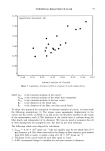
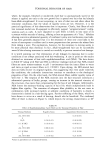
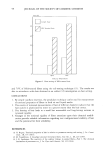
TORSIONAL BEHAVIOR OF HAIR 91 0.3 0.2 0.! Logarithmic Decrement (3) ß ß ß ß ß ß ß :// i i ! i i i i i . 65 70 75 80 85 90 95 100 Fiber Diameter 04m) Figure 2. Logarithmic decrement at 65% RH. there is a relevant difference in properties between the cuticular and cortical materials, then this histological inhomogeneity can exert readily discernible effects as seen in the dependence of the supercontraction characteristics of hair on the hair diameter (5). Speakman, in his pioneering study of wool torsion (6), found no obvious relation between the torsional moduli and the fiber diameter over a wide range of humidities. While the data reported by Bogaty (1) did show lower moduli for fine fibers than for coarse ones, the author did not attach much importance to this small difference. Our results of torsional modulus measurements carried out in air at 65% RH (Figure 1) with hair of different racial origin show no apparent dependence of fiber diameter. The values of torsional moduli are within the range of those published by Bogaty (1) and the logarithmic decrement appears constant (Figure 2). Although wetting of the fibers drastically lowers their rigidity (Figure 3), the modulus invariance with the fiber 0.3 0.2 Rigidity Ratio ß ß ß ß ß ß ß ß ß ß ß ß ß ß ß ß I I I I I I I _ 75 80 85 90 95 1OO 105 Fiber Diameter (•m) ( /
Purchased for the exclusive use of nofirst nolast (unknown)
From: SCC Media Library & Resource Center (library.scconline.org)