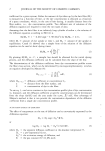
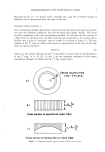
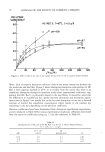
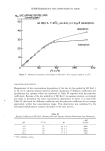
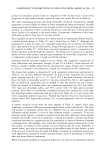
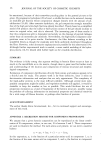
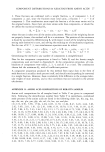
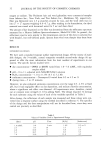
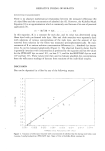
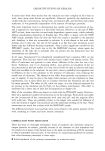
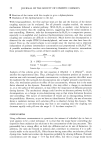
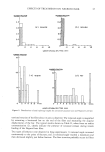
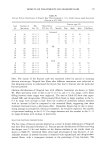
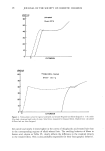
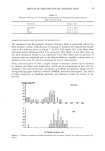
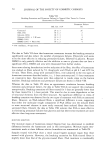
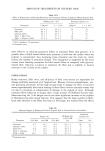
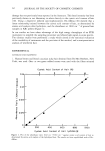
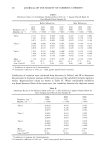
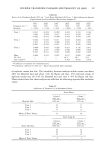
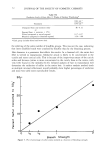
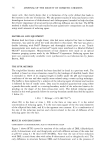
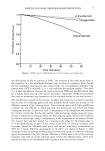
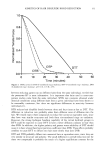
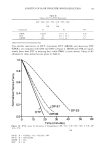
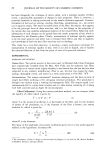
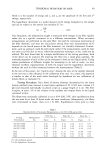
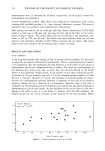
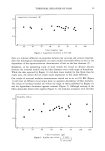
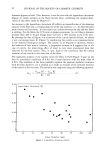
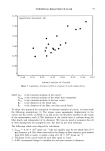
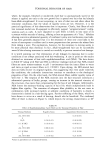
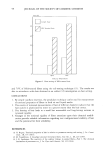
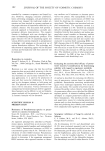
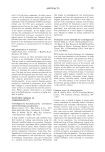
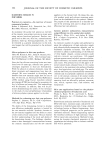
92 JOURNAL OF THE SOCIETY OF COSMETIC CHEMISTS diameter appears to hold. This, however, is not the case with the logarithmic decrement (Figure 4), which increases as the fibers become finer, confirming the original obser- vation of this effect made by Bogaty (1). An increase in the logarithmic decrement (8) reflects an intensification of the damping capacity of the fiber and a corresponding rise of the loss modulus, i.e., the fiber becomes more viscous and less elastic. In this respect the contrast between the dry and wet fibers is striking. For dry fibers the G•/G ratio is diameter-invariant, for wet fibers a diameter decrease from 100 to 70 Ixm brings about well over a 50% increase in the G•/G ratio. By plotting the data of Figure 4 as a function of the cuticle fraction of hair, we obtain a very convincing linear fit (Figure 5), implicating the cuticle as an important factor in the observed rheological changes. The cuticle, in its response to moisture, mimics the behavior of hair matrix however, a progressive increase in 8 suggests that in the case of cuticle, the plasticizing effect of water is even more pronounced than that observed for the hair matrix. This, in turn, leads to the conclusion that the torsion modulus of the cuticle is less than that of the fiber. The regression analysis of the rigidity ratios for fibers in H20 (Figure 3) gave us the best fit (correlation coefficient of 0.83) for a linear function with the slope value of 0.001. The smallness of the latter probably explains the apparent modulus invariance with the fiber diameter, yet it allowed us to make an estimate of the torsional modulus of the cuticle in the wet state. The modulus was computed using the following equation: G-comp R24 - G-cort R41 = R4 _ R4 ............ (V) 0.55 0.50 0 ./45 0.40 0.35 Logarithmic Deeremenk (5) ß ß ß i f 80 85 90 Fiber Diameter (gm) Figure 4. Logarithmic decrementin H20. I i 95 100 105

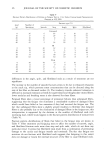
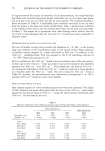
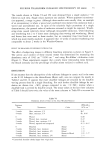
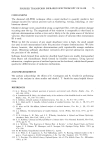
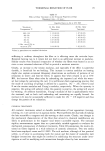
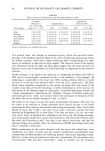
TORSIONAL BEHAVIOR OF HAIR 93 0.55 0.50 0.45 0.40 0.35 0.30 Logarithmic Decrement (•) ß i ! I I I I 0.10 fl.11 0.12 0.13 0.14 0.15 0.16 0.]7 Volume Fraction of Cuticle Figure 5. Logarithmic decrement in H20 as a function of cuticle content of hair. where Gcut Gcomp Gcort R• R1 is the torsional modulus of the cuticle. is the torsional modulus of the whole hair (composite). is the torsional modulus of the hair cortex. is the diameter of the whole hair. is the diameter of the fiber core (less cuticle band). To adopt this approach for evaluation of torsional modulus of cuticle, we have made the following assumptions' (1) The torque causes equiangular displacement in the cuticle and the cortex (2) There is no slip at the cuticle/cortex interface in the course of the measurement and (3) The thickness of the cuticle layer is uniform along the fiber length and independent of its diameter. We have no proof or assurance that all of these assumptions are stringently met, but they do not seem irrational. The following values were adopted for calculation: 1. Gcomp = 0.18 X 10¹⁰ dynes cm -2 (the wet rigidity ratio for the whole hair of 75 }xm diameter is 0.246 when corrected for the change in fiber diameter upon transfer from 65% RH to water, it yields a value of 0.18 X 10 ]ø dynes cm-2). 2. Thickness of the cuticle band for each fiber equal to 3 3. 0.001 incremental change in modulus for each }xm increase in diameter.
Purchased for the exclusive use of nofirst nolast (unknown)
From: SCC Media Library & Resource Center (library.scconline.org)