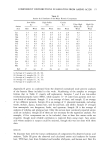
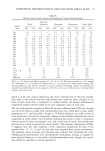
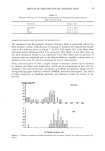
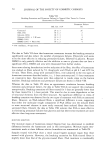
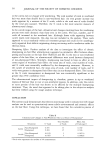
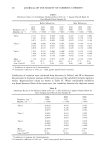
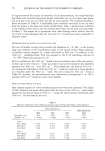
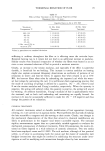
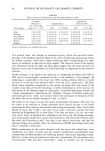
94 JOURNAL OF THE SOCIETY OF COSMETIC CHEMISTS The computation yielded the values of wet torsional moduli of 0.24 x 10 •ø dynes cm -2 and 0.012 X 10 •ø dynes cm -2 for the cortex and the cuticle, respectively. While the 20-fold difference between the moduli of the hair cortex and the cuticle is large and possibly endowed with some error, it is not unreasonable. Unlike the hair cortex which is a filament/matrix composite where a water-unpenetrable phase may, via polar or covalent links to the matrix, restrain the viscous flow of the latter, no highly organized structures have been found among the cuticle proteins. Admittedly, the density of disulfide crosslinks in the cuticle is higher than that in the matrix, but these crosslinks are concentrated in the exocuticle layer and are virtually absent from the endocuticle which is likely to be highly plasticized by water. The data also suggest that in the dry state the cuticle acts as a homogeneous, isotropic solid, its torque resistance not greatly different from the remainder of the hair. In this regard, it is of interest to point out that the melting of the filament phase which accompanies, for example, hair supercontraction results also in a drastic lowering of the wet torsional modulus of the fiber in spite of retaining the full and intact complement of the disulfide crosslinks. The value of such modulus lies in the range of 0.004 to 0.01 X 10 •ø dynes cm -2, which resembles that of the cuticle. Also, the torsional modulus of supercon- tracted hairs at 65% RH, as well as their logarithmic decrement, is indistinguishable from that of intact fibers. There are some cosmetic-related consequences of a low modulus cuticle. The most obvious is that the contribution of the cuticle to the stability of the hair configuration in the wet state (such as acquired in waving) must be negligible. This is unwelcome news to people with fine hair where the cuticle makes up as much as 25% of their hair weight. On the other hand, the cuticle appears to be an accessible and potentially rewarding depository of materials that could mechanically strengthen this layer. In this respect it can be readily shown (using Equation V) that by reducing the water content of the cuticle alone down to 15-16%, one might increase the torsion modulus of a fine (50 p•m) wet fiber by a factor of over 2. The softness and pliability of the cuticle can be an asset from the point of view of set impartation (water setting) as upon drying, the rigidity of the cuticle increases relatively more than that of the cortex. This ad- vantage may be lost, however, when the hair is exposed to a high humidity environ- ment. DRY HEAT Some of the most frequently used styling aids are heat appliances such as blow dryers, heat setters, and curling irons. In a recent study of tensile and chemical properties (7) of hair exposed to heat setters, no evidence was found of measurable changes in the treated fibers as compared to their untreated controls. It seemed appropriate to com- plement the above study with a brief investigation of the effect of heat on the torsional properties. The methodology approach was somewhat different in that a single exposure of hair to different temperatures was used and followed subsequently by determination of the rigidity ratio in air at 65% RH. The results, summarized in Table II, strongly suggest that even brief exposure to elevated temperature increases fiber rigidity and that this is not just simply associated with the dehydration of the fiber (P205 control). The effect is relatively long lasting and is also accompanied by a slight decrease in the logarithmic decrement. We have not tested enough fibers to determine whether the

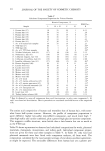
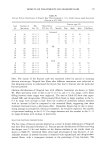
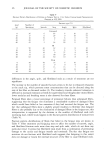
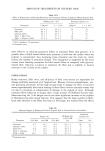
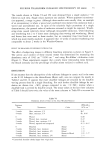
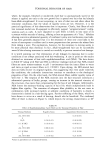
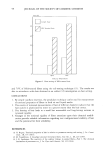
TORSIONAL BEHAVIOR OF HAIR 95 Table II Effect of Heat Treatment on the Torsional Properties of Hair (Treatment time--30 min.) Rigidity Ratio in Air at 65% RH Treatment 24 Hrs. After 48 Hrs. After Temperature øC Treatment Treatment lOO-lOl 1, 12 (0.02) 1.07 (0.02) 88-90 1. ll (0.02) 1.06 (0.03) 74-76 1.10 (0.02) 1.05 (0.02) 60-6l 1.07 (0.04) 1.02 (0.03) 45-46 1.06 (0.02) 1.03 (0.02) 6 Hrs. over P205 in vacuo at 25øC 1.04 (0.01) 1.03 (0.02) Values in parentheses are standard deviations. stiffening is uniform throughout the fiber or is affecting more the cuticular layer. Repeated heating (up to 4 times) did not lead to an additional increase in modulus. Similar results were obtained irrespective of whether the fibers were heated in an air oven or over saturated solutions of NaI to provide a moisture reservoir. Clearly, an increase in the torsion modulus, and especially if the effect is somewhat durable, is beneficial for set holding. This increase in torsion modulus on heating might also explain occasional laboratory observations on aesthetics of patterns of set relaxation in water- and heat-set fibers. It appears that when relaxed in air at 65% RH, the heat-set fibers often relax by unbending the imparted curl while the water- set hair relaxes by untwisting the curl. It is well known from engineering practice that the mode of uncoiling of springs is defined by a quantity, 1/G - 2/E, where G and E are the torsion modulus and Young's modulus, respectively. When the quantity is negative, the spring will unbend when the quantity is positive, the spring will uncoil by twisting. At ambient humidities, Young's modulus of hair is approximately twice the torsional, and so both curl unbending and untwisting are equally favored. An increase in G may be occasionally sufficient to make the 1/G - 2/E negative and thus change the pattern of set relaxation. CHEMICAL TREATMENTS All cosmetic treatments aimed at durable modification of hair appearance (waving, coloring, etc.) are carried out in aqueous media. Water performs the dual task of making the hair accessible to reagents and also serving as their carrier. Clearly, any changes in the mechanical characteristics of the fiber that attend its chemical modification are likely to predominate in the reagent- (and water-) accessible regions. The torsional rigidity measurements appear thus as a particularly suitable approach to evaluate the mechanical consequences of chemical treatments. Table III summarizes the results ob- tained on fibers exposed to a wide selection of cosmetic alterations. Two test media have been employed: water and 0. ! HC1. The acid medium, although of less practical utility, is of value in ascertaining both the nature and the extent of coulombic (salt bridges) interactions that might be involved in stabilizing the structure under inves- tigation as well as modifying such interactions brought about by hair treatments.
Purchased for the exclusive use of nofirst nolast (unknown)
From: SCC Media Library & Resource Center (library.scconline.org)