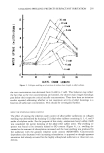
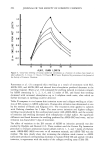
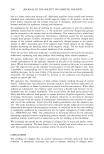
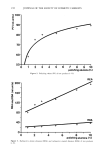
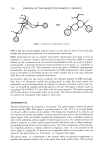
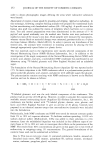
214 JOURNAL OF THE SOCIETY OF COSMETIC CHEMISTS after treatment. In order to evaluate the scratching values, each average value of 5 measurements of roughness depth over a length of 1.5 mm at intervals of 0.1 mm was used for calculations. In each case, 4 incisors extracted for orthodontic reasons were embedded flat, labial side upwards, in a form. The surfaces of the teeth were then polished with standard tooth- paste I (Superpolish, Hawe Neos, Switzerland) and a rotating brush until the average roughness depth (RaI) of the surface amounted to approximately 0.040 [xm. After pol- ishing, the teeth were then brushed for two hours in a toothbrushing machine equipped with a medium brush (Broxodent 2000) at a load of 50 g on the brush head using a suspension of 10 g toothpaste in 10 ml water in each case. The teeth were then rinsed under running water to remove the toothpaste, dried, and the roughness measured once again (RAP). In order to eliminate biological variation as much as possible, a standard silica tooth- paste II (roughening standard) which produced an average roughness depth (Rail) of approximately 0.200 [xm was also used in each of the tests. The following sandwich procedure was adopted, the teeth being repolished at the beginning of each measure- ment: 1. Measurement (M1) Standard toothpaste II 2. Measurement (M2) Test toothpaste A 3. Measurement (M3) Test toothpaste B 4. Measurement (M4) Standard toothpaste II 5. Measurement (MS) Test toothpaste C 6. Measurement (M6) Test toothpaste D 7. Measurement (M7) Standard toothpaste II Block 1 ß Block 2 The teeth were employed until the roughness of the enamel layer changed significantly after brushing with standard toothpaste II compared with its previous measurement. As soon as a single tooth of the set was no longer usable, all four teeth were rejected. The evaluation of results was carried out in each case for a block of four toothpastes. The scratching value (SV) for standard toothpaste II was set at - 100. The scratching value for test toothpaste A, for instance, was then calculated according to the following for- mula: SV = - (RAP^ - RaI) X 200 (RalI- RaI) m + (RalI- RaI)•4 POLISHING EFFECT The polishing value (PV) is defined as the percentage that a test dentifrice reduces the roughness of enamel, whereby 0.200 [•m. (standard toothpaste II) is zero and 0.040 [•m (standard toothpaste I) is 100%. The more positive the number, the greater the polishing effect of the toothpaste. The polishing values were determined with basically the same procedure as the scratching value. At the outset of each measurement the teeth were treated with stan- dard toothpaste II. After toughening, the toothpastes were tested according to the same

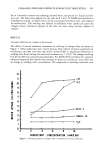
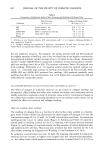
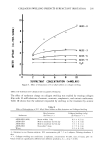
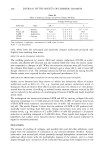
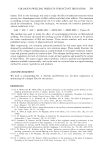
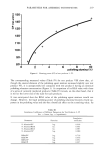
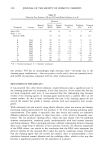
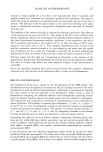
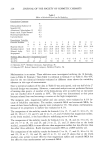
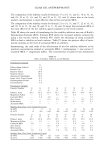
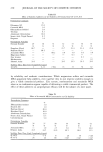
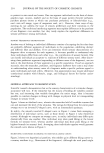
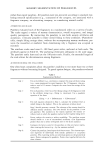
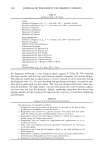
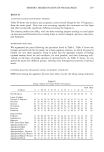
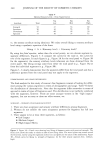
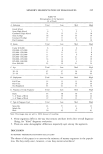
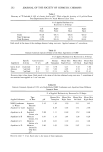
PARAMETERS FOR ASSESSING TOOTHPASTES 215 block system as used for determining the scratching values, with standard toothpaste II being replaced by standard toothpaste III (polishing standard). Standard toothpaste III was introduced for practical reasons. Originally it was a paste made out of polymethacrylate particles containing a small amount of finely powdered silicon carbide. The toothpaste identified as test product VIII (see TEST PRODUCTS below) is now used because of its comparable properties and its closer similarity to market toothpastes. Under the given conditions, it reduces the roughness from 0.200 ptm to approximately 0. 143 ptm, which corresponds to a polishing value of 36. After using the test toothpaste or standard toothpaste III, the new roughness (either RaC or RaIII) was determined. The calculation of the polishing values was then carried out according to the following formula: PV = (RaII- RaC^) X 72 (RaII- RaIII) m + (RaII- RaIII)•t4 CLEANING EFFECT The measurement of cleaning effect was carried out on extracted, stained human teeth by Missouri Analytical Laboratories (48). For each measurement, eight teeth were used. Their reflectance in visible light was measured, and the areas beneath the reflection curves were calculated. The magnitudes of the areas before (Ab) and after (A s) brushing with the test toothpaste were determined and from these the cleaning power (CP) was calculated according to the following formula: CP - As - Ab Ab X 100 The greater the cleaning effect of the toothpaste the higher its CP value will be. TEST PRODUCTS For the tests, the test products I-VI were used which contained as the sole abrasive component "Poliertonerde P10 feinst" (polishing alumina P10 from the A}coa Com- pany having a very narrow primary crystal size distribution of approximately 1 ptm) at concentrations of 1, 2, 3, 5, 8, or 10%. Furthermore, test product VII, a silica gel toothpaste, and test product VIII, the same formula as VII with a 1% addition of polishing alumina, were also tested. Table I contains the composition of test product VI with 10% polishing alumina. With test products I-V having lower alumina contents, the deficit was compensated for with water, and the consistency was adjusted by a minimal increase in the Carbopol © 940 content. Table II contains the composition of test product VII which can be trans- formed into test product VIII by adding 1% alumina with a corresponding decrease in water.
Purchased for the exclusive use of nofirst nolast (unknown)
From: SCC Media Library & Resource Center (library.scconline.org)