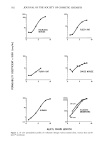
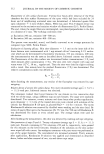
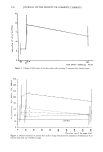
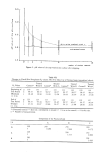
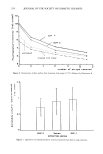
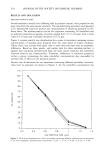
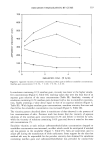
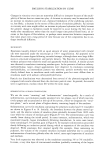
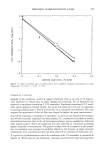
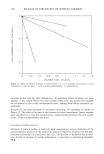
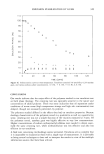
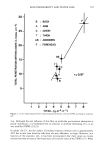
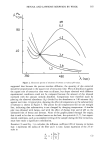
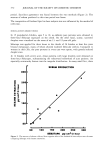
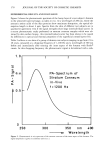
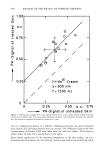
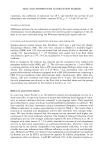
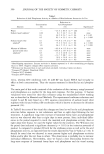
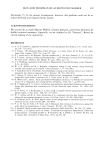
380 JOURNAL OF THE SOCIETY OF COSMETIC CHEMISTS 1.00 O.U. 0.75 0.50 ! I o o 0.25 o/ IJrido © Creom 300 n rn 1200 Hz I I 0.25 0.50 o.u. 0.75 = PA-Signo[ of untreoted Skin Figure 3. Photoacoustic signals of the inner aspects of forearms of 13 test subjects before and after treating the skin with Ilrido © cream. The mean signal amplitudes obtained with treated and untreated skin together with the respective standard deviations are marked by a cross. tion at a chopping frequency of 1,200 Hz. Differences between the spectra obtained with treated and untreated forearm skin are plotted. The differential spectra for both concentrations of Eusolex 6300 were taken from the same test subject. They show an almost linear increase with concentration of the agent. After topical application of the sunscreen preparation to the skin surface, the sun- screening agent penetrates into the stratum corneum and reaches the underlying viable

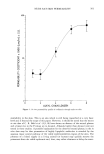
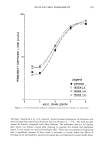
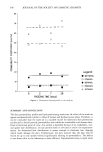
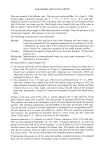
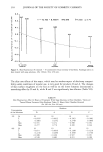
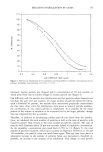
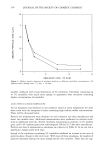
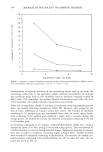
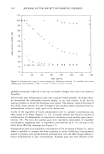
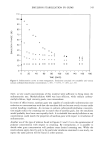
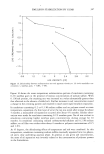
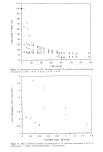
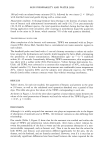
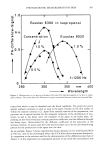
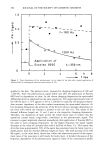
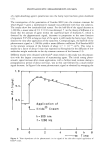
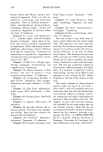
PHOTOACOUSTIC MEASUREMENTS ON SKIN 381 _1,0 •O.U. •m '05 • ß I I Euso[ex 6300 in Isopropano[ Concentrotion 1.0ø/o 0.5ø/ø Eusotex 8020 1.0 ø/o 0 I 250 300 f=1200 Hz 350 nm 400 Wovetength Figure 4. Photoacoustic i. vivo spectra of Eusolex 6300 and 8200 topically applied to the skin in isopro- panol solution. The curves show the differences in signal amplitudes between treated and untreated skin. tissue from which it may be absorbed into the blood capillaries. The protective action against sunburn continues to exist as long as the agent remains on the skin surface or within the stratum corneum (12). Apart from external removal of the preparation, two processes are of special interest for the temporal variations of the distribution of sun- screen on and in the horny layer: the transport of the agent to the horny layer, de- pending on the vehicle/stratum corneum partition coefficient, and the diffusion through the horny layer, characterized by the diffusion coefficient of the sunscreen in the stratum corneum. In many cases the latter process comes out to be the rate-determining process for the penetration of the agent into the skin. As an example, Figure 5 shows experimental results obtained in vivo with Eusolex 8020 at 350 nm, close to the wavelength where this UVA filter shows maximum absorption. In comparison to the solution used for the determination of the differential spectrum of Figure 4, in this experiment an isopropanol solution of one tenth the concentration was
Purchased for the exclusive use of nofirst nolast (unknown)
From: SCC Media Library & Resource Center (library.scconline.org)