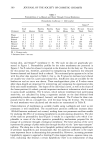
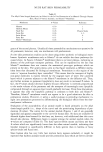
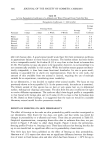
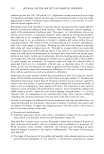
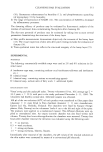
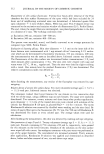
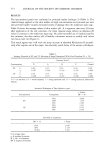
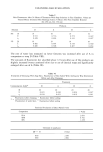
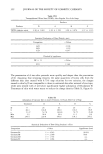
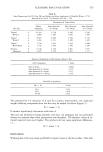
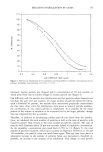
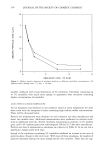
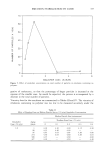
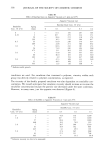
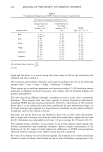
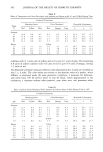
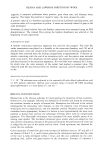
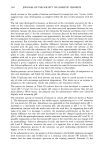
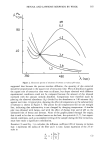
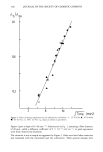
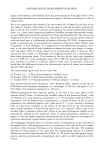
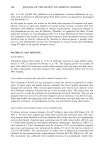
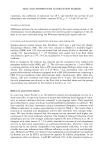
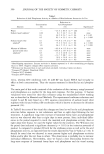
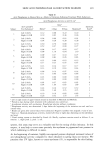
390 JOURNAL OF THE SOCIETY OF COSMETIC CHEMISTS Table I Reduction of Acid Phosphatase Activity as a Marker of Skin-Surfactant Interaction In Vivo Reduction in Concentration Acid Phosphatase • Solution (%) (%) Significance b Water -- -23.4 --- 85.9 (n = 120) -- Sodium lauryl sulphate c 0.01 8.1 -+ 22.7 (n = 10) none 0.1 62.5 --- 53.7 (n = 10) p = 0.05 0.5 83.1 --- 23.3 (n = 10) p = 0.001 Sodium lauryl ether 0.1 -75.8 --- 174.2 (n = 10) none sulphate a 0.5 75.2 --- 30.2 (n = 10) p = 0.001 1.0 64.3 -+ 15.3 (n = 10) p = 0.001 Mixture of different 0.01 -83.6 --- 115.9 (n = 10) none special lauryl ether 0.1 - 143.0 --- 357.9 (n = 10) none sulphates e 0.5 13.2 --- 49.8 (n = 10) none 1.0 -14.7 -+ 88.7 (n = 10) none 5.0 18.4 q- 56.0 (n = 10) none 7.5 19.7 -+ 44.0 (n = 10) none • Hand-dipping experiment. Enzyme activities in htuTmns expressed in % after normalizing pre-dipping values to 100%. Negative changes reflect enzyme activation. b Wilcoxon test for paired data in each individual calculated. Individual values not shown. c Texapon Z © (Henkel, DiSsseldorf, FRG). a Texapon N25 © (Henkel). e Texapon ASV © (Henkel). tivity, whereas 60% inhibition with 10 mM KF was found EDTA had virtually no effect at both concentrations. Thus the enzyme measured is identified as acid phospha- tase. The main goal of this work consisted of the evaluation of skin irritancy using lysosomal acid phosphatase as a marker for the long-term response. For this purpose, 12 human volunteers were tested for their skin tolerance using the standardized elbow washing test as described in Materials and Methods. The experimental surfactant solutions used (coded A and B) were based on a 20% aqueous concentration of sodium lauryl ether sulphate with (A) and without (B) cocobetaine which is known to decrease the irritation potential (14). In Table II the scores of the visual skin changes are listed as well as the acid phosphatase activities before exposure to test substances and four or eight days following the last treatment. A significant long-term increase of lysosomal horny layer acid phosphatase activity was observed after four or eight days in most persons. Since individual differ- ences in the period required to reach the maximal acid phosphatase activity (four or eight days) were found, we used the higher values for the statistics. The Wilcoxon test for paired data indicated a significant decrease (p = 0.01) in the irritation potential of product A compared to product B both for the erythema scores as well as for the acid phosphatase activity, as expected from the results reported by Van de Valk et al. (14). It should be noted that we observed in some persons higher acid phosphatase activities before and/or after the test than in others. This observation is probably due to intrinsic individual differences. Nevertheless, since we found a close relationship between the long-term response of lysosomal horny layer acid phosphatase and the visual scoring

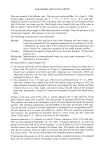
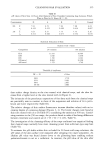
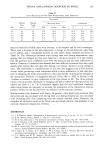
SKIN ACID PHOSPHATASE AS IRRITATION MARKER 391 Table II Acid Phosphatase in Human Skin as a Marker of Irritation Following Treatment With Surfactants Acid Phosphatase Activity in mU/10 cm 2 After e Site a (periodb)/ Erythema Subject Test Substance c Before d 4 Days 8 Days Maximum f Score g Left (3.0)/A 0.12 0.08 0.22 0.22 3 1 Right (3.0)/B 0.19 0.02 0.46 0.46 2 Left (3.0)/A 0.04 0.00 0.01 0.01 1 2 Right (3.0)/B 0.04 0.28 0.28 0.28 3 Left (3.5)/A 0.50 0.70 0.68 0.70 3 3 Right (3.5)/B 0.52 0.27 0.00 0.27 1 Left (4.0)/A 0.04 0.17 0.02 0.17 1 4 Right (4.0)/B 0.09 1.19 0.04 1.19 3 Left (4.0)/A 0.09 0.27 0.10 0.27 0 5 Right (4.0)/B 0.09 0.83 0.26 0.83 3 Left (4.0)/A 0.35 0.00 0.12 0.12 1 6 Right (4.0)/B 0.17 0.23 0.55 0.55 3 Left (4.5)/A 0.13 0.14 0.17 0.17 0 7 Right (4.5)/B 0.13 0.19 0.63 0.63 3 Left (5.0)/A 0.06 0.14 0.07 0.14 1 8 Right (5.0)/B 0.11 0.96 0.00 0.96 2 Left (5.0)/A 0.23 0.00 0.00 0.00 0 9 Right (5.0)/B 0.21 0.00 0.00 0.00 1 Left (5.0)/A 0.05 0.57 0.65 0.65 0 10 Right (5.0)/B 0.04 1.69 0.65 1.69 1 Left (5.0)/A 0.24 0.16 0.32 0.32 1 11 Right (5.0)/B 0.26 1.49 2.15 2.15 3 Left (5.0)/A 0.19 0.19 0.82 0.82 1 12 Right (5.0)/B 0.26 0.52 1.35 1.35 2 a Left or right inside of upper forearm treated as described in Materials and Methods. b Period in days during which treatment with surfactants was carried out. c A:surfactant solution with cocobetaine. B:surfactant solution without cocobetaine. a Phosphatase activity was determined 3 days before the beginning of the irritation test and used as a control value. e Results are given after control values were subtracted. Negative numbers were assigned a value of zero. f Same as e. Maximal phosphatase activities, reached after four or eight days depending on the individual, are listed. g Visual scoring system as described by Frosch (4). Briefly, erythema reaction scored as follows: 0, no reaction. 1, slight pink. 2, pink. 3, red. system, this assay may serve as a valuable tool for the rating of skin irritancy. In this respect, it may help to score more precisely the erythema in pigmented test persons in which reddening is difficult to assess. At the beginning of summer, highly sun-exposed persons displayed increased values of acid phosphatase activity compared to those obtained in spring (data not shown). We presume that UV light, known to cause erythema (15), is responsible for this finding.
Purchased for the exclusive use of nofirst nolast (unknown)
From: SCC Media Library & Resource Center (library.scconline.org)