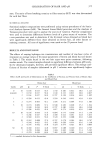
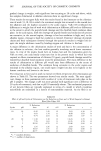
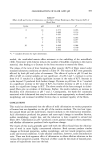
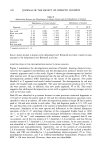
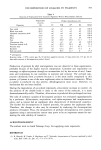
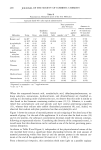
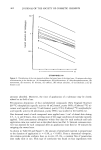
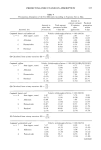
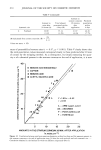
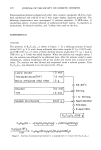
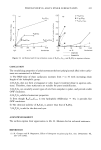
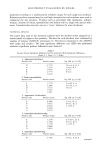
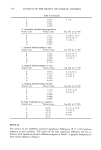
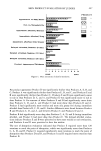
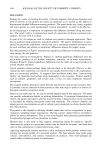
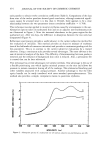
CHLORINATION OF HAIR AND pH 383 Table IV Effect of pH and Cycles of Chlorination on the Ratio of Knot Breaking-to-Fiber Tenacity (K/T) of Blond Hair Cycles pH K/T s* 0 10 0.575 0.055 7 O.6OO 0. 134 2 0.591 0.155 15 10 0.594 0.063 7 O.924 O.O77 2 O.796 0.07! 30 10 0.648 0.084 7 O.955 0. 148 2 0.850 0.122 * s = standard deviation for eight observations. tended, the crosslinked matrix offers resistance to the unfolding of the microfibrils (10b). Treatment with chlorine reduces the number of disulfide crosslinks in the matrix material, thus leading to a •lecrease in the force necessary to extend the fibers. The values of the ratio of knot breaking-to-fiber tenacity (K/T) of fibers tested under standard laboratory conditions are shown in Table IV. The values of K/T were generally affected by both pH and cycles of treatment. The effects of cycles at pH I0 and the effect of pH on control samples are not significant. At pH 2 and 7, increase in cycles from 0 to 15 resulted in a highly significant increase in the value of K/T. Increase in cycles beyond I5 produced little further change. Decrease in pH from I0 to 7 resulted in a significant increase in the"value of K/T, but further decrease in pH to 2 did not result in a significant change in K/T. The above results of the knot strength in chlori- nated fibers give no evidence of brittleness. Rather, the results indicate an increase in flexibility with chlorination at pH 7 and 2. Consequently, the harsh feel commonly associated with chlorinated hair may be attributed more appropriately to altered surface morphology and increased interfiber friction than to increased rigidity of the fibers. CONCLUSIONS This study has demonstrated that the effects of mild chlorination on various properties of human hair are dependent on the pH of the reaction medium. The two hair types, the natural blond and the dark brown, reacted similarly to the chlorination treatment. Acid chlorination produced the greatest and most rapid change in interfiber friction, surface morphology, weight loss, and the reduction in force required to extend wet fibers 20%. Chlorination at pH 7 produced a more gradual change in these properties, and alkaline chlorination produced little significant change. The results of this study generally agree well with the effects found from the chlorina- tion of wool in more highly concentrated solutions. Both systems produce similar changes in frictional properties, surface morphology, and wet tensile properties under acidic and neutral conditions. Under alkaline conditions, however, some dissimilarities exist. There was little apparent effect of chlorination in dilute alkaline solutions on the various fiber properties studied. This lack of effect could be the result of limited pene- tration of hypochlorite ions into the hair.

384 JOURNAL OF THE SOCIETY OF COSMETIC CHEMISTS The pH levels in this study varied over a wide range. Future research should examine the effects of chlorination at more subtle variations of pH in the neutral region, where most chlorination of human hair occurs. REFERENCES (1) (2) (3) (4) (5) (6) (7) (8) (9) (lO) (11) (12) (13) 14) 15) 16) 17) 18) 19) N. B. Fair and B. S. Gupta, The chlorine-hair interaction. I. Review of mechanisms and changes in properties of keratin fibers, J. Soc. Cosmet. Chem., this issue. Shrink-resist processes for wool: Part II. Commercial methods, Wool Sci. Rev., 18, 18-37 (1960). K. R. Makinson, Shrinkproofing of Wool (Marcel Dekker, New York, 1979). M. W. Andrews, A. S. Inglis, and V. A. Williams, Chemical changes in the cuticle of oxidized wool, Text. Res. J., 36, 407-412 (1966). J.P. Faust and A. H. Gower, Water-treatment of swimming pools, Kirk-Othmer Encyclopedia of Chem- ical Technology, Vol. 22, 2nd ed., (Interscience Publishers, New York, 1970), pp. 124- 134. F. L. Strand, Swimming Pool Operation Manual (National Swimming Pool Institute, Washington, D.C., 1967). J. Lindberg and N. Gralen, Measurement of friction between single fibers. iI. Frictional properties of wool fibers measured by the fiber-twist method, Text. Res..]., 18, 287-301 (1948). N. Fair and B. S. Gupta, Effects of chlorine on friction and morphology of human hair,J. Soc. Cosmet. Chem., 33, 229-242 (1982). J. A. Maclaren and B. Milligan, Wool Science. The Chemical Reactivity of the Wool F•bre (Science Press, Marrickville, N.S.W., 1981), pp. 289-291. W. E. Morton and J. W. S. Hearle, Physical Properties of Textile Fibers, 2nd ed. (Halsted Press, New York, 1975), a. p. 410, b. pp. 454-455. J. Lindberg and N. Gralen, Measurement of friction between single fibers. lV. Influence of various oxidizing agents on the frictional properties of wool fibers, Text. Res. J., 19, 183-201 (1949). A. K. van der Vegt and G. J. Schuringa, The relation between wool felting and single fiber proper- ties, Text. Res. J., 26, 9-16 (1956). M. Harris and D. Frishman, Some aspects of the chlorination of wool to produce shrink resistance, Am. Dyest. Rep., 37, P52-56 (1948). J. H. Bradbury, The theory of shrinkproofing of wool. II. Chemical modification of the fiber surface and its effect on felting shrinkage, friction and microscopic appearance, •xt Rer. J., 31, 735-743 (1961). J. H. Bradbury, G. E. Rogers, and B. K. Filshie, The theory of shrinkproofing of wool. V. Electron and light microscopy of wool fibers after chemical treatments, Text. Res. J., 33, 617-630 (1963). A. Hepworth, J. Sikorski, D. J. Tucker, and C. S. Whewell, The surface topography of chemically treated wool fibres,J. Text. Inst., 60, 513-546 (1969). J. R. McLaughlin and W. S. Simpson, "Rate Studies of the Chlorination of Wool," in Fibrous Pro- terns.' Scientific, Industrial and Medical Aspects, Vol. 2, D. A. D. Parry and L. K. Creamer, Eds. (Aca- demic Press, New York, 1980), pp. 213-225. G. Valk, Reaction between chlorine and wool proteins, Part I: Nature of the chemical modification of wool including proteins from reaction liquors, Proc. 3rd Intl Wool Text. Res. Conf,, Paris, 2, 371-381 (1965). A. Kantouch and S. H. Abdel-Fattah, Oxidation of wool with chlorine and some chlorinated com- pounds, Appl. Polym. Symp., 18, 317-323 (1971).
Purchased for the exclusive use of nofirst nolast (unknown)
From: SCC Media Library & Resource Center (library.scconline.org)