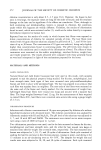
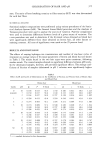
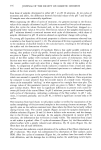
444 JOURNAL OF THE SOCIETY OF COSMETIC CHEMISTS EXPERIMENTAL DESIGN MATERIALS The test materials consisted of four oil-in-water lotion formulations (Products A, B, C, and D) and one water-in-oil lotion formulation (Product E). PROCEDURE Test products were transferred to plain 5-ounce white plastic squeeze bottles and iden- tified by A, B, C, D, or E prior to the start of the study. All judges followed the same washing procedure of their arms prior to each evaluation. Test products were dispensed at a prescribed amount from an Eppendorf repeater pipette to the inner surface of the judges' forearms. Products too viscous to be used in the repeater pipette were weighed out onto individual weight dishes immediately prior to the evaluation session. The attributes to be evaluated were determined by evaluating a representative number of currently marketed cream and lotion products and selecting ones in common. This was done as part of the training procedure. The phases and attributes evaluated were as follows (3): Product appearance. A uniform amount of each test product was visually evaluated for thickness, or the degree to which the test product retains its shape. Product rub-in. During the first 15 rotations each test product was evaluated for its spreadability, or the ease of moving the product over the skin. Product absorption. Each judge evaluated the rate of absorption by determining the point at which the product lost the wet, moist feeling and resistance to continued pressure was perceived. This was done by counting the number of rotations required for the product to reach the point of absorption, or 120 rotations, whichever comes first. Appearance of skin. Following absorption the test site was evaluated for shine, the amount of light reflected off the skin. Immediate aJ%rJ%/. Immediately following absorption the judges independently evalu- ated each product for (1) oiliness, greasiness, a fatty tacky residue (2) drag, the ease of moving the fingers across the skin and (3) residue, the quantity of product remaining on the skin. Delayed afterJ%l. Five, fifteen, and thirty minutes following application of the test product, the judges evaluated the quantity of product residue remaining on the skin. Other attributes. Other attributes perceived by the judges included oiliness/greasiness five minutes following absorption and "treated feeling," a term developed by the judges to describe a moisturized feeling lacking a distinct product residue. The term "moistur- ized" was considered as an attribute, but the judges were unable to agree on a defini- tion. Thus, "treated feeling" was chosen as a term which encompasses "moisturized" and is able to be defined. The panel was conducted in accordance with guidelines from other trained panels such as those for flavor and texture (4). All evaluations were conducted in an independent manner, with discussion among the judges restricted to a minimum during the actual evaluations. The identity of the test products was blinded from the judges and each was

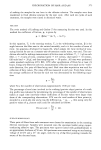
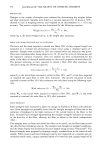
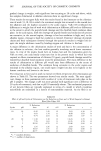
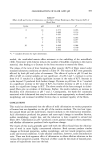
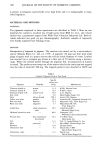
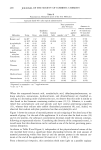
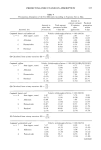
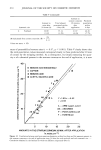
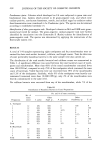
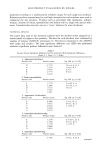
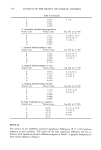
SKIN PRODUCT EVALUATION BY JUDGES 445 presented according to a randomization schedule unique for each judge and attribute. Reference products representing low and high intensities for each attribute were used in evaluating the test products. Products such as petroleum jelly (greasiness, oiliness, residue), mineral oil (shine, spreadability) and lanolin (rub-in, drag) were used as refer- ences. Untreated skin was also used as a "none" reference for some attributes. STATISTICAL ANALYSIS The source data used in the statistical analyses were the skinfeel scores assigned by a trained panel of judges to five products. The data for each attribute were evaluated by analysis of variance (ANOVA) techniques (5). The factors examined in the ANOVA were judge and product. The least significant difference test (LSD) was performed whenever significant product differences were observed. Table I Results of Least Significant Difference Test for Attributes With Significant Differences (Scale: 0 = None 10 = High) 1. Appearance/thickness Product code Product means Sig. diff. (p 5 0.05) D 9.7778 D vs A, E, B, C A 7.3333 A vs E, B, C E 4.8333 E vs C B 4.7778 B vs C C 3.9444 2. Rub-in/spreadability Product code Product means Sig. diff. (p 5 0.05) E 3. 7778 E vs D, C, A B 3. 3889 B vs D, C, A D 1.9722 D vs A C 1.9167 A 1.4167 3. Appearance of skin/shine Product code Product means E 8.3889 B 7.8611 C 6.6944 D 3.6944 A 2.8333 4. Immediate a•er•el/residue Sig. diff. (p 5 0.05) EvsC, D, A BvsC, D,A CvsD, A Product code Product means Sig. diff. (p 5 0.05) E 7.2778 B 5.1389 C 3.7778 D 1.8889 A 1.0833 5. Immediate a•erkel/drag Product code Product means B 5.4444 EvsB, C, D, A BvsC, D, A CvsD, A Sig. diff. (p 5 0.05) BvsC, A, D, E (continued)
Purchased for the exclusive use of nofirst nolast (unknown)
From: SCC Media Library & Resource Center (library.scconline.org)