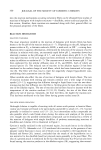
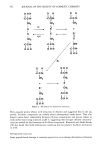
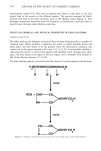
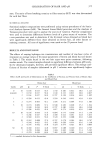
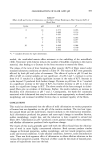
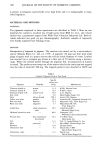
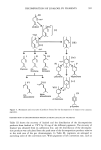
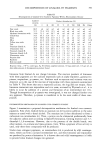
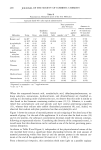
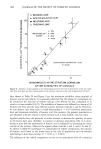
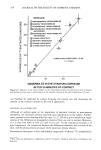
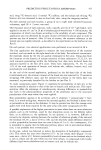
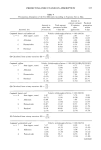
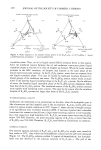
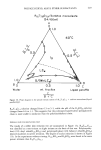
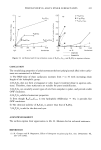
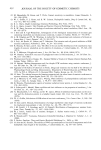
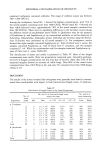
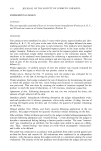
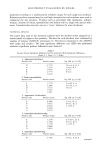
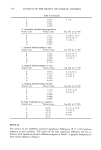
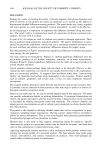
DECOMPOSITION OF LINALOOL BY PIGMENTS 393 Table III Decomposition of Linalool Over Cosmetic Pigments With a Microcatalytic Reactor Linalool Product distribution (%) recovery Pigments (%) I II III IV V VI VII VIII IX Other Zinc oxide 86.5 nd nd Black iron oxide 57.5 75.0 12.5 Hydrated chromium oxide 54.0 73.3 nd Cobalt blue 34.5 64.3 11.9 Silica 23.0 50.0 15.6 Mica 34.5 43.6 12.0 Yellow iron oxide 15.0 43.7 12.5 Talc 25.0 19.4 12.9 Titanium dioxide A 20.5 26.2 12.3 Ultramarine blue 18.5 46.2 14.3 Titanium dioxide R 9.5 24.0 15.6 Titanium dioxide A-R 7.5 20.9 6.8 Ultramarine violet 2.5 25.4 10.9 Prussian blue 1.0 10.0 6.9 Kaolinire 0.5 7.9 1.1 Red iron oxide 1.0 11.3 7.2 nd nd nd nd nd nd nd nd 12.5 nd nd nd nd nd nd nd 26.7 nd nd nd nd nd nd nd 16.7 7.1 nd tr tr nd nd nd 21.9 12.5 tr nd nd nd nd nd 25.6 10.5 2.3 nd nd nd nd 6.10 16.3 22.5 5.0 nd nd nd nd nd 14.4 13.7 10.1 7.2 10.9 9.4 tr 2.0 12.3 18.0 13.1 8.2 9.8 nd nd 0.1 24.4 11.7 1.7 0.8 0.8 nd nd 0.1 13.5 12.5 7.3 5.2 11.4 10.4 nd 0.1 10.5 12.6 7.9 4.2 7.3 5.8 nd 24.0 17.4 12.3 7.2 2.9 4.3 8.0 7.2 4.4 7.7 6.9 3.1 1.5 1.5 6.9 30.8 24.7 9.1 1.1 11.4 5.7 9.1 30.7 11.4 12.5 12.4 13.4 12.9 4.6 6.2 16.5 8.8 6.7 Reaction temp., 178 ø C carrier gas, N 2 50 ml/min pigment amount, 10 mg pulse size, 0.3 }xl nd, no detectable amount of decomposition product found. limonene from linalool do not change limonene. The reaction products of limonene with these pigments are the cyclized terpenoids such as alpha-terpinene, gamma-ter- pinene, terpinolene, p-cymene, etc. Products such as myrcene and ocimene were not detected, as in the case of the reaction of terpinolene with these pigments summarized by Table V. This shows that once a terpenoid cyclizes, the ring does not reopen. Since limonene isomerizes into terpinolene and vice versa, as stated by Wystrach et al., it is likely to occur by addition of a proton and formation of an intermediate (iv) (11). Though decomposition of p-cymene was investigated, it was not changed further over any pigment. Therefore, p-cymene is considered to be the most stable of these com- pounds. DECOMPOSITION MECHANISM OF LINALOOL OVER COSMETIC PIGMENT Figure 3 summarizes a proposed decomposition mechanism for linalool over cosmetic pigments. First of all, linalool forms an oxonium ion (i) by proton addition in the same manner as noted with t-butyl alcohol. The oxonlure ion is then alehydrated to form a carbonium ion intermediate (ii). Then, a proton can be eliminated preferentially from the adjacent carbon atom according to Saytzeff elimination, forming myrcene and 3,7- dimethyt-l,3,6-octatriene. However, due to the presence of the double bonds, two other isomers, cis-ocimene and trans-ocimene, form. When a pigment of low activity is used, only these three compounds will be produced. Under more stringent pigments, an intermediate (iii) is produced by allyl rearrange- ment, which can form a cyclized intermediate (iv), and then limonene and terpinolene are produced by proton elimination. It is known that such allyl rearrangement is liable to proceed when linalool changes into geraniol.

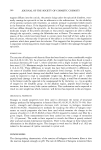
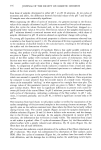
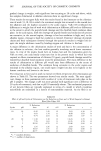
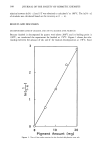
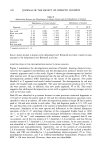
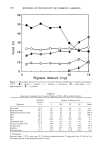
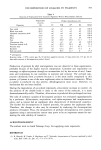
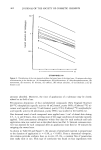
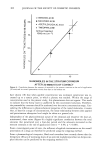
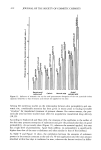
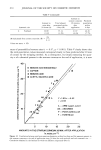
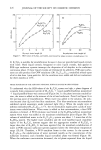
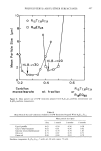
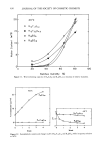
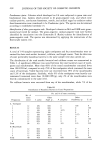
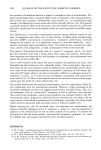
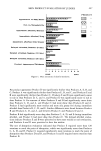
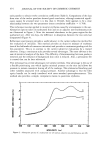
394 JOURNAL OF THE SOCIETY OF COSMETIC CHEMISTS 60 50 40 oxo 30 ß - 20 - 10 I I ! i 50 70 Pigment Amount [mg) Figure 5. Relationship between the amount of talc and the products distribution of linalool decomposed at 178 ø C. --O--, myrcene + ocimene --¸--, limonene + terpinolene --(}--, alloocimene --O--, alpha-terpinene --{)--, p-cymene. Table IV Reaction of Limonene Over Cosmetic Pigments With a Microcatalytic Reactor Limonene Product distribution (%) recovery Pigments (%) V VIII X* IX Other Zinc oxide 79.0 nd nd nd nd nd Black iron oxide 85.4 nd nd nd nd 100.0 Hydrated chromium oxide 75.4 nd nd nd nd 100.0 Silica 60.0 nd nd nd nd 100.0 Mica 87.5 nd nd nd nd nd Talc 16.2 28.4 34.4 24.1 12.9 0.2 Ultramarine blue 87.0 nd nd nd nd nd Titanium dioxide A-R 25.0 50.8 25.4 23.7 nd 0.1 Prussian blue 16.7 nd nd nd 58.0 42.0 Kaolinite 7.5 16.0 26.7 8.4 25.2 23.7 Red iron oxide 51.7 31.5 27.4 17.8 16.4 6.9 * 'y-Terpinene. Reaction temp., 178øC carrier gas, N2 50 ml/min pigment amount, 10 mg pulse size, 0.3 •1 nd, no detectable amount of decomposition product found.
Purchased for the exclusive use of nofirst nolast (unknown)
From: SCC Media Library & Resource Center (library.scconline.org)