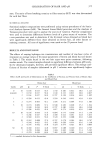
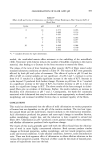
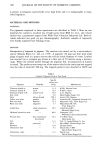
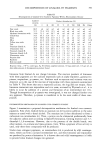
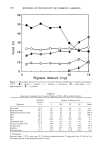
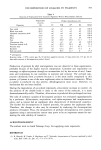
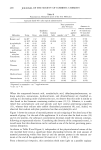
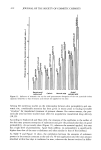
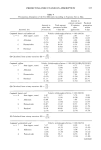
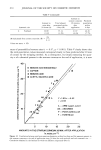
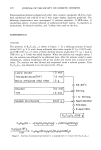
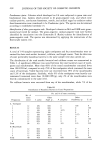
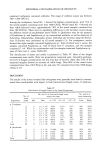
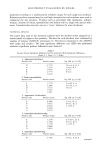
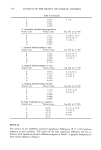
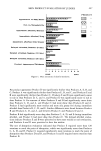
448 JOURNAL OF THE SOCIETY OF COSMETIC CHEMISTS DISCUSSION During the course of training the panel, it became apparent that group dynamics and level of interest in the project are nearly as important to its success as the ability to discriminate skinfeel differences among products. The panel works very closely together and must operate as a well synchronized "human instrument" in order to be effective. In the beginning it is important to emphasize the difference between liking and inten- sity. The panel's task is to evaluate how much of a particular attribute is perceived in a product, not how well it is liked. A total of 8-10 judges are used to evaluate test products through replication. Their data is analyzed using parametric statistical analyses. The panel's performance is main- tained by previously established criteria that sets a minimum standard deviation level for each attribute and allows no significant differences among the judges' scores. The data presented in Table I indicates that significant differences in skinfeel perception exist among the test products. The only water-in-oil formulation, Product E, showed significant differences over the oil-in-water products at all skinfeel attributes similarly, oil-in-water formulations, Products B and C, showed significant differences over the other oil-in-water products at several skinfeel attributes. Lotion products whose package labels indicate them to be clinically effective in alle- viating dry skin conditions, but which are not equally well-received in the marketplace, pose an interesting problem. It suggests that attributes other than "moisturizing ability" are important and perhaps more meaningful to the consumer. Product qualities such as oiliness, greasiness, and residue may, in fact, be more important consumer perceptions. The trained skinfeel descriptive panel fills the gap between clinical and consumer data. It provides critical information about products that may help to predict or better un- derstand consumer acceptance levels. Based on our work thus far, we can see several applications for this approach. The panel can provide information helpful in guiding formulators. If prototype formulations are tested, the panel's descriptive abilities may be of help. Characteristics can be increased or decreased by relating descriptive terms and chemicals. The cosmetic chemist can adjust percent concentrations or add or subtract given materials to achieve desired skin- feel characteristics. The panel is also helpful in defining skinfeel terms that can be incorporated in ques- tionnaires sampling larger populations. Having concise characteristics of products allows for better information. This is even more helpful when planning questionnaires for specialized groups such as physicians or nurses. Skinfeel data is also used to help support advertising claims for products. Specific characteristics unique to a particular product may be tested by the panel, and these data used to help substantiate a related advertising claim. Applying appropriate sensory methods in skin evaluations holds promise toward com- pleting the testing profile of a potential product. We have already done work using clinical, instrumental, and sensory evaluations of products. This three-pronged ap- proach offers a balanced profile of information.

SKIN PRODUCT EVALUATION BY JUDGES 449 REFERENCES (1) J. Close, R. Blank, A. Gelinas, and N. Penkin, Sensory evaluation: A scientific aid for R&D chemists, Cosmetic Technology, 42-45 (December 1982). (2) Sensory Evaluation Division of iFT, Sensory evaluation guide for testing food and beverage products, Food Technology, 50- 59 (November 1981). (3) ASTM Committee E-18, Guidelines for the Descriptive Analysis of Skinj%l (in progress). (4) N. O. Schwartz, Adaptation of the sensory texture profile method to skin care products, Journal of Texture Studies, 6, 33-42 (1975). (5) M. O'Mahoney, Some assumptions and difficulties with common statistics for sensory analysis, Food Technology, 75-98 (November 1982).
Purchased for the exclusive use of nofirst nolast (unknown)
From: SCC Media Library & Resource Center (library.scconline.org)