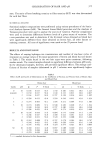
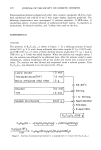
DECOMPOSITION OF LINALOOL BY PIGMENTS 387 transferred into a gas chromatograph (Shimadzu GC 7A) equipped with a hydrogen flame detector, and a 3-m column of 5% FFAP on Chromosorb W80/100 at 80øC for four minutes, at a heating rate of 5øC/min up to 220øC. Linalool recovery was obtained from a calibration curve of linalool, and the proportion of decomposition products was calculated from the peak areas on the chromatogram. Decomposition of terpinolene and limonene was conducted under the same conditions as for linalool. Identification of the decomposition products from linalool. The decomposition products were trapped into a teflon tube at liquid nitrogen temperature and after adding n-hexane, introduced into a GC/MS and GC/IR by using a microsyringe at room temperature and identified by mass spectroscopy (Hitachi RMU-6M) and infrared absorption spectros- copy (Biolad FTS-15C) (10). For GC/MS and GC/IR, the 5710 GC (Hewlett Packard) was used with a column of 3m x 2 mm (5% FFAP/Chromosorb W 80/100), which is the same as that of the micro- catalytic reactor. The MS was set at 20 eV of ionization potential, 200øC of ion source temperature, and 3000 V of accelerating voltage. Data processing was conducted by the HITAC-1011 minicomputer (Hitachi) for continuously measuring spectra every 5 seconds. For IR, a FTS-15C (Biolad) connected with a GC/IR optical system was used. The light pipe of GC/IR with 2.5 mm inside diameter and 60 cm long (inside coated with gold) was maintained at 200øC. Data processing was conducted by a NOVA-3 minicomputer (Data General, High Comp. 32-type array processor). Decomposition of t-butyl alcohol by pigments. The decomposition of t-butyl alcohol was conducted in the same way as for linalool by using the microcatalytic reactor. Helium was used as a carrier gas at a flow rate of 26 ml/min with 0.2 g of the pigment, while 3 •xl of t-butyl alcohol was injected. For analysis, as for linalool, a gas chromatograph (Shimadzu GC-4BPTF) and TCD detector were used with the column of 3 m Polapack R (80/100) heated at 80-180øC, raising the temperature at a rate of 8øC/min. Under these conditions, the analysis of t-butyl alcohol, isobutene, and water was accom- plished. Analysis of the dehydration reaction. Since the dehydration of linalool is a unimolecular reaction in a gas phase, the reaction rate is first-order with respect to the concentration of linalool. Basserr advocates that in the reaction under nonsteady-state conditions like this, the first-order reaction can be analyzed by the following equation (9): ln[l•-x)] = kK (273R) W/F ø where x is the degree of conversion, F ø is the flow rate of carrier gas at 0øC, W is the total weight of the catalyst, R is the gas constant, K is the adsorption equilibrium constant, and k is the first-order rate constant of the surface reaction. Since a flow rate was constant, W/F was controlled by means of the weight of pigment. If the relationship is linear between ln[l•l-x)] and pigment weight, the surface reaction is first-order. For comparing reactions with linalool and t-butyl alcohol, as everything except x is fixed in the respective reactions, a tentative reaction rate constant, k' = 1n[1•1-•)], was employed. For linalool, a reaction temperature of 178øC was used. In the case of t-butyl alcohol, a

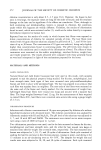
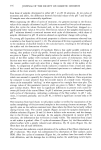
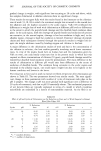
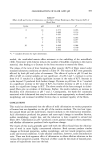
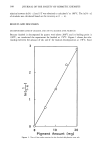
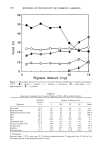
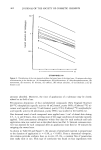
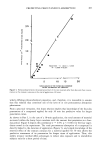
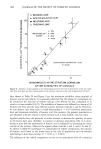
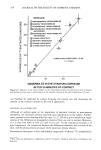
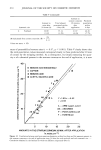
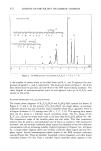
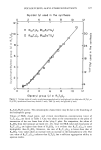
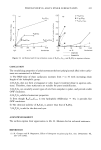
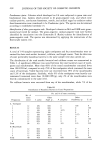
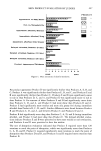
388 JOURNAL OF THE SOCIETY OF COSMETIC CHEMISTS relation between ln[•-x)] and 1/T was obtained to calculate k' at 180øC. The ln[•-x)] of alcohols was calculated based on the 'recovery as (1 - x). RESULTS AND DISCUSSION DECOMPOSITION RATES OF LINALOOL AND t-BUTYL ALCOHOL OVER PIGMENTS Because linalool is decomposed by quartz wool above 200øC and its boiling point is 198øC, we conducted the experiment for linalool at 178øC. Figure 1 shows the rela- tionship between the amount of talc and k' for linalool decomposition at 178øC. Since 0 ) • I , 0 10 20 Pigment Amount [mg] Figure 1. Test of first-order reaction for the linalool dehydration over talc.
Purchased for the exclusive use of nofirst nolast (unknown)
From: SCC Media Library & Resource Center (library.scconline.org)