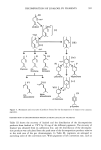
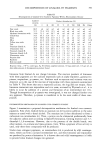
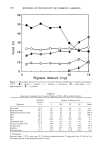
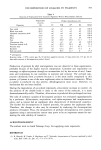
j. Soc. Cosmet. Chem., 38, 385-396 (November/December 1987) Decomposition of linalool by cosmetic pigments H. FUKUI, R. NAMBA, M. TANAKA, M. NAKANO, and S. FUKUSHIMA, Shiseido Laboratories, I050, Nippa-cho, Kohoku-ku, Yokohama-shi, Japan 223. Received July 6, I987. Presented at the Catalysis Meeting, Sapporo, Japan, October, 1983. Synopsis The reaction between pigments and linaIool, which is a common component of perfumes, was carried out with a microcatalytic reactor at 178øC. Most of the linalool was decomposed by these pigments with high catalytic activity, and the decomposition products differed depending on the nature of the pigment. The decomposition products were identified by mass spectroscopy and infrared spectroscopy showing that these products were dehydrated linalool such as myrcene, ocimene, and alloocimene, and cyclized products such as limonene, terpinolene, and alpha-terpinene. Furthermore, p-cymene was produced by those pigments having a high catalytic activity. The following decomposition mechanism is suggested for linalool from the decomposition products: Dehy- drated linalool is formed via a carbonium ion intermediate formed on acidic sites on the pigments, and cyclized products are formed after allyl rearrangement. Finally, p-cymene, which is a main cause of un- pleasant odor in some pigmented cosmetics, is formed by dehydrogenation of the cyclized products. INTRODUCTION If metal oxides and clays having catalytic activity are used as pigments for cosmetics, other components in the products, for example, perfumes, oils, and medicaments may be decomposed. In the case of perfumes, the isomerization of 2-pinene over solid acids (1) and the reaction of d-limonene oxide over solid acids or bases (2) have been reported by Tanabe. Dehydrogenation of d-limonene to p-cymene in the presence of sodium was studied by Pines and coworkers (3). Investigations of such reactions have been under- taken to clarify the catalytic action related to perfume synthesis, while deterioration of the perfume in cosmetics, wherein perfumes and pigments exist together, have been scarcely studied. Holzner investigated the degradation of linalool and linalyl acetate by kaolinire and talc. However, he did not describe decomposition products (4). Previously we reported the dehydration and dehydrogenation of isopropyl alcohol and isomerization and polymerization of propylene oxide over pigments using a microcata- lytic reactor (5-8). The microcatalytic reactor is the most suitable method for mea- suring the decomposition of perfumes over pigments since it permits rapid quantitative evaluation of the decomposition reaction. Furthermore, this analytical method has been established by Basserr et al. (9). We selected linalool as the perfume to study because it 385

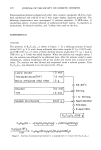
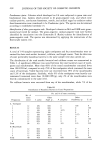
386 JOURNAL OF THE SOCIETY OF COSMETIC CHEMISTS is present in bergamot and lavender oil at high levels and it is indispensable to many other fragrances. MATERIALS AND METHODS MATERIALS The pigments employed in these experiments are described in Table I. Most are raw materials for cosmetics. Linalool was of high purity from BBA Co. Ltd., and t-butyl alcohol was a guaranteed reagent from Wako Pure Chemical Industries Ltd. Both al- cohols indicated one peak via gas chromatography. Authentic samples of terpenoids were kindly supplied from Takasago Corp. METHODS Decomposition of terpenoids by pigments. The reaction was carried out by a microcatalytic reactor (Honma Riken Co. Ltd.) at 178øC. A pigment (10 mg) was held with small plugs of quartz wool in a quartz reactor tube with an inside diameter of 4 mm. Linalool was injected into a nitrogen gas stream at a flow rate of 50 ml/min using a microsy- ringe. When the linalool passed through the pigment bed, decomposition of linalool occurred. The products were swept out of the reactor tube by the carrier gas and trapped into the tube of tenax GC 400 mg. The trapped products were desorbed at 200øC and Table I Cosmetic Pigments Used in This Study Specific surface area Pigments Remarks (m2/g) Manufacturer Titanium dioxide A Titanium dioxide R Titanium dioxide A-R Zinc oxide Silica Yellow iron oxide Red iron oxide Black iron oxide Cobalt blue Hydrated chromium oxide Prussian blue Talc Mica Kaolinire Ultramarine blue Ultramarine violet anatase 11.4 #328, National Lead rutile 14.9 R-KB- 1, Bayer anatase-rutile 54.0 p-25, Degussa -- 4.0 Sakai Kagaku Kogyo Ltd. silicon dioxide 200.4 Aerosil 200, Degussa goethite 19.4 Amaochre # 1, Amagasaki Seiteisho Ltd. hematite 15.4 Mapicored-516L, Titan Kogyo Ltd. magnetite 5.7 Mapicoblack BL- 100, Titan Kogyo Ltd. cobalt aluminium 18.5 Cobalt blue-LMC, oxide Mitubishi Metal Corp. -- 80.0 Ultragreen 3597 Whittaker Clark & Daniels INC ferric ammonium 30.3 671 Milori blue, ferrocyanide Dainitiseika Ltd. -- 11.3 Talc-15, Asada Milling Co. Ltd. muscovite 7.7 Mica #800, Wakita Kogyo Ltd. -- 11.8 Georgia Kaolin -- 9.1 Daiichi blue C-B80 Daiichi Kasei Kogyo Ltd. -- 11.3 Daiichi rose Daiichi Kasei Kogyo Ltd.
Purchased for the exclusive use of nofirst nolast (unknown)
From: SCC Media Library & Resource Center (library.scconline.org)