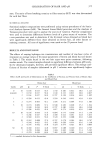
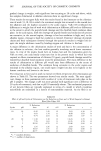
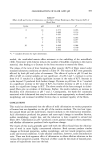
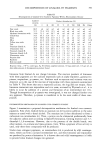
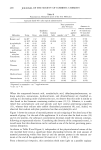
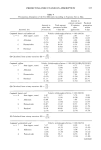
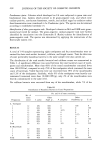
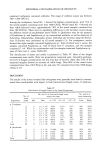
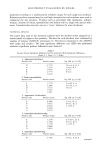
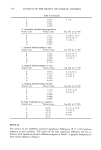
MICROBIAL CONTAMINATION OF PRODUCTS 439 examined toothpastes contained coliforms. The range of coliform counts was between 300- 1200 CFU/ml. Among the toothpastes, brand No. 1 showed the highest contamination, with 75% of the tested samples containing more than 1000 CFU/g. While brand No. 4 showed the least viable bacterial count, approximately 70% of the tested samples contained less than 100 CFU/ml. There were no significant differences in the bacterial counts among the different brands of mouthwashes tested (Table I). Qualitative tests for the presence of Pseudomonas sp. and Staphy/ococcus sp. by conventional methods, as well as detection of Escherichiae, Edwardde/lea, Sa/mone//ae, proteae, k/ebsielleae and Yersineae using the Entero- tube II (Roche) were performed on all tested samples (13). For toothpastes, results showed that eight samples contained Staphy/ococcus sp., three of which were S. aureus. Six samples contained Pseudomonas sp., half of which were P. aeruginosa, and two samples contained E. co/i. While for mouthwashes only five samples contained Staphy/ococcus sp., none of them were S. aureus (Table III). The distribution of yeasts and molds is presented in Table IV. Most of the fungal contaminants were molds. Only two preparations contained yeast. Generally speaking, the level of fungal contamination was less than that of bacteria. More than 50% of the examined samples showed no recovery of viable fungi. Over 80% of the tested items contained fewer than 100 CFU/g or ml, and only 5% contained more than 1000 fungal cells/g or mi. DISCUSSION The results of the survey revealed that toothpastes were generally more heavily contami- nated than mouthwashes with respect to both bacterial and fungal counts. In addition, Table IV Distribution of Fungal Counts in the Tested Preparations No. and % of items with fungal count No. and % of No. of within the range items containing items Preparation tested Min. Max. 0- 10 2 10 2-10 3 10 3-10 4 Yeast Molds A. Toothpaste 1 12 0 1.6 x 10³ 6(50) ' 4(33) 2(17) 0(0) 6(50) 2 12 0 3.2 x 10³ 10(81) 1(8) 1(8) 0(0) 5(42) 3 12 0 1.2 x 10² 10(81) 2(17) 0(0) 0(0) 5(42) 4 12 0 2.6 x 10³ 11(92) 0(0) 1(8) 0(0) 2(17) 5 12 0 2.0 x 10² 11(92) 1(8) 0(0) 0(0) 5(41) 6 12 0 1.2 X 10³ 9(75) 2(17) 1(8) 1(8) 3(25) 7 12 0 3.0 X 10³ 10(81) 0(0) 2(17) 1(8) 2(17) 8 12 1.0 X 10³ 8(57) 4(33) 0(0) 0(0) 4(33) Total 96 0 3.2 X 10³ 75(78) 14(15) 7(7) 0(0) 33(32) B. Mouthwash 1 12 0 4 x 10 12(100) 0(0) 0(0) 0(0) 1(8) 2 12 0 6 x 10² 11(92) 1(89) 0(0) 0(0) 1(8) 3 12 0 4 X 10² 11(92) 1(8) 0(0) 0(0) 2(17) 4 12 0 2 X 10² 11(92) 1(8) 0(0) 0(0) 1(8) Total 48 0 6 X 10² 45(94) 3(6) 0(0) 0(0) 5(11)

440 JOURNAL OF THE SOCIETY OF COSMETIC CHEMISTS the incidence of hazardous bacteria is higher in toothpastes than in mouthwashes. The tested mouthwashes often contained higher levels of substances with strong antimicro- bial activity such as phenol, sulfacetamide, ethyl alcohol, etc., in concentrations high enough to be diluted up to seven times and still be clinically effective (10). This general conclusion should be taken with reservation, since the brands chosen for this study were selected at random and do not necessarily reflect the entire spectrum of available prepa- rations. The distribution in microbial contamination patterns among different brands of each class of preparation may reflect one or more factors, including good manufacturing practices (GMP), post-process contamination, inadequate preservation, extended storage by the retailer, etc. It is significant, however, to note that brands No. 1 and 3 showed consistently high contamination levels. This might be due to production condi- tions, nature of the preparation, or high contamination levels of raw materials. The presence of hazardous bacteria such as S. aureus, P. aeruginosa, and E. co/i would give the consumer more than a strong worry when using such products. Fortunately, those organisms were detected at a low frequency in toothpastes, and mouthwashes were almost free of them (Table III). Due to wide variation in the nature and uses of cosmetics and personal care items, their allowable microbial limits are still a debatable subject. One would expect that micro- bial limits for eye area cosmetics would be different from mouthwashes (8,14). How- ever, most of the international standards recommend a maximum of 100 aerobic bac- teria and 100 fungal cells/g or ml and no detectable coliforms or pathogens (such as P. aeruginosa, S. aureus., etc.) in one g or ml of toothpaste, mouthwash, and cosmetics for intact skin (8, 14,15). Most of the reported data on the microbial content of such prepa- rations over the world are within these limits (16). Our studies showed that the examined mouthwashes, with few expectations (Table II), are in agreement with the international standards. However, a high percentage of the examined toothpastes are above the suggested quantitative microbial limits. Also, sev- eral pathogens, such as S. aureus and P. aeruginosa, as well as coliforms, were recovered from some of the toothpastes, which is unacceptable by any standard (Tables I, III, IV). As mentioned above, production conditions and raw materials are very likely to be the major sources of microbial contamination for toothpastes, especially with those brands which showed consistently high microbial counts in different samples (16). Before devising any code for microbial limits of toothpastes and mouthwashes, the absence of specific pathogens such as P. aeruginosa, S. aureus, etc. must be considered in addition to the overall limits for the microbial content of the product. To achieve the final goal of a safe and sound product, raw materials, containers, equipment, etc. must be carefully and continuously examined for their microbial content. REFERENCES (1) W. B. Hugo, Antimicrobial agents as preservatives in pharmaceutical and cosmetics products. The scope of the problem. J. Appl. Bacteriol., 44, Siii-SV (1978). (2) H. S. Bean, Preservatives for pharmaceuticals. J. Soc. Cosmet. Chem., 23, 703-708 (1971). (3) D. W. Anderson and M. Ayers, Microbiological profile of selected cosmetics with and without pre- servatives after use. J. Soc. Cosmet. Chem., 23, 863-873 (1972).
Purchased for the exclusive use of nofirst nolast (unknown)
From: SCC Media Library & Resource Center (library.scconline.org)