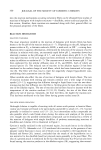
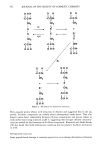
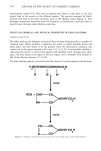
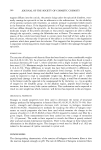
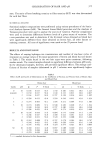
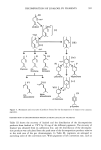
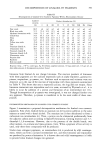
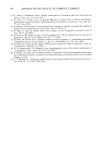
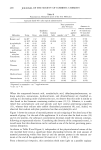
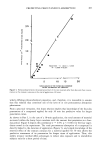
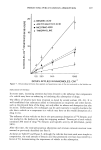
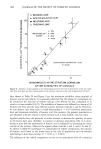
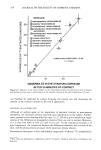
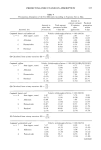
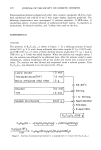
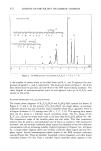
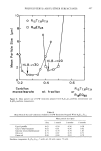
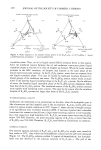
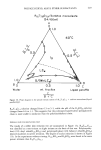
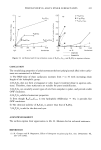
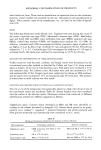
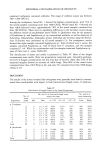
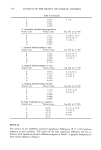
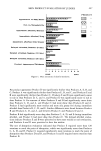
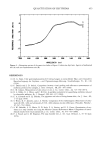
PREDICTING PERCUTANEOUS ABSORPTION 399 I RATS AT THE TERM OF AP•t. ICATION I='RC•ED4JI• GROUP UI•NA RY AND FECAL E XCI•TION DURING 4 DAYS TOTAL I:•N•TR ATED AMOUNTS WITHIN 4 DAYS SACRIFICE: Ak•0UNTS IN THE WHOLE • (S.C. EXCEPTED GROUP •) 6 SUCCESSIVE STFUPPtNGS ON EACH RAT TREATED AREA TOTAL AMOUNTS PRESENT IN THE S.C. RESERVOIR AT 30 MIN APPLICATION Figure 1. Procedures for determining total percutaneous absorption within four days and stratum corneum reservoir at the end of application. Urinary excretion was established by daily sampling of the urine and liquid scintillation counting (Packard Instruments 460 C, USA). The feces were collected daily, pooled, and counted by liquid scintillation after lyophilization, homogenization, and combus- tion of the samples with an Oxidizer 306 (Packard Instruments, USA). After four days, the animals were sacrificed and a series of six strippings was carried out on the dosed area to determine the amount of product (not penetrated) within 96 h. The remaining skin of the treated area (epidermis and dermis) was sampled and counted by liquid scintillation after digestion in Soluene 350 (United Technology Packard, USA). The carcasses were lyophilized, homogenized, and samples were counted by liquid scin- tillation after combustion. The total amount of chemical penetrating within four days was then determined by adding the amounts found in the excreta (urine + feces), in the epidermis and dermis of the application area, and in the whole animal body. At the end of application and washing, the stratum corneum of the treated area of the animals from the second group was removed by six strippings, using 3M adhesive tape. The radioactivity on each strip was measured after complete digestion of the keratinic material in Soluene 350 (United Technology Packard, USA), addition of Dimilume 30 (United Technology Packard, USA), and liquid scintillation counting. In our experi- mental conditions, the capacity of the stratum corneum reservoir for each compound has been defined as the sum of the amounts found in the first six strippings. RESULTS AND DISCUSSION The percutaneous absorption results (Table II, Figure 2) show that after 96 h, large differences exist in the amounts of substances that have penetrated through the skin. Thus, one can observe that the species that penetrates most, benzoic acid, penetrates 50 times more than dexamethasone.

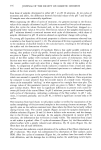
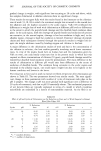
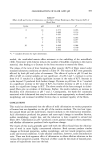
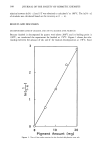
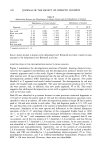
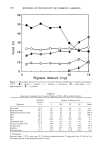
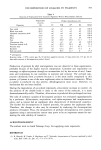
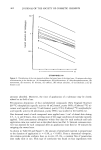
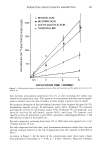
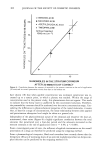
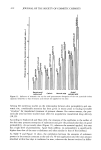
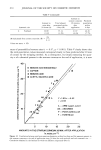
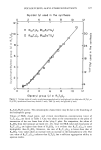
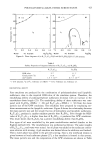
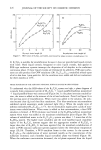
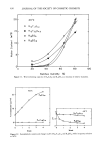
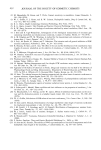
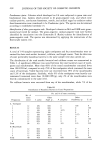
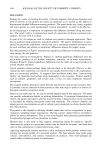
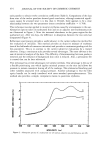
400 JOURNAL OF THE SOCIETY OF COSMETIC CHEMISTS Table II Percutaneous Absorption Levels of the Test Molecules Amounts found 96 h after topical administration Total penetration after 96 hours Epidermis % of -t- dermis Animal applied Molecules Urine Feces area treated body nmoles ß cm- 2 dose Amounts in stratum corneum of treated area 30 min after application Benzoic acid 24.80 a 1.32 0.50 0.01 26.60 13.30 17.60 (0.50) b (0.30) (0.05) (0.004) (0.70) (0.35) (1.50) Acetylsalicylic 5.40 0.43 0.85 0 6.70 3.35 5.15 acid (0.70) (0.15) (0.20) (0.70) (0.35) (0.64) Dehydroepi- 1.67 3.00 0.19 0.43 5.28 2.65 1.95 androsterone (0.15) (0.30) (0.03) (0.08) (0.20) (0.10) (0.40) Sodium 3.50 0.48 1.00 0 4.98 2.50 3.85 salicylate (0.50) (0.10) (0.17) (0.71) (0.35) (0.29) Testosterone 1.72 2.05 0.24 0.33 4.32 2.16 2.06 (0.43) (0.60) (0.05) (0.15) (0.46) (0.23) (0.23) Caffeine 2.52 0.42 0.15 0.65 3.73 1.86 2.76 (0.25) (0.07) (0.01) (0.06) (0.30) (0.15) (0.34) Thiourea 2.10 0.76 0.20 0.20 3.23 1.61 2.63 (0.40) (0.04) (0.02) (0.04) (0.48) (0.24) (0.33) D-mannitol 1.60 0.42 0.30 0.30 2.63 1.32 2.22 (0.20) (0.15) (0.10) (0.10) (0.17) (0.08) (0.37) Hydrocortisone 0.46 0.33 0.04 0.03 0.86 0.43 0.93 (0.07) (0.07) (0.01) (0.01) (0.08) (0.04) (0.15) Dexamerhasone 0.16 0.30 0. l0 0.04 0.60 0.30 0.41 (0.02) (0.05) (0.02) (0.01) (0.06) (0.03) (0.02) Expressed in nanomoles ß cm -2 application area S.D:(n = 6). When the compounds benzoic acid, acetylsalicylic acid, dehydroepiandrosterone, so- dium salicylate, testosterone, hydrocortisone, and dexamethasone are classified ac- cording to a decreasing order of penetration rate, we observe that this order is similar to that found in the literature concerning studies in man (12, 13). Likewise, it is estab- lished that acetylsalicylic acid and salicylic acid have similar penetrating properties (13), whereas their sodium salts exhibit diminished penetration (8), and, indeed, we observed that sodium salicylate penetrates less than acetylsalicylic acid. Figure 3 shows the amount of material present on each stripping of the dosed area of the animals of group 2 at the end of the application. It is of note that for both in vitro (14) and in vivo systems, the substance concentration decreases inside the stratum corneum, following an exponential relation. Considering the diversity of the compounds tested, it would seem that this observation can be outlined as one of the factors governing percu- taneous absorption. As shown in Table II and Figure 4, independent of the physicochemical nature of the test material there exists a significant linear relationship between the total amount of material penetrating within four days (y) and the amount present in the stratum cor- neum at the end of the application (30 min) (x) (r = 0.98, p 0.001). From a theoretical viewpoint, this correlation sheds some light on a possible explana-
Purchased for the exclusive use of nofirst nolast (unknown)
From: SCC Media Library & Resource Center (library.scconline.org)