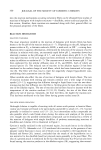
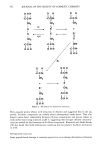
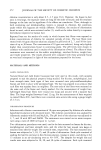
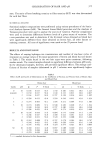
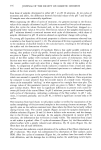
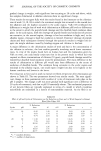
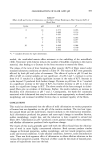
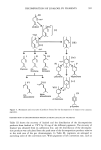
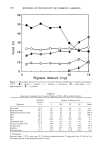
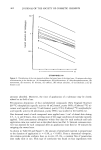
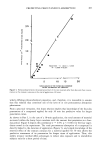
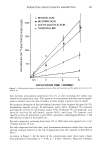
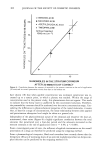
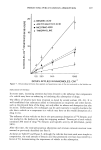
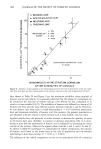
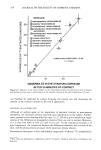
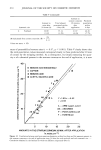
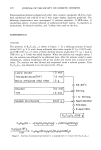
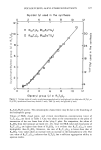
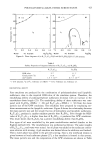
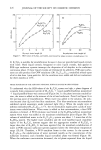
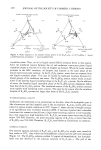
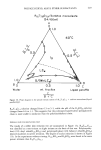
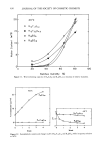
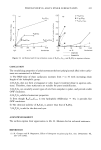
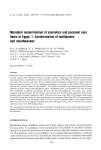
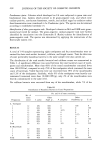
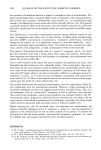
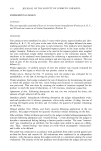
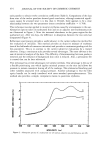
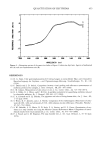
428 JOURNAL OF THE SOCIETY OF COSMETIC CHEMISTS Sorbitan rnonooleate/Liquid paraffin Sorbltan monooleafe/Llquld paraffin [2/8wt} [2/8wt} A A 0 0 (a) • 40øC (b) • 40oc • S • • I?. I B , )-0 ' 0 0.5 1.0 C B 0 0.5 1.0 C Water wf. fraction RI2T?.eG?.B/Llquld paraffin Water wf. fraction Rl•EO•o/Liquid paraffin C [2/Swt) C (2/swt) B+C B+C Figure 9. Phase diagrams in the pseudo ternary system of (a) (R12T7.sG7. 9 or (b) R12EO2o q- liquid paraffin)/(sorbitan monooleate + liquid paraffin)/H20. crystalline phase. Thus, an oil-in-liquid crystal (O/LC) emulsion forms in this system. Since the interfacial tension between the oil and surfactant continuous phase (liquid crystalline phase) is very low (31), fine oil droplets are formed. When the water content increases in the O/LC emulsion, oil droplets may disperse in the outer phase of the liquid crystal and water mixture. In the R12TxGy system, water does not separate from the liquid crystalline phase. This may be caused by hydrogen bonding between hy- droxyl groups of the surfactant and water. The R12EO20 system cannot retain as much water in the lamellar liquid crystalline phase as the R12T7.sG7. 9 system. By the addition of water, the lameliar liquid crystalline phase of the R12EO X system disappears earlier than that of the R12TxGy system. The interfacial tension of the R12EO X system increases more rapidly with increasing water content. This may be the reason why the emulsion droplets of R12EO X systems are larger than those of the R12TxGy systems. WATER-RETAINING CAPACITY Surfactants can sometimes act as moisturizers on the skin, when the hydrophilic part is like a humectant and the lipophilic part is like an emollient. R•2TxGy and R•2EO X were placed in various humid conditions at 20øC. Figure 11 shows the rate of weight increase at an equilibrium state vs relative humidity (RH). It has been reported that a desirable humectant for cosmetics should have a high water-retaining capacity at low humidity but a low capacity at high humidity (32). R•2TxGy can retain more water than R12EO X below 70% RH. However, the water-retaining capacity of R12TxGy is lower than that of R•2EO X over 70% RH. Therefore, R12TxGy may behave as a humectant in cosmetics. CHEMICAL STABILITY One percent aqueous solutions of R12T7.8G7. 9 and R12EO20 by weight were stored for four weeks at 40øC, after which the formaldehyde content and the pH were measured (Figure 12). The R•2EO20 solution yielded 22 I•g/ml of formaldehyde, but formalde- hyde was not detected in the aqueous solution of R•2T7.sG7. 9. The pH of the

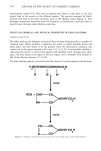
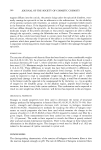
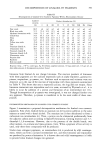
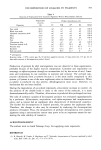
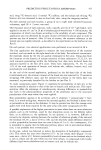
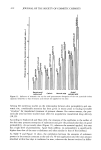
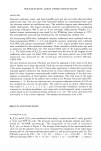
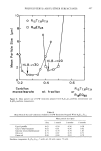
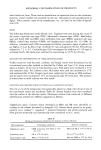
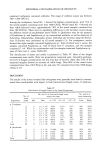
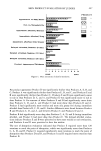
POLY(GLYCERYL) ALKYL ETHER SURFACTANTS 429 Ri2T?.sG?.B/Sorbifan monooleafe {34/66wfl A 0 1.0 40'C [D LC• 1.0 O/{W+LC•} , 0 B 0 0.5 1.0 C Wofer wf. frocfion Llquld porc ffln c B+C Figure 10. Phase diagram in the pseudo ternary system of (R•2T7.sG7. 9 + sorbitan monooleate)/liquid paraffin/H20. R12T7.8G7. 9 solution changed from 6.5 to 5.1, while the pH of the R12EO20 solution changed from 6.6 to 3.3. This suggests that the poly(oxytetramethylene) poly(glycerol) chain is more stable to oxidation than the poly(oxyethylene) chain. DERMAL AND EYE IRRITATION TEST The results of a rabbit skin irritation test are summarized in Figure 13a. R•8T•4.•G•3.2 was classified as a non-irritant to slight irritant on the basis of this test. Poly(oxyethy- lene) (10) oleyl ether(R•8:lEO•o) and poly(oxyethylene) (20) behenyl ether(R22EO20) showed moderate-to-severe irritation. The degree of ocular irritation is shown in Figure 13b. In the experiment without rinsing, R•8:•EO•o and R22EO20 were found to be more potent irritants than R18T•4.•G•3.2.
Purchased for the exclusive use of nofirst nolast (unknown)
From: SCC Media Library & Resource Center (library.scconline.org)