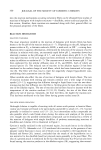
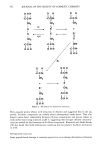
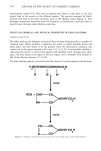
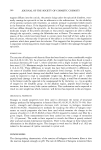
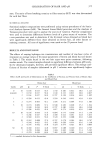
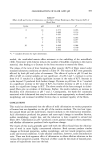
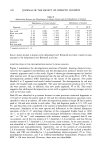
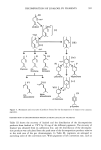
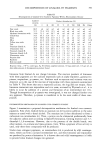
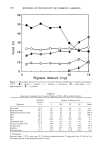
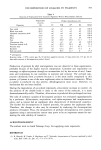
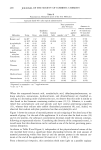
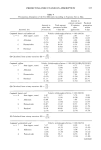
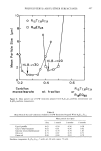
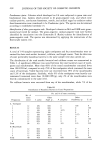
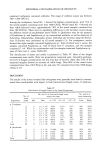
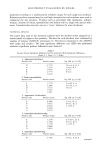
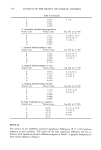
DECOMPOSITION OF LINALOOL BY PIGMENTS 395 Table V Reaction of Terpinolene Over Cosmetic Pigments With a Microcatalytic Reactor Terpinolene Product distribution (%) recovery Pigments (%) IV VIII X* IX Other Zinc oxide 90.3 nd nd nd nd 100.0 Black iron oxide 60.0 nd nd nd nd 100.0 Hydrated chromium oxide 74.5 nd nd nd nd 100.0 Silica 95.8 nd nd nd nd 100.0 Mica 97.1 nd nd nd nd 100.0 Talc 18.7 nd 58.0 25.0 11.7 5.3 Ultramarine blue 94.1 nd nd nd nd 100.0 Titanium dioxide A-R 61.3 nd 20.2 28.4 nd 51.4 Prussian blue 38.1 13.1 22.2 9.1 43.5 12.1 Kaolinite 22.6 nd 61.2 26.6 12.2 tr Red iron oxide 66.1 21.7 40.5 21.7 tr 14.5 * •y-Terpinene. Reaction temp., 178øC carrier gas, N2 50 ml/min pigment amount, 10 mg pulse size, 0.3 •tl nd no detectable amount of decomposition product found. Production of geraniol by allyl rearrangement was not observed in these experiments, probably because of the higher reaction temperature. Limonene and terpinolene can rearrange to alpha-terpinene through an intermediate (iv) by the action of acid. Limo- nene and terpinolene do not isomerize to myrcene and ocimene. The cyclized com- pounds ultimately form p-cymene because it is the most stable compound in this system. p-Cymene is one of the most unpleasant odors in deteriorated cosmetics. When p-cymene is produced via this scheme, dehydrogenation must occur. However, its mechanism has not been clarified. During the degradation of uncyclized terpenoids, alloocimene increases in content. As the position of the double bond is closer to the center of the molecule, it is more thermodynamically stable. Therefore, alloocimene is produced after prolonged reaction. The odor of authentic samples of decomposed products was evaluated organoleptically by a perfumer. Alloocimene, terpinolene, and alpha-terpinene had camphoraceous odors, and p-cymene had an unpleasant odor characteristic of deteriorated cosmetics. The further the decomposition of linalool proceeds, the greater the unpleasant odor. Therefore, the change in odor may be estimated by analyzing the decomposition products of linalool. Thus, the measurement of perfume decomposition over cosmetic pigments using a microcatalytic reactor may prove to be an important means for esti- mating the odor stability of cosmetics. ACKNOWLEDGEMENT The authors wish to thank Takasago Corp. for supplying some terpenoids. REFERENCES (1) R. Ohnishi, K. Tanabe, S. Morikawa, and T. Nishizaki, Isomerization of 2-pinene catalyzed by solid acids, Bull, Chem. Soc. Jpn., 47, 571-574 (1974).

396 JOURNAL OF THE SOCIETY OF COSMETIC CHEMISTS (11) (2) K. Arata, S. Akutagawa, and K. Tanabe, Isomerization of d-limonene oxide over solid acids and bases,J. Catal., 41, 173-179 (1976). (3) H. Pines, J. A. Vesely, and V. N. Ipatieff, Migration of double bonds in olefinic and diolefinic hydrocarbons catalyzed by sodium. Dehydrogenation of d-limonene to p-cymene, J. Am. Chem. Sot., 77, 347-348 (1955). (4) G. Holzner, How accurate is an accelerated test? (comparative analyses concerning the stability of perfume oils in accelerated test), Costa. & Perf., 89, 37-48 (1974). (5) H. Fukui, T. Saito, M. Tanaka, and S. Ohta, Catalytic activity of pigments in cosmetics, Cosm. & Toil., 96, 37-46 (1981). (6) H. Fukui and M. Tanaka, Catalytic activity of pigments. IV. Effects of alkali metal on acidic sites of pigments, J. Jpn. Soc, Colour Material, 56, 765-771 (1983). (7) H. Fukui, M. Tanaka, and Y. Fujiyama, Catalytic activity of pigments. V. Isomerization mechanism of propylene oxide on titanium dioxide, J. Jpn. Soc. Colour Material, 57, 478-491 (1984). (8) H. Fukui, M. Tanaka, and M. Nakano, Polymerization of propylene oxide over pigments,J. Jpn. Soc. Colour Material, 58, 640-647 (1985). (9) D. W. Basserr and H. W. Habgood, A gas chromatographic study of the catalytic isomerization of cyclopropanea, J. Phys. Chem., 64, 769-774 (1960). (10) R. Namba, H. Fukui, and O. Nakata, Studies on application of gas chromatography/fourier trans- form infrared spectrometry. I Analysis of decomposition products of linalool by pulse-reactor, Bunseki Kagaku, in press. V. P. Wystrach, L. H. Barnum, and M. Garber, Liquid phase catalytic isomerization of ot-pinene,J. Am. Chem. Soc., 79, 5786-5790 (1957).
Purchased for the exclusive use of nofirst nolast (unknown)
From: SCC Media Library & Resource Center (library.scconline.org)