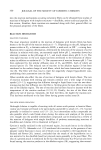
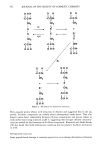
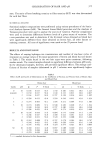
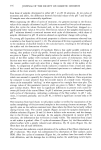
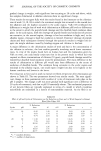
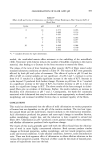
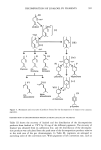
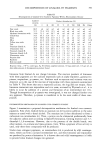
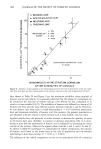
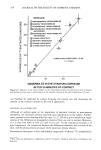
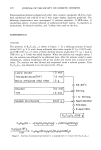
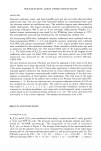
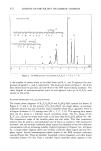
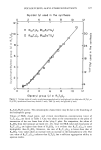
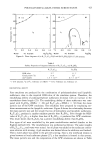
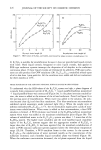
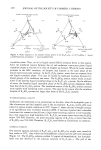
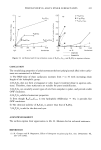
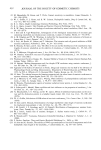
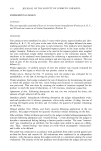
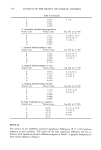
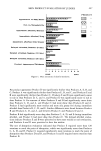
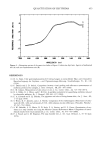
REVIEW OF CHLORINE-HAIR INTERACTION 361 R'CHCISCI N HO RSCI : RSOCl CI H O 2 2 RSSR + Cl RSCl RSOH • RSO Cl : RSOH 2 2 CI 2 H O 3 2 RSO SR 2 Figure 1. Interrelationships of the products from the chlorination of alkyl disulfides. dative C-S fission could also be taking place. A mechanism suggested for this reaction involves a bimolecular [3-elimination of the disulfide group initiated by a proton ab- straction from the tx-carbon by the attack of a nucleophile (26) (Figure 2). Tyrosine also has been found to be more readily oxidized in the acid region than in the alkaline region (13,21,22,25,27,28). N-CHLORO COMPOUNDS N-chloro compounds can be of two types in proteinous materials, either a chloramine, formed by the chlorination of a terminal amino group, or a chloramide, formed by the chlorination of a peptide bond. Some authors have suggested that N-chloro compounds are formed as a first step in the oxidation of wool by chlorine (4,6,7,23). Others have suggested that N-chloro compounds are formed but play no further part in the oxida- tion process, and remain a part of the keratin fiber (4,6,29,30). All amino acids have been found capable of being chlorinated and oxidized at the amino group (31-35). Monochloramines (RNHC1) and dichloramines (RNHC12) are readily formed. Mono- chloramines are relatively stable in slightly basic and slightly acidic solutions, while dichloramines are relatively stable only below pH 6 (36,37). Oxidation is generally an oxidative deamination, resulting in the formation of an aidehyde. In cystine, however, the predominant reaction is oxidation of the disulfide group (31,38), with little or no oxidative deamination. The effect of halogens can be expected to be more important on the amide group than on the amino group in protein materials, since the peptide bond, consisting of the amide group, is much more prevalent than the amino group in these structures. Chlor- amides, however, are not readily formed under conditions by which cystine is oxidized. For example, Pereira eta/. (39) reacted N-acetylalanine in HOCI solution at room temperature for 48 hours. No amide chlorination took place. These authors also chlori- nated a series of dipeptides and found that only the terminal amino groups were reacted. Other researchers have reported similar results (36,37,40,41). However, Mc- Laughlin and Simpson (9) did find that in the acid chlorination of wool, a lag period existed during which chlorine was consumed by the fibers and no protons were released.

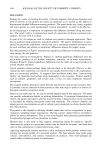
362 JOURNAL OF THE SOCIETY OF COSMETIC CHEMISTS OHH O H -C-C-N- -C-C?N- I CH 2 CH2 S .-- I I s .• s CH 2 CH2 I -C-C-N- II I I OHH O H II I -C-C-N- Il CH 2 . CH 2 I -C-C-N- OHH O H II I -C-C-N- Il CH 2 I I -C-C-N- / (•H2 II I I O H H /• -C-C-N- / II I I OHH OHH II I I -C-C-N- I CH 2 I .-- S I CH 2 I -C-C-N- II I I OHH Figure 2. Mechanism for lanthionine formation. They equated proton release with reduction of chlorine and suggested that in the lag period, N-chloro compounds are formed which subsequently break down. They also found a more direct relationship between chlorine consumption and proton release in weak rather than strong solutions at pH 3, suggesting that stronger chlorine concentra- tions are needed for the formation of N-chloro compounds. Kantouch and Abdel-Fattah (18) also found that mild chlorination conditions did not produce N-chloro derivatives in wool. PEPTIDE BOND CLEAVAGE Some peptide bond cleavage is certainly expected to occur during chlorination of keratin
Purchased for the exclusive use of nofirst nolast (unknown)
From: SCC Media Library & Resource Center (library.scconline.org)