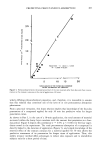
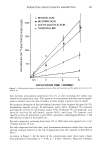
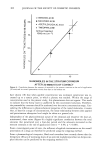
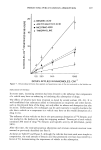
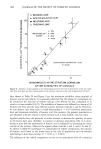
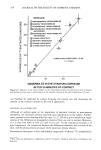
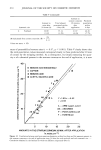
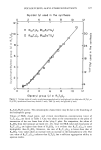
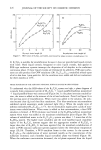
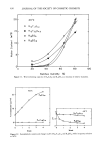
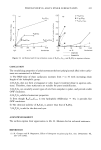
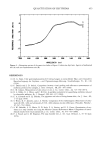
PREDICTING PERCUTANEOUS ABSORPTION 415 possible to predict the total quantity y absorbed over a four-day period. It should also be mentioned that this correlation curve is similar to that established in the hairless rat (see Part I), thus suggesting that the relationship between reservoir function of the horny layer and percutaneous absorption is independent of the animal species. CONCLUSION The consequences of these findings make it easier to screen new drugs in animals and thus to predict their toxicological and/or pharmacological implications. They permit circumvention of some ethical difficulties of human experiments, particularly in the case of potentially toxic agents. It is obvious that the experimentor has a higher degree of responsibility when performing in vivo percutaneous absorption studies in humans. Moreover, blood and urine analysis used generally in in vivo methods provide severe technical problems due to the low concentrations that must be assayed. Radiolabeled compounds are detected with high sensitivity but imply ethical problems when applied to humans. For technical convenience, labeled compounds were used in our experi- ments. However, because of the relatively large amounts of substance present in the stratum corneum at the end of application, it should be possible, with the stripping method, to measure percutaneous absorption in both animals and humans by appro- priate nonradioactive analytical techniques. However, in cases where it is essential to use labeled substances, this method makes it possible both to substantially reduce the level of radioactivity administered and to limit contact time. ACKNOWLEDGMENTS The authors would like to thank A. M. Cabaillot, C. Patouillet, M. H. Grandidler, and M. Zanini for their excellent technical assistance. REFERENCES (1) R. T. Tregear, "The Permeability of Skin to Molecules of Widely Differing Properties," in Progress in Biological Sciences in Relation to Dermatology, 2nd ed., A. Rook and R. H. Champion, Eds. (Cambridge University Press, Cambridge, 1964), pp. 275-281. (2) R. K. Winkelmann, The relationship of structure of the epidermis to percutaneous absorption, Br. J. Dermatol., 81 (suppl. 4), 11-22 (1969). (3) F. N. Marzulli, Barrier to skin penetration, J. Invest. Dermatol., 39, 387-393 (1962). (4) D. Lindsey, "Percutaneous Penetration," in Proceedings of the XII International Congress of Dermatology, D. M. Pillsbury and C. S. Livingood, Eds. (Excerpta Medica, Amsterdam, 1963), pp. 407-415. (5) H. I. Maibach and R. J. Feldmann, Effect of applied.concentration on percutaneous absorption in man, J. Invest. Dermatol., 52, 382 (1969). (6) R. C. Wester and H. I. Maibach, Relationship of topical dose and percutaneous absorption in rhesus monkey and man, J. Invest. Dermatol., 67, 518-520 (1976). (7) B. J. Poulsen, "Design of Topical Drug Products: Biopharmaceutics," in Drug Design, Vol. IV, E. J. Ariens, Ed. (Academic Press, New York, 1973), pp. 149-190. (8) F. D. Malkinson and S. Rothman, "Percutaneous Absorption," in Handbuch der Haut und Geschlecht Skrauberten Normale und Pathologische der Haut, Vol. 1, Part 1, A Marchionini and H. W. Spier Eds. (Springer, Berlin-Heidelberg, 1963), pp. 90-156. (9) R. B. Stoughton, Percutaneous absorption, Toxicol. Appl. Pharmacol., 7 (suppl. 2), 1-6 (1965). (10) C. F. H. Vickers, Existence of a reservoir in the stratum comeurn, Arch. Dermatol., 88, 20-23 (1963).

416 JOURNAL OF THE SOCIETY OF COSMETIC CHEMISTS (11) (12) (13) (14) (15) (16) (17) (18) (19) (20) (21) (22) (23) (24) (25) (26) (27) (28) (29) (30) (31) (32) (33) (34) (35) (36) (37) (38) R. B. Stroughton and W. F. Fritsch, Influence of dimethyl sulfoxide (DMSO) on human percuta- neous absorption, Arch. Dermatol., 90, 512-517 (1964). R. J. Feldmann and H. I. Maibach, Percutaneous penetration of steroids in man, J. Invest. Dermatol., 52, 89-94 (1969). R.J. Feldmann and H. I. Maibach, Absorption of some organic compounds through the skin in man, J. Invest. Dermatol., 54, 399-404 (1970). H. Schaefer, G. Stiittgen, A. Zesch, W. Schalla, and J. Gazith, "Quantitative Determination of Percutaneous Absorption of Radiolabelled Drugs In Vitro and In Vivo in Human Skin," in Current Problems in Dermatology, J. W. H. Mali and S. Karger, Eds. (Basel, 1978), pp. 80-94. J. E. Treherne, Permeability of skin to some electrolytes, J. Physiol., 13, 171-180 (1956). R. J. Scheuplein, Mechanism of percutaneous absorption: II. Transient diffusion and relative impor- tance of various routes of skin absorption, J. Invest. Dermatol., 48, 79-88 (1967). R. J. Scheuplein and L. W. Ross, Mechanism of percutaneous absorption of solvents deposited solids, J. Invest. Dermatol., 62, 353-360 (1974). E. Skog and J. E. Wahlberg, A comparative investigation of the percutaneous absorption of lethal compounds in the guinea pig by means of the radioactive isotopes 5•Cr, 58Co, 65Zn, •ømAg, •5mCd, 2ø3Hg, J. Invest. Dermatol., 43, 187-192 (1964). N. V. Sheth, M. B. Keough, and S. L. Spruance, Measurement of the stratum corneum drug reser- voir to predict the therapeutic efficacy of topical iododeoxyuridine for herpes simplex virus infection. Annual meeting of the American Federation of Clinical Research, Washington DC (May 1986). S. Rothman, Physiology and Biochemistry of the Skin (University of Chicago Press, Chicago, 1954). M. Bart, Percutaneous absorption, J. Pharm. Sci., 51, 395-408 (1962). B. Idson, Biophysical factors in skin penetration, J. Soc. Cosmet. Chem., 22, 615-620 (1971). B. Idson, Percutaneous absorption, J. Pharm. Sci., 64, 901-924 (1975). E. Schutz, Der Einflub von poly&hylenglycol 400 auf die percutane resorption von wirkstoffen, Archiv fur Experimentale Pathologie und Pharmakologie, 232, 237-240 (1957). I. H. Blank and R. J. Scheuplein, "The Epidermal Barrier," in Progress in Biological Sciences in Relation to Dermatology, 2nd ed., A. Rook and R. H. Champion, Eds. (Cambridge University Press, Cam- bridge, 1964), pp. 245-261. W. B. Shelley and F. M. Melton, Factors accelerating the penetration of histamine through normal intact skin, J. Invest. Dermatol., 13, 61-64 (1949). R. J. Scheuplein, "Site Variation in Diffusion and Permeability," in Physiology and Pathophysiology of the Skin, Jarret, Ed. (Academic Press, New York, 1979), pp. 1731-1752. B. W. Barry, "Dermatological Formulations: Percutaneous Absorption," in Drugs and Pharmaceutical Sciences, Vol. 18, J. Swarbrick, Ed. (M. Dekker, New York and Basel, 1983). R. J. Feldmann and H. I. Maibach, Regional variations in percutaneous penetration of •4C cortisol in man, J. Invest. Dermatol., 48, 181- 183 (1967). H. I. Maibach, R. J. Feldmann, T. H. Milby, and W. F. Serat, Regional variations in percutaneous penetration in man, Arch. Environ. Health, 23, 208-21 l (1971). R. C. Wester, H. I. Maibach, D. A. Bucks, and M. B. Aufrere, In vivo percutaneous absorption of paraquat from hand, leg and forearm of humans, J. Toxicol. Environ. Health., 14, 759-762 (1984). R. L. Bronaugh, R. F. Stewart, E. R. Congdon, and A. L. Giles, Methods for in vitro percutaneous absorption studies. I. Comparison with in vivo results. Toxicol. Appl. Pharmacol., 62, 474-480 (1982). J. W. Bridges, W. R. French, R. L. Smith, and R. T. Williams, The fate of benzoic acid in various species, Blochem. J., 118, 47-51 (1970). A. Benfenati and F. Brillanti, Sulla distribuzione delle ghiandole sebacee nella cute del corpo umano. Archivo Italiano de Dermatologia, Vol. XV(1), 33-42 (1939). G. Szabo, "The Regional Frequency and Distribution of Hair Follicles in Human Skin," in The Biology of Hair Growth, W. Montagna and R. A. Ellis, Eds. (Academic Press, New York, 1958), pp. 33-38. H. O. Calvery, J. H. Draize, and E. P. Lang, Metabolism and permeability of normal skin, Physiol. Rev., 26, 495-540 (1946). H. I. Blank and E. Gould, Penetration of anionic surfactants into the skin. II. Study of mechanisms which impede the penetration of synthetic anionic surfactants into skin, J. Invest. Dermatol., 37, 311-315 (1961). J. E. Shaw, S. K. Chandrasekaran, A. S. Michaels, and L. Taskovitch, "Controlled Transdermal
Purchased for the exclusive use of nofirst nolast (unknown)
From: SCC Media Library & Resource Center (library.scconline.org)