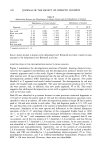
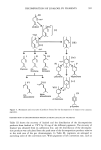
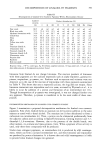
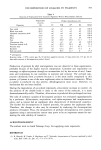
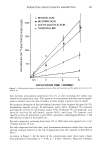
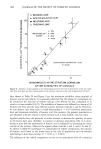
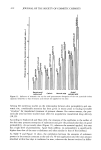
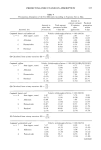
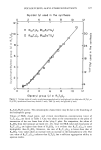
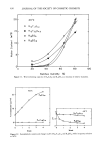
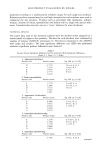
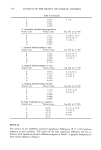
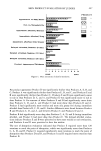
PREDICTING PERCUTANEOUS ABSORPTION 407 20- z 15- z uJ 10- '7 O O z z 0 BENZOIC ACID ,• . ACETYLSALICYLIC ACID /• ß NICOTINIC ACID // ß THEOPHYLLINE i i i i 125 250 500 1000 DOSES APPLIED IN NANOMOLES.CM -2 Figure 7. Relationship between dose applied and penetration rate of the test materials in the hairless rat. INFLUENCE OF VEHICLE In recent years, increasing attention has been devoted to the influence that components of a vehicle may have on enhancing or hindering skin absorption of drugs. The effects of vehicles have been reviewed in detail by several authors (20-23). It is well established that substances added to formulations as excipients and other factors, such as the physical form of the drug, not only affect its release and absorption but also its action. Unfortunately, few techniques can be used routinely to rapidly elucidate the role that a vehicle or a component in a vehicle may have on the overall absorption of a drug in vivo. The influence of nine vehicles on the in vivo percutaneous absorption of •4C benzoic acid was studied in the hairless rat using the stripping method. Twenty }xl of each vehicle contained 200 nmol of (ring •4C) benzoic acid (specific activity 40 mCi/mmol, purity 98%). After this time, the total percutaneous absorption and stratum corneum reservoir were assessed as previously described (see Part I). As shown in Table IV and Figure 9, although the vehicles that were used were simple in composition, the total amount of benzoic acid that penetrated over four days varied by a factor of 50, demonstrating the importance of vehicle in skin absorption.

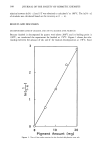
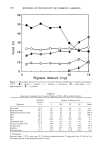
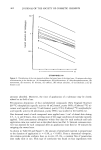
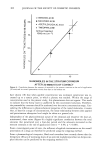
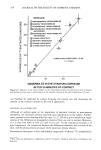
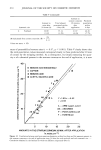
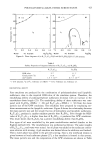
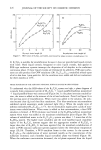
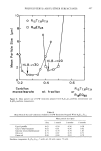
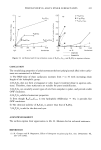
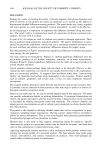
408 JOURNAL OF THE SOCIETY OF COSMETIC CHEMISTS 20- o o z z 15- 10- o BENZOIC ACID . ACETYLSALICYLIC ACID •, NICOTINIG ACID ., THEOPHYLLINE 1: 125 Nanornoles.cm '• 2: 250 applied 3: 500 4: 1000/4 14 ß ß 23 CORRELA]'ION COFFFICIEIN]' :.O.98 P 0.o01 i i :5 10 NANOMOLES INTHE STRATUM CORNEUM AFTER 30 MINUTES OF CONTACT Figure 8. Influence of dose applied on the relationship between the level of penetration of the test mate- rials after four days and their concentration in the stratum corneum at the end of application (30 rain). Also shown in Table IV and Figure 9 are the maximum solubility values (mg/ml) of benzoic acid in each vehicle. It is generally admitted that the release of a compound can be favored by the selection of vehicles having a low affinity for that compound or in which it is least soluble (24,25). The solubility of benzoic acid differed by a factor of 30 between the least and the most efficient solvent medium (vehicles 4 and 6). However, we can observe that there exists a weak relationship (r = 0.01) between penetration level and maximum solubility of benzoic acid. For instance, the greatest penetration is not obtained with the vehicle in which benzoic acid is least soluble, and vice versa. Applied vehicles have the potential to either increase or decrease the quantity of water in the horny layer and, therefore, to increase or decrease penetration (26). It is inter- esting to note that the penetration of benzoic acid is enhanced by increasing the water content of the vehicles, whatever the organic phase (vehicles 1 and 5, and 6, 8, and 9). As shown in Table IV and Figure 10, independent of vehicle composition, the amount of benzoic acid found in the horny layer at the end of application and the amount penetrating in four days correlate (r = 0.99, p 0.001). The influence of the vehicle composition on the in vivo penetration level of a chemical
Purchased for the exclusive use of nofirst nolast (unknown)
From: SCC Media Library & Resource Center (library.scconline.org)