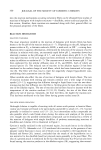
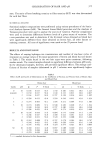
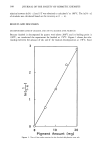
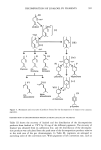
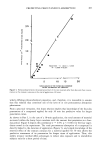
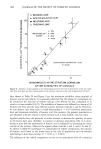
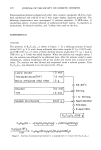
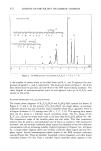
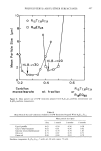
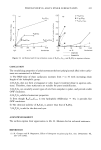
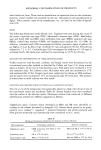
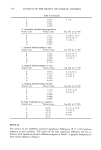
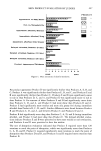
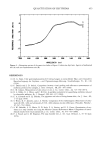
388 JOURNAL OF THE SOCIETY OF COSMETIC CHEMISTS relation between ln[•-x)] and 1/T was obtained to calculate k' at 180øC. The ln[•-x)] of alcohols was calculated based on the 'recovery as (1 - x). RESULTS AND DISCUSSION DECOMPOSITION RATES OF LINALOOL AND t-BUTYL ALCOHOL OVER PIGMENTS Because linalool is decomposed by quartz wool above 200øC and its boiling point is 198øC, we conducted the experiment for linalool at 178øC. Figure 1 shows the rela- tionship between the amount of talc and k' for linalool decomposition at 178øC. Since 0 ) • I , 0 10 20 Pigment Amount [mg] Figure 1. Test of first-order reaction for the linalool dehydration over talc.

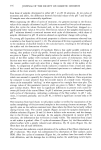
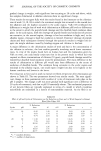
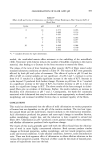
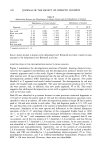
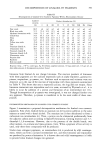
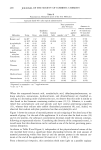
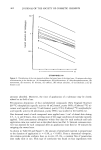
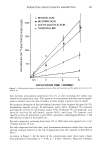
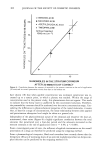
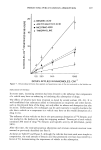
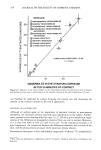
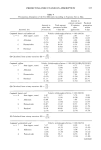
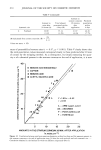
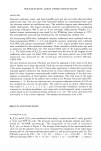
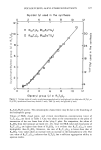
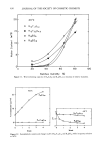
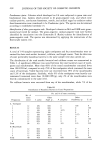
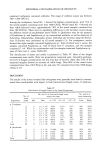
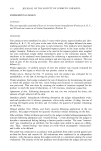
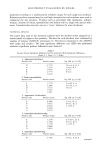
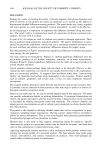
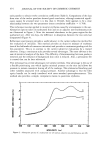
DECOMPOSITION OF LINALOOL BY PIGMENTS 389 there is a linear relationship between the amount of talc and k', dehydration of linalool is considered to be a first-order reaction. Dehydration of t-butyl alcohol was measurable over a wider range of temperatures. Figure 2 shows Arrhenius' plots for the dehydration of t-butyl alcohol over seven typical pigments. Since a linear relationship was recog- nized between log k' and I/T, k' for t-butyl alcohol at 180øC for every pigment was calculated using these Arrhenius plots. Table II shows the data obtained as log k' for dehydration of t-butyl alcohol at 180øC and log k' for dehydration of linalool at 178øC. A correlation was found for dehydration of t-butyl alcohol and linalool over these seven pigments (0.9226). 10.0 1.0 0.1 1/T [ K 0.01 ¾/l [] I 1.5 2.5 3.0 400 300 200 150 100 60 Temperature (øC) Figure 2. Arrhenius plots of the dehydration of t-butyl alcohol over cosmetic pigments. --O--, zinc oxide --I-- , black iron oxide --/X--, mica --O--, talc --[•--, ultramarine blue --&--, kao- linire --0--, red iron oxide.
Purchased for the exclusive use of nofirst nolast (unknown)
From: SCC Media Library & Resource Center (library.scconline.org)