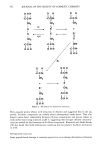
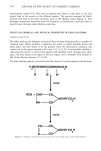
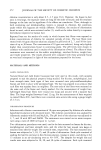
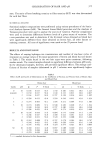
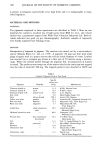
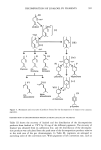
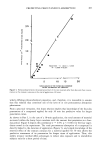
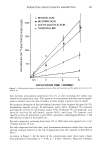
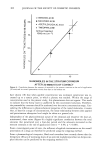
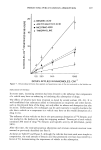
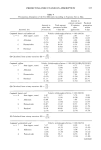
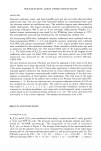
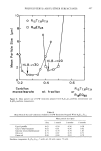
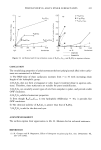
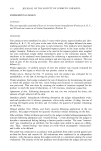
POLY(GLYCERYL) ALKYL ETHER SURFACTANTS 421 PROPERTIES Nonionic surfactant, water, and liquid paraffin were put into test tubes that had teflon sealed screw caps. The test tubes were repeatedly shaken in a thermostated bath until the solutions reached an equilibrium state. The solubility regions were determined by visible observations. The liquid crystalline structure was determined by a polarizing microscope (Olympus, BH-2) and an X-ray low-angle diffractometer (Rigaku Co.). Surface tension measurements were made by the Wilhelmy plate technique at 25øC. The formaldehyde given off was determined by the acetylacetone method (13). For determining HLB value, hydrophilic nonionic surfactants were combined with sor- bitan monostearate (HLB-v = 4.7), and lipophilic nonionic surfactants were combined with POE (20) sorbitan monostearate (HLB-v -- 14.9). Liquid paraffin-water systems were emulsified by the combined surfactants. Phase inversion emulsification was used to determine the HLB-value (14). The required HLB value of the liquid paraffin was 11.2. The HLB-values of RnTxGy were calculated from the ratio of the weights of two surfactants which gave the finest O/W emulsions. The mean particle size of the O/W emulsions was measured by the centrifugal sedimentation method (Horiba, CAPA-500). The skin irritation potential of RnTxGy was tested by applying it three times to the bare skin of rabbits over a three-day period. Each test site was evaluated 0 (for non-visible) to 3 (for severe responses) 24, 48, and 72 hours after application. Cellular skin injury from topically applied substances was characterized by a local inflammatory response, mani- fested by three important macroscopically visible events: reddening of the skin (ery- thema), accumulation of fluid (edema), and vasodilation. The total score of the mean inflammatory response for six rabbits was recorded as the Primary Irritation Index (PII, maximum = 9). For the eye irritation test, an aqueous surfactant solution of 0.05 ml was instilled into one eye of each rabbit. The other eye acted as control. Observations were made 0.5, 1, 1.5, 2, 3, 4, 5, 6, 7, and 24 hours after instillation. Lesions in the conjunctiva, nictating membranes, and cornea were scored separately using a numerical system based on the modified procedure of Draize et al. (15). The scores used were 0 for non-visible to 4 for a severe response. The theoretical maximum score is 96. RESULTS AND DISCUSSION SYNTHESIS OF RnTxGy R•2T•Gy and R•8T•Gy were synthesized from lauryl or stearyl alcohol (1 mol), glycidol (y mol), and THF (3y mol). The structure and average molecular weights were deter- mined by •H-NMR spectroscopy. The assignment of the peaks of acetylated R•2T7.sG7. 9 is shown in Figure 2. The average chain lengths of the oxytetramethylene units (x) and the glyceryl units (y) can be calculated by integration of the alkyl chain proton peak (b), the tetramethylene proton peak (c), and the acetyl proton peak (d). The C/B ratio is given by C/B = (4x + 2)/2(n - 3) forx = (n- 3)(C/2B) - 1/2. The D/B ratio becomes D/B = (3y + 3) / 2(n - 3) for y = (n - 3) (2D/3B) - 1, where n

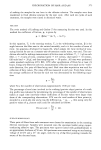
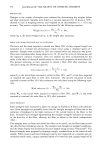
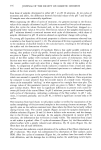
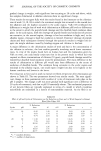
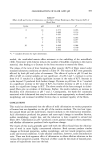
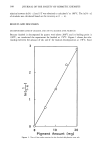
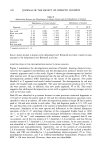
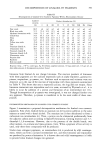
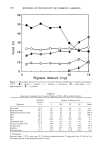
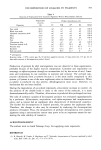
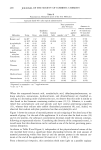
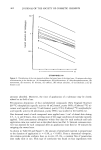
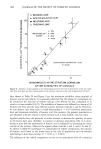
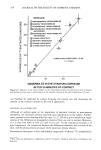
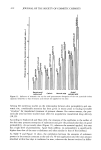
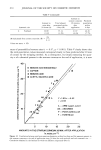
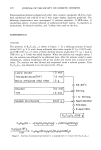
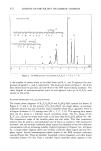
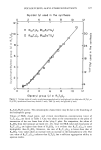
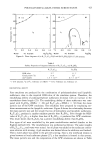
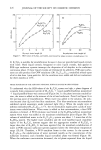
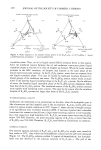
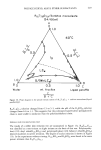
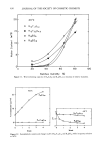
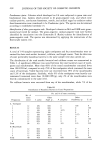
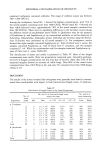
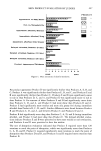
422 JOURNAL OF THE SOCIETY OF COSMETIC CHEMISTS Ri2TB.oG7.9-Ac d ?COCh5 CHa(CH2)9CH2CH20(CH2CH2CH2CH20)8.o(CH2CHCH20)7.90COCH3 a b c e e c c e f h f d d d OCOCH3 OCOCH3 - CH20CH2CHCH20CH2CHCH20COCH5 f h f f hg d e Figure 2. •H-NMR spectrum of acetylated R•2TxGy (x -- 7.8, y = 7.9). is the number of carbon atoms in the alkyl chain and B, C, and D represent the inte- grations of signal b, c, and d, respectively. The results are shown in Figure 3. All of the fatty alcohol and the glycidol, and one-third of the THF reacted during synthesis. The chain lengths of tetraoxymethylene units (x) and glyceryl units (y) in RnTxGy were similar in this series. SOLUTION PROPERTIES OF R•2TxGy/H20 SYSTEMS The binary phase diagrams of R12TxGy/H20 and R12EO,e/H20 systems are shown in Figure 4, 5, and 6. In the systems of Rt2TxGy/H20 , two single phases, an isotropic surfactant solution (ID) and a lameliar liquid crystalline phase (LC,•), appeared. Point A in Figure 4a shows a 1:1/2 spacing ratio (20 = 1.17, 2.33). This spacing ratio means that the LC,• phase is a lameliar liquid crystalline phase. The LC,• phase of the R12T1.2G2.1 system can retain more water in the layer than the R12EOx system (16-18). The temperature range of the lameliar phase was also wider. This blue translucent solution may be used as a microemulsion type of lotion in cosmetics. The cloud point increased, and the isotropic surfactant phase region (ID) expanded to the low surfactant concentration with an increasing number of glyceryl groups (y) (Figures 5,6). In Figure 6a, a simple phase diagram shows one isotropic surfactant phase region and one two- phase region. Several mesomorphous phases appear in the POE nonionic surfactant systems (Figure 6b). These are lameliar, hexagonal, inverse hexagonal, and cubic liquid crystalline phases (16-20). Only a lameliar liquid crystalline phase appears in the
Purchased for the exclusive use of nofirst nolast (unknown)
From: SCC Media Library & Resource Center (library.scconline.org)