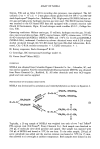
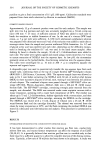
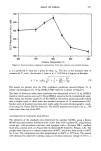
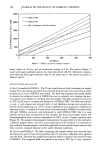
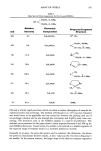
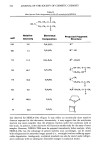
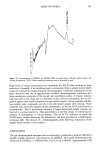
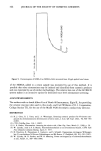
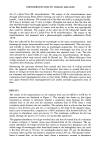
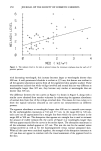
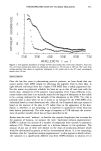
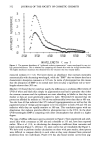
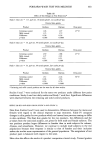
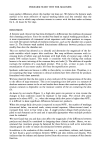
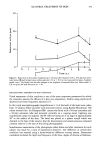
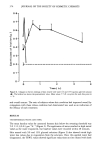
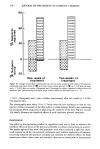
352 JOURNAL OF THE SOCIETY OF COSMETIC CHEMISTS o 250 + + + + + + + + + + + + * + ++ % . % %, 351ZI 451ZI 551ZI 651ZI 75g WAVELENGTH ( nm) 1•o p•d½•t$/•olu•t½½r$. •h•$ •$ obt•½d by comp•r• the •orm•l $14• •th the •t•I•o-•ol•½(l The higher absorbance maximum was obtained from the volunteer that was visually darker. extracted melanin (11-12). The latter shows an absorbance that increases essentially monotonically with decreasing wavelength, while the "EMP" that we observe here has a characteristic absorption resonance at 335 nm. In terms of photoprotection this means that the absorption of EMP in its normal state does not play a significant role at wave- lengths shorter than 305 nm. Mischer (13) found that he could not justify the differences in erythema effectiveness of UVB of white and black skin simply on pigmentation and had to postulate that either the stratum corneum and the epidermis are more absorbing in blacks or that they are thicker or they are more genetically adapted to light. Westerhof (5) reported that the protection afforded by melanin at 310 nm was substantially lower than that at 405 nm. Van der Leun (6) has indicated that UV induced hyperpigmentation as well as that the pigmented areas of vitiligo patients appear to be less sensitive to both 254 and 336 nm radiation while they are equally sensitive to 300 nm. This conclusion agrees with our observation that melanin provides effective photoprotection in the UVA. In the short UVB wavelengths EMP is competing with other chromophores that absorb to a higher degree. The type of diffuse reflectance spectra presented in Figure 2 from pigmented and amel- anotic skin with a resonance at 285 nm and a shoulder at 335 nm, have been reported earlier. Wan et al. (14), in calculating the absorption coefficient from caucasian and black epidermis (Figure 5, reference 13), show curves that are remarkably like Figure 2. We have tried to perform similar calculations on these with poor results these spectra were difficult to compare directly to each other as they were obtained from extracted epidermis from two individuals. Poulet (15) has also found similar curves from pig-

PHOTOPROTECTION BY HUMAN MELANIN 353 mented and non-pigmented skin through photoacoustic spectroscopy. We feel confi- dent that the apparent absorption spectrum of epidermal melanin pigmentation is es- sentially correct. In comparing the edge of the absorption spectrum of EMP with that of the erythema action spectrum it was found that the latter is a slower function of wavelength than the EMP apparent absorption spectrum. Therefore, the much higher sensitivity of human skin to UVB than to UVA can only be partially accounted for by the absorbance of EMP. Morison (16) has considered the possible roles of melanin in human skin and concluded that photoprotection from the UV is not its primary function. CONCLUSIONS a. Human epidermal melanin pigmentation, in its natural state, absorbs light differ- ently than does synthetic and extracted melanin. b. Human EMP provides less protection in the wavelength range 305-280 nm of the UVB than previously assumed. At these wavelengths the epidermal proteins are the primary absorbers. c. UVB photoprotection is important to dark- as well as lighter-skinned individuals. ACKNOWLEDGMENTS We express our gratitude to Dr. M. M. Selim, Chairman, Department of Derma- tology, A1-Sabah Hospital, for his constant support and encouragement. We also thank Mr. Iqbal Sadiq for his tireless and inspired assistance. This work was partially sup- ported by the Environmental Protection Council of Kuwait. REFERENCES (1) R. R. Anderson andJ. A. Parrish, The optics of human skin,J. Invest. Dermatol., 77, 13-19 (1981). (2) P. Amblard, J. Beani, R. Gautron, J. Reymond, and B. Doyon, Statistical study of individual variations in sunburn sensitivity in 303 volunteers without photodermatosis, Arch. Dermatol. Res., 274, 195-206 (1982). (3) S. Shono, M. Imura, M. Ota, S. Ono, and K. Toda, The relationship of skin color, UVB-induced erythema, and melanogenesis, J. Invest. Dermatol., 84, 265-267 (1985). (4) K. H. Kaidbey, P. Agin, R. M. Sayre, and A.M. Kligman, Photoprotection by melanin--A com- parison of black and Caucasian skin, J. Am. Acad. Dermatol., 1, 249-260 (1979). (5) W. Westerhof, D. Babelaar, R. H. Cormane, J. Langelaar, and J. Hup Middelkamp, The protective role of epidermal melanin in a patient with porphyria variegata and vitiligo, Acta Dermatovener., 61, 23-31 (1981). (6) J. C. van der Leun, Delayed pigmentation and ultraviolet erythema, Photochem. Photobiol., 4, 459-464 (1965). (7) N. Kollias and A. Baqer, On the assessment of melanin in human skin in vivo, Photochem. Photobid., 43, 49-54 (1986). (8) N. Kollias, A. Baqer, and K. Razi Naqvi, Fiber optic spectrophotometer for noninvasive transmission and diffuse reflection studies, Spec. Lett., 19, 149-165 (1986). (9) N. Kollias and A. Baqer, Spectroscopic characteristics of human melanin in vivo, J. Invest. Dermatol., 85, 38-42 (1985).
Purchased for the exclusive use of nofirst nolast (unknown)
From: SCC Media Library & Resource Center (library.scconline.org)