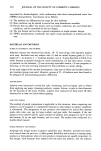
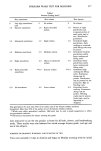
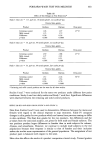
356 JOURNAL OF THE SOCIETY OF COSMETIC CHEMISTS supervised by dermatologists), with confirmatory data from transepidermal water loss (TEWL) measurements. Conclusions are as follows: (1) The method can differentiate bar soaps for skin mildness. (2) Skin condition can be related to several bar soap formulation variables. (3) Factors that can affect test results, such as climatic conditions, sex, and initial skin condition, can be controlled by the test design. (4) The test design can be either a paired-comparison or single product design. (5) TEWL measurements corroborate the expert visual assessment of redness and dry- ness. MATERIALS AND METHODS SUBJECTS: ELIGIBILITY AND NUMBER Informed consent was obtained from adults, 18-55 years of age, who regularly washed with soap. Excluded was any subject who (1) had an initial dryness grade of 3.0 or higher (0 = no dryness, 3 = moderate dryness, on a 0-6 scale described in Table I) on either forearm as assessed during the initial examination, (2) had skin cancer, eczema, or psoriasis on the forearms, (3) was receiving injectable insulin, (4) was pregnant or lactating, or (5) was receiving treatment for skin problems or contact allergy. In the early stages of the method development, base sizes of about one hundred subjects per treatment group were used. However, groups of 25-30 subjects were later found to be adequate for discriminating product differences. RESTRICTIONS Subjects were instructed to avoid hot tubs, swimming, and sun lamps, and to refrain from applying any soaps, cleansing products, creams, lotions, or gels to their forearms for the duration of the study. Further, subjects were instructed to keep water off their forearms for at least two hours before grading. PAIR TEST DESIGN The method of paired comparisons is applicable in this situation, when competing test products can be assigned to contralateral forearms so that subject-to-subject variability is eliminated. The assignment of test products was balanced by initial skin dryness grade, skin color, sex, age (in large studies), and pair order. For example, if the test products were coded P and H, equal numbers of subjects were assigned to use P on the left forearm, H on the right forearm, and vice versa. The studies were conducted in a double-blind manner. SINGLE PRODUCT TEST DESIGN Although this design results in greater variability and, therefore, provides less statis- tical control than the pair test, it offers greater flexibility and economy in testing many products or formulations when all inter-product comparisons are equally important. In this design, both forearms were washed with the same test product, and the subjects

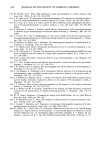
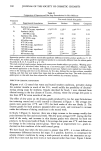
FOREARM WASH TEST FOR MILDNESS 357 Table I Forearm Grading Scale* Skin smoothness Skin redness Skin dryness Very high smoothness/ 0 No redness 0 No dryness slick Extreme smoothness 1.0 Barely detectable 1.0 redness o 1.o 2.0 Substantial smoothness 2.0 Slight redness 3.0 Moderate smoothness 3.0 Moderate redness 4.0 Slight smoothness 4.0 Heavy or substantial redness 5.0 Barely detectable ** 5.0 Extreme redness * * 5.0 smoothness 6.0 No smoothness 6.0 Severe redness Patches of slight powderiness and occasional patches of small scales may be seen. Distribution generalized. 2.0 Generalized slight powderiness. Early cracking or occasional small lifting scales may be present. 3.0 Generalized moderate powderiness and/or heavy cracking and lifting scales. 4.0 Generalized heavy powderiness and/or heavy cracking and lifting scales. Generalized high cracking and lifting scales. Eczematous change may be present. Powderiness may be present but not prominent. May see bleeding crack. 6.0 Generalized severe cracking. Eczematous change may be present. Bleeding cracks may be present. Scales large, may be beginning to disappear. Non-generalized: No more than 50% of the surface area of the forearm exhibits attribute. Generalized: More than 50% of the surface area of the forearm exhibits attribute. * Whole units reflect generalized condition. Half units may be used in grade assignments to reflect non-generalized condition. ** Discontinue treatment(s) for subject reaching this grade. were instructed to use the test product at home for all bath, shower, and handwashing needs. These studies were also balanced for initial average dryness grade, and age and sex of the subjects. SCHEDULE OF GRADINGS, WASHINGS, AND DURATION OF TEST Tests were normally 12 days in duration and began on Monday morning with the initial
Purchased for the exclusive use of nofirst nolast (unknown)
From: SCC Media Library & Resource Center (library.scconline.org)