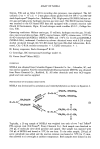
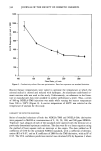
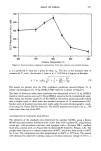
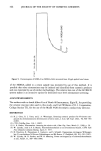
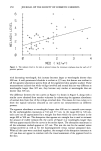
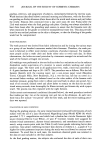
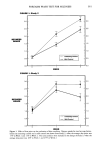
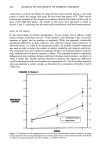
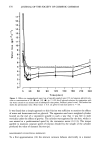
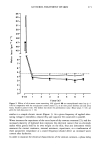
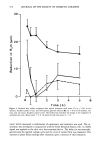
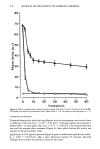
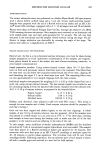
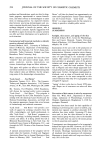
374 JOURNAL OF THE SOCIETY OF COSMETIC CHEMISTS 0'8-- 0'7-- 0'6-- •' 0-5- o o "- 0.4- o ß •- o.3- o o 0-2- • i I I I I o I 2 3 4 Time ( h ) Figure 6. Changes in friction readings of skin treated with water (O) and 15% aqueous glycerol solution (I•). The broken line shows the pretreatment value. Mean values - S.E. are given for each data point (n = 5). and overall texture. The ratio of subjects whose skin condition had improved overall by comparison with those whose condition had deteriorated was used as an indication of the efficacy of each treatment. RESULTS TRANSEPIDERMAL WATER LOSS (TEWL) The mean baseline value for untreated forearm skin below the sweating threshold was 5.0 -+ 0.3 (S.E.) gm-2h - • (Figure 2). The application of water resulted in high initial values as the water evaporated, but baseline values were recorded within 20 minutes. Skin treated with 5% and 15% glycerol solutions (Figure 2) also showed initial high water loss values due to evaporation from the solutions. Once this applied water had disappeared, the TEWL values showed significant reductions on sites treated with both

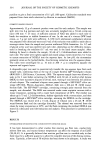
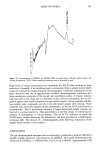
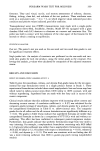
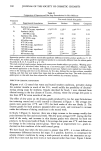
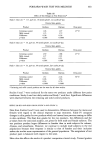
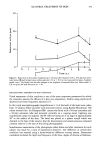
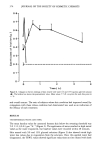
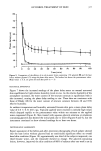
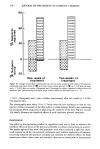
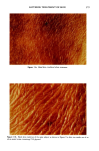
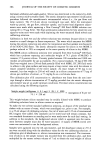
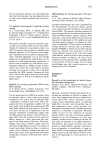
GLYCEROL TREATMENT OF SKIN 375 30- 20- OJ 0 10 20 30 40 50 60 70 80 90 100 Relative humidity (ø•o) at 24øC +-0-5 ø Figure 7. Increase in phase delay readings from untreated skin with increasing ambient relative humidity. Figures show mean _+ S.E. of ten readings per data point on a typical subject. the glycerol solutions at 10 minutes and all subsequent time points (p 0.05 by comparison with the water control, Student's paired t-test). TEWL values on glycerol- treated skin remained lowered for at least four hours. TEWL was also markedly decreased by the application of glycerol in emulsion systems (Figure 3) (p 0.02 at all time points between one and seven hours by comparison with the non-glycerol control, Student's paired t-test). SKIN SURFACE TOPOGRAPHY A mean Rtm value of 70 + 3.3 (S.E.) Ixm was obtained on the forearms at ambient temperature and relative humidity. When excess water was applied for 1 minute and then patted dry, there was a rapid mean decrease of 15 Ixm in the Rtm value (p 0.05, Student's paired t-test) which disappeared within 30 minutes (Figure 4). The skin smoothing from the addition of water was just detectable to the naked eye and very reproducible. Application of an aqueous solution of glycerol to the skin surface (Figure 4) enhanced and prolonged the smoothing effects of water (p 0.02 at 30 minutes, one hour, and two hours, Student's paired t-test). Similar effects were found when glycerol was incor- porated into an oil-in-water emulsion (p 0.02 at two and five hours, Student's paired t-test). The effect was still discernible after 24 hours (Figure 5).
Purchased for the exclusive use of nofirst nolast (unknown)
From: SCC Media Library & Resource Center (library.scconline.org)