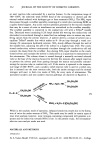
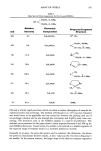
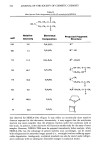
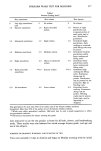
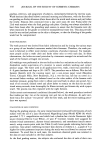
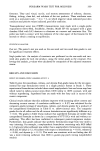
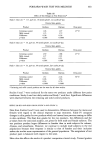
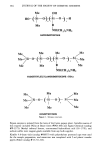
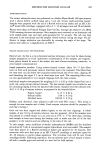
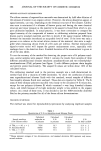
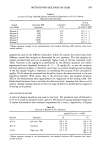
METHOD FOR SILICONES ON HAIR 389 Table II Accuracy of Using Dimethyl Siloxane Standards for Quantitation of % Si in Various Organofunctional Siloxanes %Sias Sample Calculated MW Calculated determined (neat fluids) of polymer % Si by AAS ( ___ SD)* Siloxane A 8005 35.0 35.6 + .3 Siloxane B 7980 35.1 36.2 + .3 Siloxane C 7698 36.4 36.3 + .3 Siloxane D 8059 34.7 33.4 -4_-_ .3 Siloxane E 30480 41.3 35.3 + .3 Siloxane F 7630 36.7 36.8 -4_-_ .3 * Means represent averages of two determinations, and standard deviations (SD) represent only instru- mental variation. prepared by each of two different researchers. Table III contains the results from three different treated hair samples as determined by two operators. The hair samples in- cluded untreated hair and two increasingly higher levels of silicone treatment (with TSA). Variation in the mg/kg Si as determined by the different operators was within experimental error (standard deviation of +/- 30 mg/kg Si), as was the variation between replicate samples. It should be noted that an accurate weighing and recording of the hair sample weight is important in controlling the accuracy of the calculated Si mg/kg. The Si values for untreated hair should be close to the detection limit or the test should be repeated. With values close to the detection limit, the standard deviation (SD) of the measurement often approximates the magnitude of the reading itself. The blank should measure close to or below the detection limit, meaning that there is no Si present. Sample readings that are in this low range of detection should also be suspected of having no Si present. APPLICATIONS OF METHOD A series of siloxane emulsions was used to treat hair. The emulsions were all diluted to 0.25 wt % solids in deionized water, and two TSA fluids of varying polymer length and % amino functionality were evaluated (represented by x and y, respectively, in Figure Table III Precision of Method by Two Operators mg/kg Si by A.A. (+ SD)* Tress # Treatment (1) (2) K13-3 Low conc. TSA 150 + 30 140 --- 30 170 --- 30 150 + 30 K13-U Untreated 70 +- 30 60 --- 30 70 -+ 30 30 + 30 K14-2 High conc. TSA 370 + 30 380 + 30 380 + 30 * Means represent averages of two determinations, and standard deviations (SD) represent only instru- mental variation.

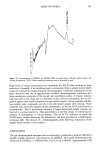
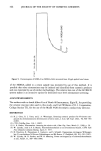
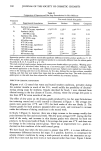
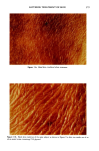
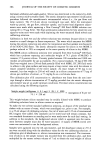
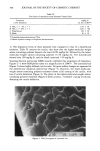
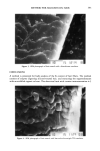
390 JOURNAL OF THE SOCIETY OF COSMETIC CHEMISTS Table IV First Series of Aminofunctional Siloxane*-Treated Hair Treatment mg/kg Si (. 25% Emulsion) by AA (+ SD)** A TSA, x = 96, y = 2 1170 + 50 B TSA, x = 298, y = 2 4220 + 100 C Dimethicone 190 + 20 D Blank 30 + 30 * Trimethylsilylamodimethicone (TSA). ** Means represent averages of duplicate determinations. 1). The deposition levels of these polymers were compared to that of a dimethicone emulsion. Table IV contains the results, that show that the higher-molecular-weight amine-containing polymer deposits the most (4220 mg/kg Si), followed by the lower- molecular-weight amine-containing polymer (1170 mg/kg Si). The dimethicone showed only 190 mg/kg Si, and the blank contained 30 mg/kg Si. Scanning electron microscopy (SEM) visually confirmed this progression of deposition. Figures 2- 5 show SEM photos taken at a magnification of 2000 x. The untreated hair (Figure 2) shows highly defined cuticle scales. No gross surface changes are apparent for the dimethicone emulsion-treated hair (Figure 3). However, the lower-molecular- weight amine-containing polymer treatment shows a full coating of the cuticle, with loss of cuticle definition (Figure 4). The photo of the higher-molecular-weight amine- containing polymer treatment (Figure 5) shows a heavy, "wrinkled" coating of silicone, obscuring the cuticle definition. Figure 2. SEM photograph of untreated hair.
Purchased for the exclusive use of nofirst nolast (unknown)
From: SCC Media Library & Resource Center (library.scconline.org)