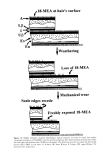
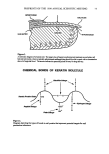
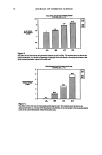
HUMAN HAIR CUTICLE 37 surfactants, such as disteryl dimethyl ammonium chloride or cetyl trimethyl ammonium chloride, as conditioners for human hair lies in their ionic binding at surface sites from which 18-MEA has been removed by environmental or other damaging processes, i.e., restoration in continuity of the low coefficient-of-friction surface. Taking the aforementioned facts into consideration, the compelling conclusion is that the DFE in normal hair involves both asymmetry of surface architecture (as dictated by overlapping scales) and an outer surface covered with a robust low coefficient-of-friction material (18-MEA). Overlapping scales are the underlying cause of the effect, without which there would be no DFE (57), and this is reflected by the value of the numerator in Equation 1. The surface 18-MEA serves to enhance this initial effect by maintaining a low average frictional resistance and is reflected by the denominator in Equation 1. 18-MEA AS A BOUNDARY LUBRICANT The condition of having one end of a long-chain molecule firmly attached to an under- lying solid substrate, as with 18-MEA at the hair's surface, is a well-known characteristic of boundary lubricants that serve to efficiently maintain surfaces of low frictional resis- tance (60,61). With conventional boundary lubricants, the attachment is usually ionic, but in hair nature has conspired in the use of a covalent linkage. Straight-chain mol- ecules are prone to ordering, which dramatically increases their bulk viscosity and frictional resistance under high loads, but efficient boundary lubricants are branched so as to remain liquid-like and of low frictional resistance. The two chains of di-alkyl quaternaries ionically adsorbed onto an anionic surface typically provide for this chain disorder and are good boundary lubricants. This is undoubtedly the reason why such molecules are good conditions for hair, binding occurring between the cationic groups of the conditioner at the anionic sites on the hair surface from which the 18-MEA has been removed by various damage processes. In 18-MEA, nature has arranged for chain disorder, high molecular mobility, and low frictional resistance by using anteiso methyl- branching of the aliphatic chain. CONTRIBUTIONS OF THE CUTICLE TO THE HAIR'S OVERALL BEHAVIOR HAIR TANGLING A common property of all mammalian hairs (including human hair), once they have been shorn from the animal and the untethered fibers are mechanically agitated, is their propensity for becoming tangled and increasingly so if the fibers are immersed in water. While in the textile industry this is used to advantage in the preparation of woolen felts, in former times this was a serious handicap and the cause for the washing shrinkage of knitted or woven woolen garments. The DFE is the underlying cause of the tangling process, and indeed its elimination, typically by surface oxidation of the fibers coupled with impregnation by reactive polymers, is a common route for producing shrink- resistant woolen garments. It is now generally recognized that, as well as the presence of a DFE amongst the fibers, free root-ends are a critical feature of tangling in mammalian hair (54). In this respect

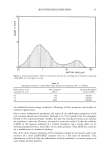
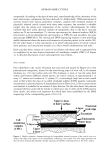
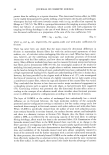
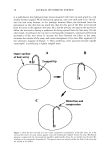
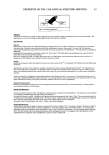
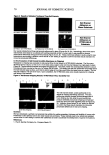
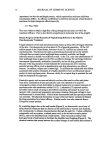
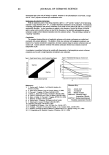
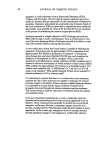
38 JOURNAL OF COSMETIC SCIENCE it is well-known that laboratory hair tresses mounted with their tip-ends glued to a tab readily become tangled. With mechanical agitation, such root-ends tend to be "driven" into the hair array because, in the jostlings between fibers, the frictional forces for movements in this direction are much less than for this part of the fiber to be ejected from the array in the opposite direction. By a similar process, one expects the tip-end to follow the root-end in having a preference for being ejected from the hair array. On the other hand, if perchance the tip-end is mechanically entrapped, continued preferential movement of the root serves to increase the force between the fibers in the array, decreases the volume of the array, and causes entrapment of yet more fiber segments (cf. the schematic diagram of Figure 7). Once underway, these processes become rapidly catastrophic in producing a tightly tangled mass. Outer surface A B of hair array d tip C Distortion and compressio Figure 7. How the free root-end of a hair causes compressive entanglement of the hair array. At A the root-end (R) enters the array surface against a tip-end mechanically trapped within the array. Mechanical agitation, coupled with the directional friction effect, preferentially drives the root further into the array (B), resulting in its compressive distortion (C). This process can occur entirely within the bulk of the array and not merely at its surface.
Purchased for the exclusive use of nofirst nolast (unknown)
From: SCC Media Library & Resource Center (library.scconline.org)