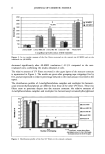
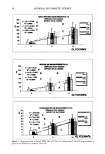
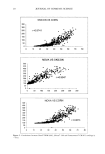
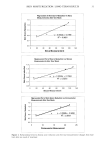
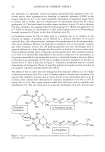
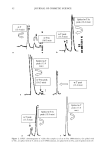
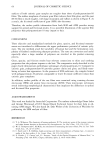
20 JOURNAL OF COSMETIC SCIENCE SKICON VS CORN 35 30 ] 25 r =0.8741 ß øø 20 t 5 _ T •-- T • I' 1 T I 0 10 20 30 40 50 60 70 80 NOVA VS SKICON 500 450 400 ß •1• 250 . I* • ' , e ,, 0 0 50 100 150 2• 2• 300 350 NOVA VS CORN -- --- 5•- 450- 3•o- ...• ••. 250- •5o- ' ß •• •. 8] 100 - •• , ß , , 50- 0 0 10 20 30 40 50 • 70 r =0.8873 80 Figure 2. Correlations between Nova © DPM 9003, Skicon © 200 and Corneometer © CM 825 readings (n = 691).

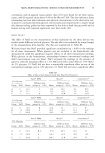
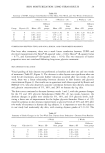
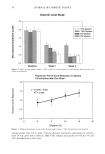
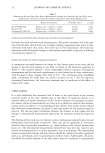
SKIN MOISTURIZATION: SHORT-TERM MEASUREMENTS 21 Table IV Correlations Between Instruments Clarys eta/. Fluhr eta/. Present work Nova vs Skicon 0.96 0.96 0.93 Nova vs Corneometer 0.97 0.82 0.87 Skicon vs Corneometer 0.89 0.83 0.89 on the Corneometer © readings, but did significantly affect the Nova © and Skicon © readings. CORRELATIONS BETWEEN DIFFERENT INSTRUMENTAL READINGS Fluhr eta/. (10) and Clarys eta/. (11 ) both reported significant correlations between the different instrumental readings. Figure 2 shows plots of our data from each instrument against each of the others. Our data are in agreement that there are significant corre- lations between the different instruments. Correlation coefficients from these plots are compared to literature values in Table IV. Our correlation coefficients are lower than those found by Clarys et al. for Nova © vs Skicon © readings and Nova © vs Corneometer © readings, but compare well with those of Fluhr eta/. The correlations between Nova © and Skicon © readings were the highest, a finding that is also in agreement with Fluhr eta/. CONCLUSIONS At all NaC1 levels and with each instrument, readings were linearly correlated with glycerin concentration. Since glycerin is both a humectant and an effective skin mois- turizer, we assume that this increase in the instrument readings is caused by an increase in skin water content. However, we cannot rule out the possibility that the increase in the readings is directly caused by glycerin through increases in polarizability of the media. The presence of sodium chloride decreased the readings slightly in the absence of glycerin and increased the readings in the presence of glycerin. The maximum effect was at 1.5% salt and 5% glycerin. The salt-induced increase in the presence of glycerin was statistically significant with all three instruments at 1.5% salt but was less at 3.0% salt. We anticipate that the explanation of the effects of salt observed in this study is related to the levels of moisture attributable to the formulations. Specifically, at low levels of hydration, i.e., 0% glycerin, there may be insufficient water remaining in the stratum corneum to fully ionize the NaCI, thereby diminishing the conductivity relative to formulations containing glycerin. The hygroscopicity of glycerin may provide water for solubilization of the NaC1. Our results indicate that salt by itself will not cause large positive artifacts in electrical readings. REFERENCES (1) M. Loden, Biophysical methods of providing objective documentation of the effects of moisturizing creams, Skin Res. Technol., 1, 101-108 (1995).
Purchased for the exclusive use of nofirst nolast (unknown)
From: SCC Media Library & Resource Center (library.scconline.org)