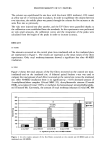
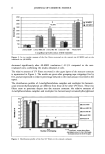
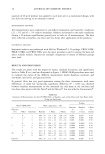
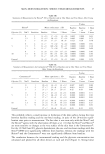
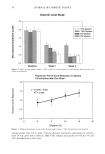
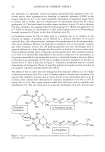
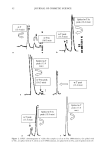
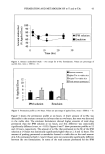
CATIONIC POLYMERS 5 7 60 50 40 10 0 PQ10 PQ10 PQ10 PQ10 Guar Guar (L/H) (M/H)(M/M)(M/L) (H/H) (L/H) Figure 1. 20 ø gloss of polyquarternium-10 and cationic guar films. control polymer film dulls the substrate. The fact that polyquaternium-10 samples have a higher gloss than the control surface means that these polymers improve the gloss of the Leneta surface. Gloss values of both cationic guar films are significantly lower than that of the control surface, suggesting that cationic guar materials dull the substrate chosen in this study. Figure 2 compares the gloss readings of 1.0% coacervate gels with those of polymer films. The gloss of a coacervate gel is lower than that of the corresponding neat polymer. This result strongly suggests that the cationic polymer is responsible for shine, and the incorporation of SDS decreases gloss. The gloss reduction is probably due to the non- homogeneity of the binary system. Gloss is a function of surface smoothness and the refractive index of the material. The lower gloss of coacervate films may result from increased surface roughness or decreased refractive index. Because the coacervate gels are slightly surfactant-deficient (Table II), there is a distribution of unbound SDS and free polymer throughout the film. The non-uniform distribution can negatively contribute to surface roughness, thus decreasing the gloss. Streaming potential experiments have demonstrated a positive zeta potential of hair in the presence of polymer and surfactant (15,16). Thus, the slight positive charge of the coacervate gel may more realistically represent what actually deposits and remains on hair. The polyquaternium-10 coacervates also produced a higher gloss than the cationic guar coacervates. As in the neat polymer films, the guar (H/H) coacervate presented the least shine among all cationic materials. An important conclusion emerges from Figure 2 that polyquaternium-10 provides better gloss than the cationic guars whether the polymer deposits as neat polymer or in the coacervate form. A higher gloss value indicates a higher surface quality of deposited polyquaternium-10 films. The gloss results of cat-

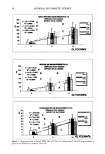
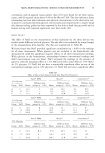
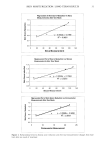
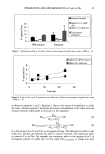
58 JOURNAL OF COSMETIC SCIENCE 6O 5O 4O 10 polymer ß 1% gel PQlO PQlO PQlO PQlO Guar Guar (L/H) (M/H)(M/M)(M/L) (H/H) (L/H) Figure 2. 20 ø film gloss of cationic polymers and coacervate gels with SDS. control ionic polymers both with and without surfactant agree very well with the visual assess- ment of the films. OPACITY The opacity of the films on the Leneta charts was examined visually and spectrophoto- metrically. Figure 3 compiles opacity readings of the 1% coacervate gels in comparison with the neat polymer films. Lower opacity readings confirm that polyquaternium-10 and guar (L/H) films are more transparent than guar (H/H), which is consistent with visual inspection. In fact, the wet gel of guar (H/H) presented a yellow haze whereas polyquaternium-10 gels were clear and colorless. The guar (L/H) sample displayed improved color and less haziness than guar (H/H). The coacervate gels followed the same trend as the neat polymer films. Figure 2 also demonstrated that the presence of surfactant in coacervate gels has little impact on the opacity or the clarity of polymer films. Opacity is an important appearance attribute applying to the diffuse rather than to the specular aspect of appearance. Higher opacity readings indicate the stronger power of the polymer hiding a substrate. The film opacity measured by the Hunter Tristimulus colorimeter is inversely related to film transparancy. Figure 3 shows that polyquater- nium-10 and guar (L/H) films give opacity readings similar to that of the control surface, suggesting that the surface beneath the polymer film can be observed. In other words, the polymer deposits on the substrate are invisible. The measurements on guar (H/H) show lower gloss and higher opacity. This combination of the two low gloss and non-transparent films will likely impose a dulling effect when it deposits on hair fibers.
Purchased for the exclusive use of nofirst nolast (unknown)
From: SCC Media Library & Resource Center (library.scconline.org)