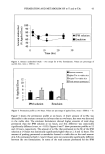
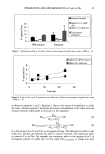
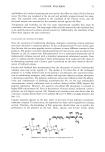
PERMEATION AND METABOLISM OF o•-T and o•-TAc 49 the possibility of the hydrolytic pathway being saturable even over a short period of 24 hours, and an increase in d3-o•-tocopheryl acetate concentration did not result in a corresponding increase in d3-o•-tocopheryl acetate hydrolysis. About 20-50% of the applied dose of the o•-TAc was found to be metabolized to o•-T when measured in terms of drug permeated in the stratum corneum and viable skin. This is about 2-5 fold higher than that found by Norkus eta/. (13) in hairless mouse skin. Tojo and Lee (27) studied the bioconversion of a provitamin to vitamins C and E in mouse skin dermis. The provitamin was inherently stable and was expected to develop actions of both vitamins E and C in the body through splitting off the phosphoric acid esters by enzyme phosphatase. They calculated the yield of bioconversion to be about 96% in the hairless mouse skin. In summary, this study has demonstrated the metabolism of o•-TAc to o•-T in viable pig skin. Topically applied o•-TAc was bioconverted to the active molecule and free radical scavenger o•-T within the skin tissue. No metabolism was detectable in the stratum corneum. This study has also elucidated the kinetics of metabolism of o•-TAc. The extent of metabolism was highest at 6-12 hours after application. Longer time periods failed to produce a higher extent of metabolism, probably due to the saturation of the hydro- lyric pathway. REFERENCES (1) A.L. Norins, Free radical formation in the skin following exposure to ultraviolet light, J. I,vest. DermatoL, 39, 445•448 (1962). (2) M.M. Marhews-Roth, Carotenoid pigment administration and the delay in development of UV-B- induced tinnors, Photochem. Photobio/., 42, 35-38 (1983). (3) N. Khettab, M.C. Amory, G. Brigand, B. Bousquet, A. Combre, A.Y. Forlot, and M. Barey, Photoprotective effect of vitamins A and E on polymamine and oxygenated free radical metabolism in hairless mouse epidermis, Biochimie, 70, 1709-1713 (1988). (4) E. Niki, "Function of Vitamin E as Antioxidant in the Membranes," in Vitami, E: Its Usef•/,es• Health a,d ], C•ri,g Diseases, M. Minoe, H. Nakamura, A. T. Diplock, and H. J. Kayden, Eds. (Karger, New York, 1992), pp. 23-30. (5) H. L. Gensler and M. Magdaleno, Topical vitamin E inhibition of immunosuppression and tumori- genesis induced by ultraviolet irradiation, N•tr. Ca,er, 15, 97-106 (1991). (6) D. L. Bissett, G. G. Hillerbrand, and D. P. Hannon, The hairless mouse as a model of skin photoaging: Its use to evaluate photoprotective materials, Photodermato/ogy, 6, 228-233 (1989). (7) P. Mayer, The effects of vitamin E on the skin, Cosmet. Toilerr., 108, 99-109 (1993). (8) M. Lopez-Torres, J. J. Thiele, Y. Shindo, D. Han, and L. Packer, Topical application of ½x-tocopherol modulates the antioxidant network and diminishes ultraviolet-induced oxidarive damage in murine skin, Br. J. Dermato/., 138, 207-215 (1998). (9) A. Parmatier, P. Jenner, B. Testa and J. C. Etter, The skin as a drug-metabolizing organ, Dr•g. Rev., 8, 319-343 (1978). (10) J. Rautio, H. Taipale, J. Gynther, J. Vepsalainen, T. Nevalainen, and T. Jarvinen, I, vitro evaluation of acyolxyalkyl esters as dermal prodrugs of ketoprofen and naproxen,J. Pharm. Sc]., 87, 1622-1628 (1998). (11) D. S. Alberts, R. Goldman, M-J. Xu, R. T. Dorr, J. Quinn, K. Welch, J. Guillen-Rodriguez, M. Aickin, Y-M. Peng, L. Loescher, and H. Gensler, Disposition and metabolism of topically adminis- tered ½x-tocopherol acetate: A common ingredient of commercially available sunscreens and cosmetics, N•tr. Ca,cer, 26, 193-201 (1996). (12) H.L. Gensler, M, Aicken, Y-M. Peng, and M. Xu, Importance of the form of topical vitamin E for prevention of photocarcinogenesis, N•tr. Ca,cer, 26, 183-191 (1996).

50 JOURNAL OF COSMETIC SCIENCE (13) (14) (15) (16) (17) (18) (19) (20) (21) (22) (23) (24) (25) (26) (27) E. P. Norkus, G. F. Bryce, and H. N. Bhagavan, Uptake and bioconversion of tx-tocopheryl acetate to tx-tocopherol in skin of hairless mice, Photothem. Photobio/., 57, 613-615 (1993). J. R. Trevithick and K. P. Mitton, Topical application and uptake of vitamin E acetate by the skin and conversion to free vitamin E, Blochem. Mo/ec. Bio/. Int., 31, 869-877 (1993). Z. Nabi, A. Tavakkol, N. Soliman, and T. G. Polefka, Bioconversion of tocopheryl acetate to tocoph- erol in human skin: Use of human skin organ culture models, Poster presentation, Colgate-Palmolive Co., Piscataway, New Jersey (1999). D. Dupuis, A. Rougier, R. Roguet, and C. Lotte, The measurement of the SC reservoir: A simple method to predict the influence of vehicles on in-vivo percutaneous absorption, Br. J. Dermato/., 115, 233-238 (1986). T. Shiratori, Uptake, storage and excretion of chylomicra-bound 3H-tx-tocopherol by the skin of the rat, Lij• Sci., 14, 929-935 (1974). K. H. Valia, K. Tojo, and Y. W. Chien, Long term permeation kinetics of estradiol. III. Kinetic analysis of the simultaneous skin permeation and bioconversion of estradiol esters, Drug. Dev. Ind. Pharm., 11, 1133-1173 (1985). Y. Miura, Histochemical studies on enzymatic activities in the skin,J. Dermatol., 74, 556-570 (1964). W. Meyer and K. Neurand, The distribution of enzymes in the skin of the domestic pig, Lab. Animals, 10, 237-247 (1976). S. W. Collier, N.M. Sheik, A. Sakr, J. L. Lichtin, R. F. Stewart, and R. L. Bronaugh, Maintenance of skin viability during in vitro percutaneous absorption/metabolism studies, Toxicol. Appl. Pharmacol., 99, 522-533 (1989). R. Dulbecco and M. Vogel, Plaque formation and isolation of pure lines with poliomyelitis viruses,J. Exp. Med., 99, 167-182 (1954). R. L. Bronaugh and R. F. Stewart, Methods for in vitro percutaneous absorption studies. III. Hydro- phobic compounds,J. Pharm. Sci., 73, 1255-1258 (1984). G. P. Kushla, Studies of Lidocaine Permeation Through Hairless Mouse Skin From Propylene Glycol-Water Mixtures, M.S. thesis, Rutgers University, New Jersey (1986). G. M.J. Beijersbergen van Henegouwen, H. E. Junginger, and H. de Vries, Hydrolysis of RRR-o•- tocopheryl acetate (vitamin E acetate) in the skin and its UV protecting activity (an in vivo study with the rat),J. Photochem. Photobiol B: Biology, 29, 45-51 (1995). K. Kramer-Stickland and D.C. Liebler, Effect of UVB on hydrolysis of o•-tocopheryl acetate to o•-tocopherol in mouse skin, J. Invest. Dermatol., 111, 302-307 (1998). K. Tojo and A. C. Lee, Bioconversion of a provitamin to vitamins C and E in skin,J. Soc. Cosmet. Chem., 38, 333-339 (1987).
Purchased for the exclusive use of nofirst nolast (unknown)
From: SCC Media Library & Resource Center (library.scconline.org)