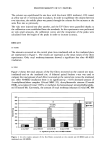
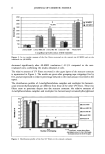
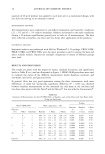
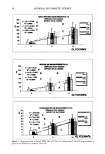
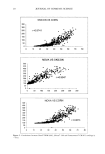
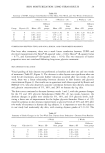
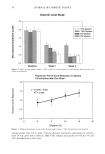
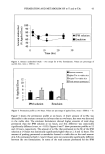
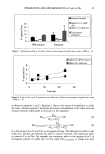
PERMEATION AND METABOLISM OF o•-T and o•-TAc 47 lO 9 8 7 6 5 4 3 2 1 o 6 12 24 Time (hours) ß alpha-T in viable skin [] Total amount of alpha-T permeated Figure 9. Permeation profile of o•-T with time. Values are percentage of applied dose, mean + SEM (n = 4). 9 • 2 6 12 24 Time (hours) ß Amount of alpha-T as metabolite from alpha-TAc IPM- solution [] Amount of alpha-T from alpha-T IPM- solution Figure 10. Amount of o•-T in viable skin either obtained as a metabolite from o•-TAc IPM solution or as the active from o•-T IPM solution. Values are percentage of applied dose, mean + SEM (n = 4). lite was confirmed to be o•-T, using spiking studies with known concentrations of o•-T. Metabolism occurred only in the viable skin, and no evidence for bioconversion was found in the SC. Evidence for the appearance of o•-T in viable skin samples was seen as early as two hours. Nabi eta/. (15) detected o•-T levels after application of o•-TAc formulations from as early as 60 minutes. Unlike the digestive tract, the skin lacks a liquid medium in which the hydrolysis of o•-TAc can occur. o•-TAc, being a lipid, is thought to diffuse across cell

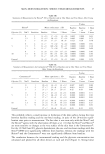
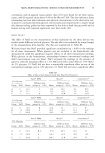
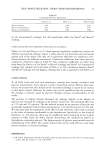
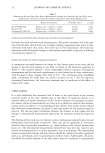
48 JOURNAL OF COSMETIC SCIENCE Table III Amount (pg) of tx-T as a Metabolite From tx-TAc in IPM Solution and as the Active From tx-T IPM solution Time (hr) Metabolite o•-T o•-T active 2 3.108 (+0.53) 2.468 (+0.43) 6 3.668 (+0.47) 1.612 (+0.40) 12 2.641 (+0.77) 3.317 (+0.60) 24 5.404 (+0.91) 2.543 (+0.30) Values are micrograms, mean _+ SEM (n = 4). membranes, enter cells, and be associated with other hydrophobic membranous struc- tures present in the cells such as the mitochondria and nuclear membranes. Hydrolysis may be catalyzed through intracellular esterases and/or lipases. At the end of 24 hours, however, there was no significant difference between the amount of active that permeated the viable skin from either the o•-TAc IPM solution (o•-TAc + o•-T in viable skin, 3.04 + 0.65) or o•-T IPM solution (o•-T in viable skin, 4.953 + 0.8). This is comprehensible if we take into account that the pH of the viable part of skin is about 7.4, and that the aromatic hydroxyl group in o•-T (pKa = 10) is not dissociated under these conditions. As o•-T is undissociated, the difference between o•-TAc and o•-T with regard to the physicochemical parameters, which determine transport, is negli- gible. Beijersbergen van Henegouwen et al. (25) found that o•-TAc and o•-T behaved similarly with regard to transport through the epidermis (i.e., penetration) and hori- zontal migration in the epidermis. In our results we also found that using a 1% o•-T formulation gives a higher concen- tration of o•-T in terms of micrograms of drug in viable skin than as a metabolite from a 5% o•-TAc formulation. Approximately 1.5% of o•-T yields the same viable skin concentration as 5% o•-TAc. This finding has important implications in the topical delivery of o•-T. To deliver larger amounts of o•-T in the skin, an o•-T formulation is more efficient than obtaining o•-T as a by-product of o•-TAc metabolism. However, this has to be weighed against stability problems with o•-T and the shelf life of the product. The most intriguing results of this study were that metabolism occurred as early as two hours on application of the ester and that the extent of bioconversion in relation to total skin concentrations reached a peak at about 6-12 hours. Longer time periods of up to 24 hours did not correspondingly increase the extent of metabolism. This could possibly be due to saturation of the metabolizing enzymes present in the skin, whose concen- trations are about two orders of magnitude lower than that in the liver. High prodrug concentration in skin may lead to enzyme saturation kinetics and, as a result, limited conversion of the o•-TAc into o•-T. Another possibility could be the waning effect of enzyme activity of the viable skin that may occur in in vitro studies at the end of 24 hours. This is a drawback of in vitro methods. In vivo, however, the extent of cutaneous metabolism is difficult to differentiate from systemic metabolism, and a better quanti- tative determination of cutaneous metabolism is still obtained in vitro. In a living skin equivalent model, maximum conversion of o•-TAc to o•-T was obtained at about six hours (15). Similar results were obtained by Kramer-Stickland and Liebier (26), who found maximum hydrolysis at three hours post-treatment and have suggested that hydrolysis in unirradiated mice may be a saturable phenomenon. They have alluded to
Purchased for the exclusive use of nofirst nolast (unknown)
From: SCC Media Library & Resource Center (library.scconline.org)