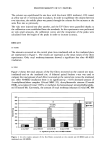
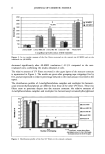
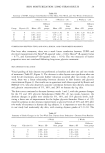
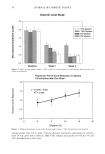
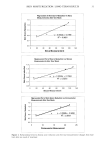
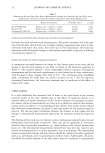
88 JOURNAL OF COSMETIC SCIENCE CONCLUSIONS Lotion with high glycerin helps restore the stratum corneum barrier and provides superior skin hydration. Clinical models that include observer scoring and bioengineering methods (e.g. DeSquame, TEWL and conductance) can predict of skin repair performance, especially when validated with in-home use clinically supervised evaluation studies. One can go beyond the maintenance and temporaw skin conditioning to actually prevent irritation and skin dryness. Product aesthetics and long lasting properties are critical to patient compliance. REFERENCES Loden, M., and Andersson, A-C., 'Effect of topically applied lipids on surfactant irritated skin' Brit. J. Dermatol. v. 134 p. 215-220 [1996]. Grove G. L. Skin surface hydration changes during a min- regression test as measured in vivo by electrical conductivity. Current Therapeutic Research v 52 p 556-561 [1992]. Highley D.R., et al: 'A stereomicroscopic method for the determination of moisturizing efficacy in humans.' J. Soc. Cosmet. Chem v. 27 p 351-363 [1976]. J.M. Lachapelle "Efficacy of Protective Creams and/or Gels" Current Problems in Dermatology 25 p 182-92 (1996)

j. Cosmet. Sci., 52, 89 (January/February 2001) Letter from the Editor TO OUR READERS: I have anxiously begun my three-year term as editor of the Journal of Cosmetic Science. My first task was to select an associate editor, and I have chosen Dr. Mindy Goldstein from Bath & Body Works. Dr. Goldstein has had experience on both the supplier and the marketed cosmetic product side, which I felt would be valuable to help broaden the journal's appeal to both sides. We plan to incorporate several reviews a year on relevant topics of interest to the readership. Dr. Brian Costello from Collaborative Research has agreed to prepare the first one, on antioxidants. We also plan to have special issues, probably at least one a year. Dr. Robert Lockhead has agreed to put together the first one for this year. My personal goal for the journal is to accelerate the review process and to respond to authors within ten weeks. Over the years we have had many complaints that the process is too slow, and many very good submissions have failed to be published due to the long lead time, as the authors have either changed companies or simply given up. The society continues to encourage submission of quality manuscripts from any area of cosmetic and OTC research that (1) gives new insights into a specific research area, (2) provides a review of special interest topics for the readership, and/or (3) provides a source for the readership to quickly become well-versed in a new area of cosmetic science for that reader. I hope you enjoy the journal during my term. Any suggestions for improve- ment are welcome and will be considered. Linda D. Rhein 89
Purchased for the exclusive use of nofirst nolast (unknown)
From: SCC Media Library & Resource Center (library.scconline.org)