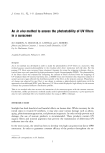
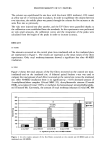
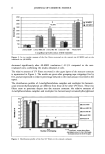
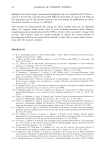
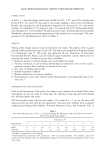
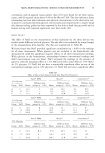
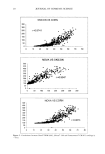
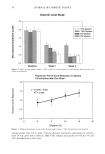
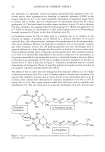
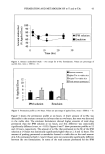
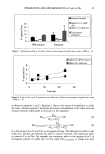
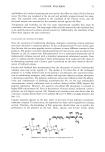
PERMEATION AND METABOLISM OF ot-T and ot-TAc 45 25- 20q 15• 0 IPM solution Emulsion ß Stratum Corneum [] alpha-TAc in viable skin [] alpha-T in viable skin [] Total amount permeated Figure 7. Permeation profile at 24 hours. Values are percentage of applied dose, mean + SEM (n = 4). • aipha-TAc IPM solution ß alpha-TAc emulsion 8 •6 •4 2 0 t , 0 10 20 30 Time (hrs) Figure 8. Total c•-TAc and c•-T permeated into viable skin. Values are percentage of applied dose, mean + SEM(n = 4). as shown in equations 1 and 2. Equation 1 refers to the extent of metabolism in viable skin only, whereas equation 2 represents the extent of metabolism in the viable skin and stratum corneum (represented as total skin in the equation). T A(vs) EX(vs) AT ATAc x 100 (1) (vs) + (vs) T A(vs) EX(TOTALSKiN ) AT AT^c ATAc X 100 (2) (vs) + (vs) + • •(•c) A is the amount of tx-T or tx-TAc as microgram of drug. The subscript (vs) refers to the viable skin, whereas the subscript (sc) refers to stratum corneum. The superscript refers to either tx-T or tx-TAc. For example, the numerator refers to the amount of tx-T in micrograms present in viable skin. In this study EX(vov^•SKiN ) is always less than

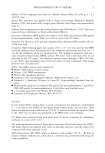
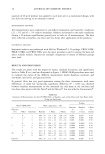
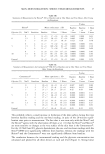
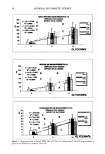
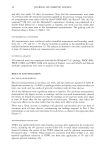
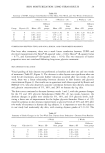
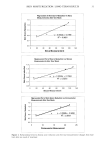
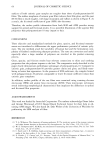
46 JOURNAL OF COSMETIC SCIENCE EX(,•s), as metabolite concentrations in the stratum corneum were below the limits of detection. Table II shows the extent of metabolism calculated using the two equations. Almost complete metabolism of the prodrug occurred in the viable skin at two hours. At six hours in cases of both the IPM solution and emulsion, the extent of metabolism was significantly lower in the viable skin compared to that at two hours. At the end of 24 hours the IPM solution had a significantly higher extent of metabolism in viable skin than the emulsion. When calculated for total skin using equation 3, the highest extent of metabolism occurred at six hours for the IPM solution and 12 hours for the emulsion. PERMEATION AND METABOLISM OF ct-T Viable skin samples for o•-T permeation and metabolism studies showed the presence of only the o•-T peak, and no metabolite peaks were detected by HPLC. Figure 9 shows the pattern of o•-T permeation with time from an IPM solution. Amounts in viable skin and total amount permeated (amount in viable skin + SC) are depicted in the figure. o•-T was detected in the SC and viable skin from an o•-T IPM solution as early as two hours by HPLC. The level of active in both tissues remained constant throughout the 24-hour study period. Figure 10 shows the amounts of (x-T from the two IPM solutions, as percentage of applied dose. The first bar represents the (x-T obtained as the metabolite from the (x-TAc IPM solution. The second bar represents this compound from an IPM solution contain- ing (x-T itself. The figure clearly shows that although detectable quantities of (x-T are obtained in the viable skin when o•-TAc is bioconverted to o•-T as early as two hours, a formulation containing pure drug o•-T is a more efficient delivery system. In terms of micrograms of drug, a somewhat larger amount of o•-T was obtained in the viable skin at 2, 6, and 24 hours as a metabolite of (x-TAc than from an (x-T solution, because the o•-TAc concentration used in the original formulation was 5%, whereas a 1% formula- tion of o•-T was used. This is depicted in Table III. DISCUSSION Metabolism of (x-TAc into the active antioxidant (x-T has been demonstrated for the first time in micro-Yucatan pig skin using in vitro experiments. The identity of the metabo- Table II Extent of Metabolism Expressed as Amount of Metabolite (l•g) to the Amount of o•-TAc Permeated in Viable Skin (l•g) and Total Skin (l•g) for the Two Formulations IPM solution Emulsion Time (hr) Viable skin Total skin Viable skin Total skin 2 100 (+_0) 26.65 (55.95) 100 (50) 24.50 (+_3.68) 6 85.386 (53.45) 52.82 (_+10.61) 62.565 (+_6.71) 34.24 (54.29) 12 65.518 (+_11.68) 25.20 (+_4.15) 76.489 (+_10.28) 42.02 (+_10.25) 24 80.223 (+_10.52) 26.69 (54.76) 44.070 (+_10.42) 20.21 (56.94) Values are percentages, mean + SEM (n = 4).
Purchased for the exclusive use of nofirst nolast (unknown)
From: SCC Media Library & Resource Center (library.scconline.org)