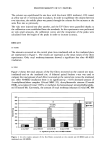
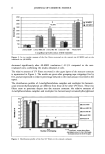
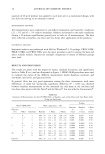
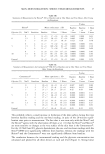
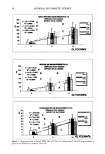
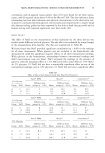
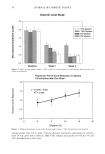
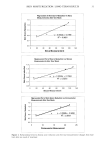
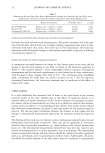
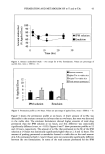
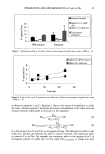
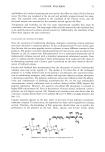
PHOTOSTABILITY OF UV FILTERS 9 sequential strippings. In the present study, the percentage of recovery (for all the filters) after 15 tape strippings is quite low: only 50% of the applied filters, because of the loss on the finger glove used for product application. Indeed, more than 45% of the UV filters were found on each finger glove. Therefore, including the amount of filter re- covered in the finger glove, almost all the applied filters were recovered. Marginean Lazar et at/. (15,16) worked also on the evaluation of the percutaneous pen- etration of UV filters. Using human skin samples set in Franz diffusion cells, they found that the penetration rate of UV filters was low and that no more than 5 % of the applied dose was recovered into the dermis after a 24-hour application period. Even if our experiment does not enable us to quantify the amount of filters that could have pen- etrated into the deeper part of the skin (because we only consider a portion of the stratum corneum), we can suppose, considering the total amount recovered (tapes + finger glove -- 95%), that this quantity is very low, as in the Marginean Lazar et at/. study. Moreover, when stripping was conducted after irradiation, they observed a gradual loss of filters, proportional to the UV-exposure dose. The present study was performed only after one dose exposure (40-MED) higher than the ones used in the Marginean Lazar et at/. study. However, both protocols showed a loss of octyl methoxycinnamate. The present Inethod enables us to compare the distribution profile of the UV filters in the stratum corneum according to the number of tape strippings, unlike the Marginean Lazar et at/. studies (8,15). Although the five filters were almost totally recovered without irradiation (taking into account the amount on the finger glove), 4-methylbenzilidene camphor and methylen bis benzotriazoyl tetramethylbutylphenol have different distri- bution profiles in the stratum corneum. Potard et al. (17) have used an HPLC analysis coupled with tape stripping for the quantification of various UV filters (including dioctylbutamido triazone and octyl methoxycinnamate) in various skin layers (stratum corneum, epidermis, dermis). This ex vivo study demonstrated that the quantity of filters collected by tape stripping decreased according to the number of strippings. In their experiment, the first six tape strippings contained more than 70% of the UV filters recovered in the stratum corneum. In the present experiment, after one hour of contact, more than 75% of the filters (for each filter) recovered were found in the first five adhesives. It means that the UV filters stay in the very upper layers of the stratum corneum, confirming other studies (16-19). CONCLUSION The Inethod combining tape stripping and HPLC assays used here gives results of the photochemical behavior of UV filters but also information on the distribution of these filters in the stratum corneum. The i, vivo results generated confirmed i, vitro results obtained on quartz plates. Moreover, this i, vivo Inethod is very close to what happens in real conditions of use, since the sunscreen is applied on the forearm and the interactions of the sunscreen agents with the stratum corneum can be studied. HPLC is more efficient than UV spectroscopy, as it enables one to detect photoproducts and offers quantitative results for the determination of the filters in strippings as opposed to qualitative data.

10 JOURNAL OF COSMETIC SCIENCE Methylen bis benzotriazoyl tetramethylbutylphenol, the new broadbrand UV filter ac- cepted in the EU has a distribution profile different from those of classical UV filters in the uppermost part of the stratum corneum that may change its performance as a filter (increased resistance to water, to rubbing?). This method has demonstrated that among the filters studied some are not degraded under UV exposure while others (such as octyl methoxycinnamate) show chemical transformation (new product detected by HPLC), which in this case doesn't change their activity. This method could be a good candidate to replace the current method of assessing photostability on quartz plates because it takes into account product interac- tions with the stratum corneum. REFERENCES (1) (2) (3) (4) (5) (6) (7) (8) (9) (10) (11) (12) (13) (14) (15) (16) H. U. Gonzenbach and G. H. Pittet, Photostability, a Must? (Roche Vitamins and Fine Chemicals, Neuilly-sur-Seine, France, 1998). J. Meijer and M. Loden, Stability analysis of three UV-filters using HPLC, J. Chromatogr., 18, 1821-1832 0995). J.E. Dinunzio and R. Rao Gadde, Determination of sunscreen compounds in topical sunscreen products,J. Chromatogr., 519, 177-124 (1990). S.C. Rastogi and G. H. Jensen, Identification of UV filters in sunscreen products by high-performance liquid chromatography-diode array detection, J. Chromatogr., 828, 311-316 (1998). V. Vanquerp, C. Rodriguez, C. Coiffard, L.J.M. Coiffard, and Y. De Roeck-Holtzhauer, High performance liquid chromatography method for the comparison of the photostability of five sunscreen agents,J. Chromatogr., 832, 273-277 (1999). R. Schwarzenbach and L. Bertschi, Determination of photostability in diluted solutions, IFSCC-- Between Congress Conference: Facts and Illusions in Cosmetics, Montreux, Switzerland, September 1995, poster 16, pp. 277-282. A. Deftandre and G. Lang, Photostability assessment of sunscreens: Benzylidene camphor and diben- zoylmethane derivatives, Int. J. Cosmet. Sci., 10, 53-62 (1988). G. Marginean Lazar, A. E. Fructus, A. Baillet, J. L. Bocquet, P. Thomas, and J.P. Marty, Sunscreens' photochemical behaviour: In vivo evaluation by the stripping method, Int. J. Cosmet. Sci., 19, 87-101 (1997). I. Beck, A. Deftandre, G. Lang, R. Arnaud, and J. Lemaire, Study of the photochemical behaviour of sunscreens--Benzylidene camphor and derivatives, Int. J. Cosmet. Sci., 3, 139 (1981). I. Beck, A. Deftandre, G. Lang, R. Arnaud, and J. Lemaire, Study of the photochemical behaviour of sunscreens--Benzylidene camphor and derivatives. II. Photosensitized isomerization by aromatic ke- tones and deactivation of the 8-methoxypsoralen triplet state, J. Photochem., 30, 215-227 (1985). P. Morliere, T. Sa. E. Melo, L. Dubertret, M. Giraud, and R. Santos, A study of the photochemical properties of some cinnamate sunscreens by steady state and laser flash photolysis, Photochem. Photobid., 36, 395-399 (1982). B.L. Diffey, R. P. Stokes, S. Forestier, C. Mazilier, A. Richard, and A. Rougier, Suncare product photostability: A key parameter for a more realistic in vitro efficacy evaluation. Part I. In vitro efficacy assessment. Protection of the Skin Against Ultraviolet Radiations, 137-142 0998). S. Forestier, C. Mazilier, A. Richard, and A. Rougier, Suncare product photostability: A key parameter for a more realistic in vitro efficacy evaluation. Part II. Chromatographic analysis, Protection of the Skin Agaimt Ultraviolet Radiatiom, 143-147 (1998). A. Karomeyer, W. Westerhof, P. A. Bolhuis, A.J. Ris, and E. A. Hische, The spectral stability of several sunscreening agents on stratum corneum sheets, Int. J. Cosmet. Sci., 9, 125-136 (1987). G. Marginean Lazar, A. Baillet, A. E. Fructus, S. Togkoz, C. M. Vincent, and J.P. Marty, Evaluation of percutaneous absorption and photochemical behaviour of sunscreens by stripping, Twentieth Congress of the International Federation of the Societies of Cosmetic Chemists, September 14-18, 1998, pp. 105-114. G. Marginean Lazar, A. Baillet, A.E. Fructus, J. Arnaud-Battandier, D. Ferrier, and J.P. Marty,
Purchased for the exclusive use of nofirst nolast (unknown)
From: SCC Media Library & Resource Center (library.scconline.org)