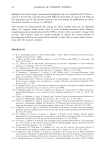
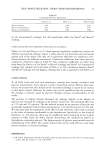
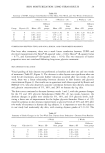
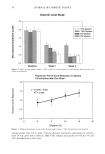
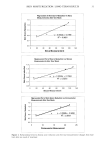
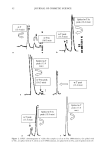
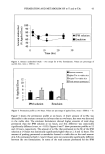
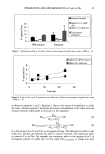
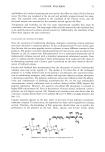
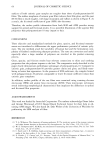
CATIONIC POLYMERS 63 HanoSoope Tapping Scan size 10.00 Setpoint 1.893 U Scan rate 1.001Hz HuNGer or saNpies 512 •.• uieu angle - light angle 2.000 pN/aiu 40,000 a0034.042 Figure 8. AFMtopographicimage ofguar(H/H). HanoScope Tapping •FM Scan size 10.00 uN Setpoint 1.950 U Scan rate 1.001Hz HuNGer oF saNpies 512 t•__ vieu angle "' .:... -• light angle . p f't' G 8 0 deg X 2,000 uN/diu 2 40,000 nN/div a0034,3?u Figure 9. AFMtopographic image of guar(L/H).

64 JOURNAL OF COSMETIC SCIENCE surfaces of both cationic guar samples are rougher than those of polyquaternium-10 films. The surface roughness of cationic guar films reduces their film gloss, and the guar (H/H) film is much rougher, with large mountains and valleys as shown in Figure 8. As a result, the frictional coefficient of guar (H/H) also decreases. Therefore, the surface profile information from both SEM and AFM provides strong support for optical and frictional results. It is a powerful illustration of the superior film properties that polyquaternium-10 may impart to hair. CONCLUSIONS Three objective and standardized methods for gloss, opacity, and frictional measure- ments are introduced to differentiate the upper performance potential of cationic poly- mers. The test methods avoid the variability of human hair and the formulation com- plexity of finished conditioning shampoo products. The tests are convenient and useful especially when a large number of polymers are involved in the product-screening process. Gloss, opacity, and friction results bear relevant connections to shine and combing properties that the polymer imparts to the hair. The comparative study described in this paper clearly demonstrates performance advantages of polyquaternium-10. Compared to cationic guar, polyquaternium-10 provides greater clarity and gloss, and likely trans- lating to better hair appearance. In the presence of SDS surfactant, the complex formed with polyquaternium-10 presents comparable or lower frictional coefficient values than cationic guar complexes. In addition, surface profiles of the cast films were examined using scanning electron microscopy (SEM) and atomic force microscopy (AFM). These microscopic techniques reveal interesting morphological characteristics that implicate the differences in optical and frictional film properties. ACKNOWLEDGMENTS This work was funded by Amerchel Corporation. The authors acknowledge Diana Leder and Alistair Westwood of UCC Bound Brook Technical Center for their help in ob- taining AFM images. We also thank Dr. Dale Weber of the University of Waterloo for performing the SEM analysis of films. REFERENCES (1) V. A. Wikerson, The chemistry of human epidermis. II. The isoelectric point of the stratum corneum and other human keratins as determined by electrophoresis. Soc. Bio/. Chem., 112, 329 (1935). (2) W. E. Thompson and C. M. Mills, An instrument for measuring the luster of hair, Proc. Sci. Sect. Toilet Goods Assoc., 15, 12-15 (1951). (3) C. Reich and C. R. Robbins, Light-scattering and shine measurements of human hair--A sensitive probe of the hair surface, J. Soc Cosmet. Chem., 44, 221-234 (1993). (4) A. Guiolet, J. C. Carson, and J. L. Leveque, "Study of the Optical Properties of Human Hair," in Proceedings of the 14th IFSCC Congress, Barcelona, Spain, 2, 1019-1038 (1986).
Purchased for the exclusive use of nofirst nolast (unknown)
From: SCC Media Library & Resource Center (library.scconline.org)