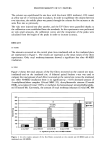
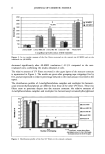
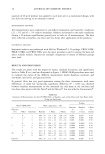
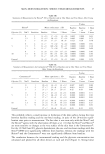
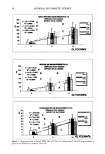
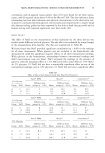
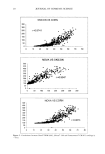
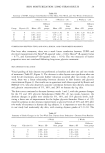
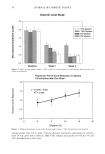
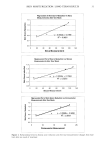
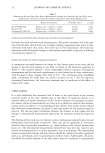
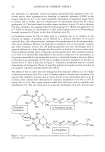
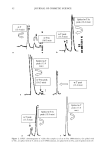
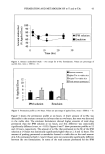
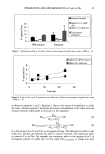
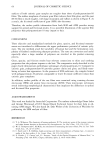
72 JOURNAL OF COSMETIC SCIENCE (see Fig. 3). This observation is not surprising since one would anticipate that most of the detergency process will occur during the foaming step. During the rinsing step polymer adsorption was found to be dependent on both the dilution ratio and rinsing speed (see Fig.4 and 1). FJ8. 2) L•q • Pdyqu•f•rnbm-10 subshn#•d for em:h • I S & S,I,• 0 S I,•d• Palyqmm!•-I 0 0 30 nn gO 120 150 190 210 TIm• (rolmlira) I• 3) F. ffect d nmnber and inlfa•y d P'6*mi• strdm on tb• subs•nti•tty d I•i•laalemiam-lO •O[''''l .... I .... I' ''' I'' '' I' '' '1"''S'' '' I' 0 10 20 30 40 •0 60 70 80 Number el •rok• lqL 4) Subslantivity dPoiyquatemimn-lO from I gram dmmpoo at diffemm water diutlem 0 500 1000 CONCLUSIONS It has been found that the adsorption of Polyquaternium-10 onto the hair surface is strongly dependent on the type of shampoo phase interacting with the hair surface. Thus, the different physical processes, such as, application, stroking, foaming and rinsing will have a strong effect on the overall performance of the conditioning polymer. REFERENCES 1) E.D. Goddard, "Polymer/Surfactant Interactions" in "Principles of Polymer Science and Technology" in Cosmetics and Personal Care", Eds. E.D. Goddard and J.V. Gruber. 2) R.T. Jones and C.A. Brown, 'q'he Behavior of Cationic Cellulose Derivatives Containing Fatty Quat Groups", Int. J. of Soc. Cosm. Sci. Vol. 10, pp-219-229 (1988) 3) E.D. Goddard and W.C. Harris, "An ESCA Study of the Substantivity of Conditioning Polymers on Hair Substrates", J. Soc. Cosm.Chem., 38, pp-233-246, July/August (1987)

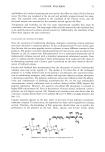
2000 ANNUAL SCIENTIFIC MEETING 73 FRONTIERS OF SCIENCE AWARD LECTURE SPONSORED BY COSMETICS AND TOILETRIES© INTERFACING CHEMISTRY• BIOLOGY AND ELECTRONICS Itamar Willner, Ph.D. Institute of Chemistry, The Hebrew University of Jerusalem, Jerusalem 91904, Israel Bioelectronics is a rapidly progressing, interdisciplinary, research topic that involves the integration of biomaterials such as enzymes, antigen/antibodies, DNA, etc., with electronic transducers such as electrodes, semiconductors, piezoelectric crystals or field-effect-transistors. The resulting bioelectronic devices are aimed to electronically transduce biological events, such as catalysis or recognition, occurring on the electronic elements. Bioelectronic devices can be used as biosensors, biofuel cell elements, or bioelectrocatalytic electrodes) Bioelectronics The electrical communication between the biomaterials and the electronic support is an essential element in the tailoring of bioelectronic devices. This is accomplished by the nanoscale engineering of biomaterials on electronic transducers. The assembly of enzyme-electrodes, antigert-antibody electrodes and DNA-sensing electrodes as a means to tailor bioelectronic devices is addressed. The structural alignment oftbe enzyme glucose oxidase, GOx, on an electrode by the surface-reconstitution of the respective apo-protein on an electron relay-FAD cofactor monolayer associated with the conductive support yields an electrically-contacted glucose sensing enzyme-electrode 2. Mediated electron transfer from the enzyme active-site to the electrode activates the bioelectrocatalytic functions of the enzyme. A major future goal in biosensor technology involves the amplification of the sensing events. This is particularly important for the development of immunosensors 3 or DNA sensors 4. Methods to accomplish the amplified electronic transduction of immunological affinity interactions 3 or DNA-recognition events 4-6 include the use of enzyme conjugates that precipitate an insoluble product on the transducer TM, the use of labeled liposomes 4's, the application of labeled semiconductor 7 nanoparticles, and the electronic transduction of polymerase-induced reactions on surfaces 8. Electronic transduction means for the biosensing event include electrochemical, photoelectrochemical and microgravimetric quartz-crystal-microbalance measurements. Optobioelectronics The photonic activation of biomaterials associated with electronic transducers is the basis for the development of optobioelectronic systems or devices 9'•ø. Different approaches to reversibly photoswitch the biological functions of enzymes TM, receptor proteins •2 or DNA •3 were developed. These include the covalent attachment of photoisomerizable groups to the biomaterials j4'•s or the iramobilization of the biomaterials in photosensitive matrices •6 that stimulate by light the biological functions of the encapsulated material. The activity of the hydrolytic enzyme papain is photoregulated to "ON" and "OFF" states by tethering to the protein photoisomerizable azobenzene units. The activity of the enzyme ct-chymotrypsin is controlled by light by its immobilization in different photoisomerizable polymer membranes. The assembly of photoswitchable redox-enzymes on electrodes •4'•s, or the integration of redox-proteins with photo-command interfaces •6 associated with conductive supports, yields optobioelectronic systems that result in the amplified amperometric transduction of recorded photonic information. The enzyme glucose oxidase was reconstituted with a nitrospiropyran-FAD cofactor, and the resulting photoisomerizable biocatalyst was assembled as an electrode on a conductive support. The resulting photoisomerizable enzyme-electrode reveals the reversible "ON" and "OFF" amperometric transduction of recorded photonic signals. Alternatively, a photoisomerizable mixed monolayer consisting of nitrospiropyran and pyridine units, acts as a command interface for controlling the electrical contact of cytochrome c with the electrode support. The cyclic and reversible photonic activation of the electrical contact between cytochrome c and the electrode enables the secondary light-controlled "ON"-"OFF" activation/deactivation of enzymes. Similarly, the interaction of antibodies with photoisomerizable antigens enables the light-switchable controlled association and dissociation of the antigen-antibody complex •7. A dinitrospiropyran monolayer assembled on solid supports enables the reversible binding of the anti-dinitrophenyl antibody, DNP-Ab, to the photoisomerizable interface. The DNP-Ab binds to dinitrospiropyran
Purchased for the exclusive use of nofirst nolast (unknown)
From: SCC Media Library & Resource Center (library.scconline.org)