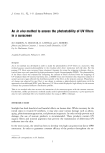
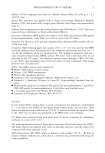
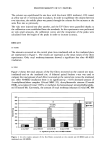
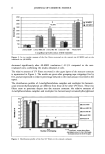
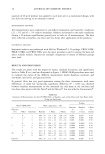
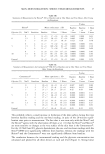
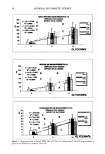
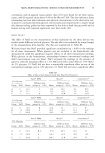
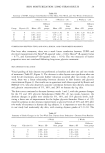
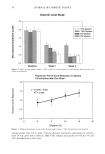
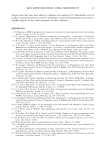
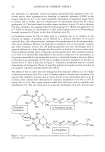
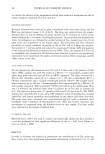
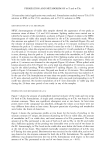
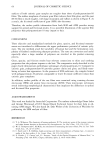
CATIONIC POLYMERS 59 2.0 1.6 0.8 [] polymer ß 1% gel 0.4 0.0 PQ10 PQ10 PQ10 PQ10 Guar Guar (L/I-I) (M/H)(M/M)(M/L) (H/H) (L/I-I) Figure 3. Film opacity of cationic polymers and coacervate gels. control The dulling effect of cationic guar materials on hair has also been reportedly observed in finished conditioning shampoos. COEFFICIENT OF KINETIC FRICTION It has been shown that frictional characteristics of combing materials are of minor importance in hair combing (17). The implication of this result is that hair-on-hair friction is more significant to combing ease than hair-on-comb friction. Therefore, the kinetic friction of polymer on polymer measured in this study can be established to predict the resistance of polymer-coated hairs to sliding or combing. The friction char- acteristics of cationic polymer films can be related to the lubricity of polymer-treated hair. The coefficient of kinetic friction for polymer over polymer at ten-day drying is plotted in Figure 4. Guar (H/H) slides more easily than polyquaternium-10 and guar (L/H) films. The polyquaternium-10 films yielded a higher frictional coefficient than guar (H/H) but similar to guar (L/H). The results suggest that guar (H/H) improves the slip property of treated skin or hair surfaces more effectively. Lower friction of guar (H/H) is attributable to rougher film because friction decreases with increasing film roughness (18). Because rough films in a friction test only contact at high points, lower friction results from a smaller contact area. The frictional properties of the 1% coacervate gels are also included in Figure 4. Interestingly, the incorporation of SDS reduces the friction of polyquaternium-10 samples significantly. The coacervate gels of polyquaternium-10 samples present less friction than the neat polymers. This indicates that SDS lubricates the polymer film by

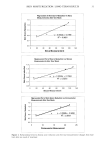
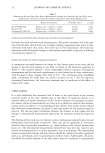
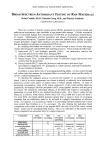
60 JOURNAL OF COSMETIC SCIENCE 0.30 ß - 0.20 = 0.10 .[3 polymer ß 1% gel 0.00 PQlO PQlO PQlO PQlO Guar Guar (L/H) (M/H) (M/M) (M/L) (H/H) (L/H) Figure 4. Coefficient of kinetic friction of cationic polymers and coacervate gels. possibly lowering surface tension. Figure 5 shows that the slip property of guar (L/H) is compromised although it offers better film clarity and gloss compared to guar (H/H). Also, in the presence of SDS, polyquaternium-10 exhibits comparable or even lower friction than the guar (H/H) coacervate. All in all, polyquaternium-10 renders high film gloss and clarity, as well as beneficial lubricity when delivered from surfactant systems. SURFACE PROFILE OF POLYMER FILMS The SEM micrographs of cationic polymer films are presented in Figure 5 (a, b, c), with the measurement bar representing 1 pro. The bright spots (domains) reflect surface textures of the films. The number and size of the "domains" in the SEM images represent the macro effect of surface roughness. Fewer such domains are present in the polyquater- nium-10 (H/H), signifying a smooth, shiny film. Guar (H/H) displays significantly larger domains that reduce gloss of the polymer film. The domains are smaller in size and more uniformly distributed in guar (L/H) than in guar (H/H). This accounts for the gloss and friction increase of this guar sample. However, tremendous film texture is still responsible for its lower gloss compared to polyquaternium-10 samples. The film difference between the two classes of cationic polymers was also confirmed by atomic force microscopy (AFM). The topographic AFM images illustrate the three- dimensional surface roughness. The surface topology of two medium-molecular-weight polyquaternium-10 samples with high and low charges are shown in Figure 6 and 7. Both polymer drawdown films appear relatively smooth, supportive of their high gloss values. Figure 8 and 9 are the AFM topographic images of two cationic guar films. The
Purchased for the exclusive use of nofirst nolast (unknown)
From: SCC Media Library & Resource Center (library.scconline.org)