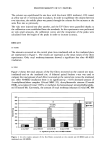
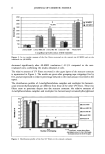
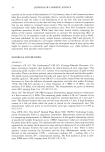
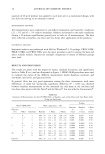
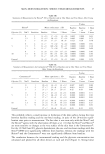
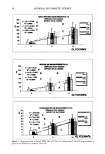
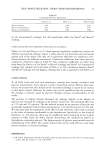
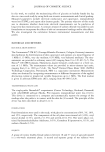
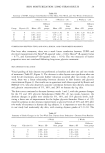
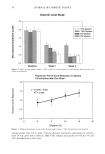
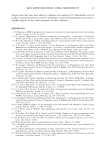
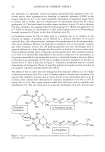
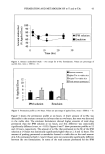
PHOTOSTABILITY OF UV FILTERS 5 The column was equilibrated for one hour with the eluent (80% methanol, 20% water) at a flow rate of 1.5 ml/min prior to analysis. In order to equilibrate the column between two injections, the mobile phase was passed through the column for five minutes at the same flow rate as previously. The vials were injected one after another, and the UV filters were quantified thanks to the calibration curve established from the standards. As the experiments were performed on very small amounts, the calibration curves and the integration of the peaks were calculated from the height of the peaks in order to increase accuracy. RESULTS IN VITRO The amounts recovered on the control plate (non-irradiated) and on the irradiated plate are represented in Figure 1. The results are expressed as the mean values of the three experiments. Only octyl methoxycinnamate showed a significant loss after 40-MED irradiation. IN VIVO Figure 2 shows the total amount of the five filters recovered on the control site (non- irradiated) and on the irradiated site. A bilateral paired Student t-test was used to compare the total amount of each filter recovered on the control site versus the irradiated one. After 40-MED irradiation there is no significant (p 0.05) decreased amount of 4-methylbenzilidene camphor (Uvinul MBC 95), dioctylbutamido triazone (Uvasorb HEB), octocrylene (Uvinul 539T), or methylen bis benzotriazoyl tetramethylbutylphe- nol (Tinosorb M). Conversely, the amount of octyl methoxycinnamate (Uvinul MC 80) 900 8( 7( 6( 5( 3( 2( 1( S . -41,10% Uvinu1539T Uvinul MBC 95 Uvinul MC 80 Uvasorb HEB Tinosorb M S. significant (p0.05) versus 0 MED irradiation I I•0 MED I a41 O•ED j Figure 1. In vitro results: amount of the five filters recovered on the control site (0 MED) and on the irradiated site (40 MED).

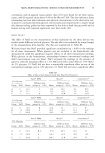
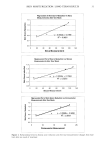
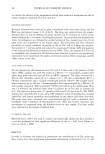
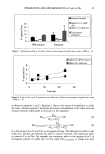
6 JOURNAL OF COSMETIC SCIENCE 450 400 350 3OO ß •- 250 • 200 •50 •00 50 0 -42'30% __ , _ -- Uvinu1539T UvinulMBC95 UvinulMC80 Uvasorb HEB Tinosorb M $ :significant (p0,05)versus 0 MED irradiation [] 0 MED [] 40 MED Figure 2. In vivo results: amount of the five filters recovered on the control site (0 MED) and on the irradiated site (40 MED). decreased significantly after 40-MED irradiation (-42.3% compared to the non- irradiated site), confirming the results obtained in vitro. The relative amount of UV filters recovered in the upper layers of the stratum corneum is represented in Figure 3. The results are given after grouping tape strippings five by five, and are expressed in relative percentage (related to the total amount recovered in the tapes). The distribution profiles of 4-methylbenzilidene camphor and methylen bis benzotri- azoyl tetramethylbutylphenol are different from those of the other UV filters. These two filters seem to penetrate deeper into the stratum corneum: the relative amounts of 4-methylbenzilidene camphor and methylen bis benzotriazoyl tetramethylbutylphenol 90 80 70 60 50 40 30 20 10 0 1-5 • ...... ,:...,.....'...%,.:i :::::!:::::i:::ii:: • ..... .: 55555 ?--':'-:"-':g• i::::i:::::::!? , ....... ....... ..= 6-10 Number of stripping El Uvinu1539T BUvinul MBC 95 rlUvinul MC 80 IUvasorb HEB -E3Tinosorb M 11-18 significant versus others filters -decreased amount in the 5 first tapes, -increased amount in the 6-10 tapes Figure 3. Distribution profile of the five UV filters in the stratum corneum.
Purchased for the exclusive use of nofirst nolast (unknown)
From: SCC Media Library & Resource Center (library.scconline.org)