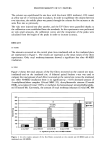
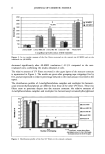
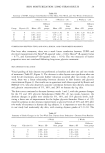
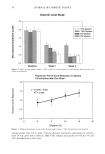
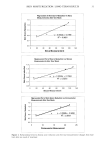
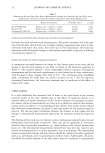
80 JOURNAL OF COSMETIC SCIENCE were conducted in a under controlled temperature and humility conditions (22+2 øC and 45+5% relative humidity) after the subjects had equilibrated to room conditions for at least 30 minutes. RESULTS Effects of NaCI and glycerin on electrical measurements after a single application are summarized in table 2. Interestingly NaCI reduced the measurements slightly for a three instruments in the absence of glycerin but increased the readings in the presence of glycerin. In general the maximum salt effects was seen at 1.5% NaCI and the effect was somewhat less at 3.0%. Table 2: Effect of salt at each glycerin level one-hour post-treatment 0% GLYCERIN NOVA DPM SKICON CORNEOMETER I [DIFFERNENT DIFFERENT FROM DIFFERENT FROM I FROM GROUPS GROUP NACL MEANS GROUPS (P0.05) MEANS GROUPS (P0 05) MEANS I(P0 05) A 0 31.0 C 23.9 B, C 8 4 B, C B 15 217 132 A,C 55 A,C I C i 3 113 A 25 A,B 16 A,B 5% GLYCERIN NOVA DPM I SKICON CORNEOMETER • MEANS [ I ] I DIFFERENT FROM ] DIFFERENT FROM I ]DIFFERENT FROM GROUP I NACL GROUPS (P0 05) MEANS [ GROUPS (P0 05) MEANS GROUPS (P0.05) A __ 0 99.1 B 61.8 B 17 7 B B 1 5 156.0 A 96.2 A, C 21 4 A, C C I 3 116 0 69.9 B 14.9 B 10% GLYCERIN ] NOVA DPM SKICON I CORNEOMETER ] , ] I DIFFERENT FROM DIFFERENT FROM DIFFERENT FROM GROUP ] NACL MEANS GROUPS (P0 05) MEANS I GROUPS (P0 05) MEANS GROUPS (P0.05) I•C 0 131 2 B, C 97 8 B, C 22.4 B 1 •-- - 239.0 A 136.4 A, C 29 9 A, C 3 213.0 A 168 2 A, B 24.6 B The instrumental readings were linearly correlated to glycerin concentration at each salt concentration and with each instrument with correlation coefficients ranging from 0.94 to greater than 0.999. In the second phase of the study a separate single application test was followed by a two-week test w•th formulations containing 1.5% NaCI and levels of glycerin from 0 to 15%. In the two-week test the legs were graded for dryness on a 4-point scale. Results are shown in table 3. Glycerin proved to be an effective skin conditioning agent as reported previously(10). Table 3: Changes in readings in the one hour and two week tests and changes in grade in the two-week test. Glycerin C-Meter C-Meter NOVA NOVA Skicon Skicon Grade Level lhr 1 week 1 hr 1 week 1 Hr 1 week Reduction 0 3 8 37 20 12 22 0.88 5 16 15 148 51 85 61 0.95 10 25 19 237 97 t83 107 1 28 15 27 23 267 118 250 130 1.40 _ There was correlation between the change in the instrument reading at in the one-hour test and the change in grade in the two-week test with all three instruments. Regression equations are given in table 4 along with p-values for the slope. We do not consider the •pparent difference in the predictive power of

2000 ANNUAL SCIENTIFIC MEETING 81 the instruments based on the p-values to be significant. It may be the result of the small base size (10) of the one-hour test. Table 4: Correlation between the one-hour change in reading and the two-week improvement in skin grade. Device Regression equation of Score R-squared P-value Reduction (SR) on 1 hour reading NOVA DPM SR = 0.0025X + 0.69 0.917 0.042 Skicon 200 SR = 0.0024X + 0.81 0.969 0.015 Corneometer CM 825 SR = 0.0209X + 0.76 0.8427 0.082 There was also good correlation between the instrumental readings taken 16 hours post treatment and the actual skin grades with all three instruments (data not shown) CONCLUSIONS Salt does effect the electrical readings after application of moistunzers to the skin but the there is still a good correlation between glycerin concentration and the electrical readings with all three instruments tested Results obtained with 10 panelists, 1 hour after treatment were predictive of moisturizing efficacy in the two week, twenty panelist test with all three instruments.. Our results show that single application tests can be predictive of longer-term results with humectant based molstunzers and that electrical measurements correlate well with skin grades. REFERENCES 1 E. Berardesca, EEMCO guidance for the assessment of stratum corneum hydrat•on electncal methods, Skin Res Technol, 3, 126-132 (1997). 2 H Tagaml, "Measurement of electrical conductance and impedance," in Handbook of non-invasive methods and the skin, J Serup and G Jemec, Eds. (CRC Press Inc, Boca Raton, 1995), pp 159-164 3 M Loden, B•ophys•cal methods of providing objective documentation of the effects of mo•stur•z•ng creams, Skin Res Technol, 1, 101-108 (1995). 4 A O Barel, P. Claws and B. Gabard, "In v•vo evaluabon of the hydratlon state of the skin measurements and methods for claim support," m Cosmet/cs Controlled Efficacy Studies and Regulation, P Eisner, H F Merk, and H I Ma•bach, Eds. (Spnnger-Verlag, Berlin, 1999), pp 57-80 5 J W. Fluhr, M Gloor, S. Lazzenm, P Kleesz, R Grieshaber and E Berardesca, Comparative study of five instruments measuring stratum corneum hydration (Corneometer CM 820 and CM 825, Skicon 200, Nova DPM 9003, DermLab) Part I In wtro, Skin Res. and Technol., 5, 161-170 (1999) 6 P Clarys, A. O Barel and B Gabard, Nonqnvas•ve electncal measurements for the evaluation of the hydrabon state of the skin comparison between three conventional instruments- the Corneometer, the Sbcon and the Nova DPM, Skin Res Technol, 5, 14-20 (1999) 7 W Courage, "Hardware and measuring principle corneometer," In Bloengineenng of the Skin' Water and the Stratum Corneum, P Eisner, E Berardesca, and H I Ma•bach, Eds (CRC Press Inc, Boca Raton, 1994), pp 171-175 8. B Gabard and P Treffel, "Hardware and measunng pnnc•ple the NOVA DPM 9003," •n Bioengineering of the Skin Water and the Stratum Corneum, E B P Eisner, H.I. Maibach, Editor (CRC Press, Inc, Boca Raton, 1994), pp 177-195. 9 H TagamL "Hardware and measuring pnnc•ple sbn conductance," •n B/oengineenng of the Skin Water and the Stratum Corneum, P Eisner, E Berardesca, and H I Ma•bach, Eds. (CRC Press Inc, Boca Raton, 1994), pp 197-203 10. D L Bissett and J. F McBnde, Sbn conditioning w•th glyceroh J. Soc Cosmet Chem, 35(11), 345-350 (1984).
Purchased for the exclusive use of nofirst nolast (unknown)
From: SCC Media Library & Resource Center (library.scconline.org)