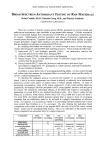
2000 ANNUAL SCIENTIFIC MEETING 73 FRONTIERS OF SCIENCE AWARD LECTURE SPONSORED BY COSMETICS AND TOILETRIES© INTERFACING CHEMISTRY• BIOLOGY AND ELECTRONICS Itamar Willner, Ph.D. Institute of Chemistry, The Hebrew University of Jerusalem, Jerusalem 91904, Israel Bioelectronics is a rapidly progressing, interdisciplinary, research topic that involves the integration of biomaterials such as enzymes, antigen/antibodies, DNA, etc., with electronic transducers such as electrodes, semiconductors, piezoelectric crystals or field-effect-transistors. The resulting bioelectronic devices are aimed to electronically transduce biological events, such as catalysis or recognition, occurring on the electronic elements. Bioelectronic devices can be used as biosensors, biofuel cell elements, or bioelectrocatalytic electrodes) Bioelectronics The electrical communication between the biomaterials and the electronic support is an essential element in the tailoring of bioelectronic devices. This is accomplished by the nanoscale engineering of biomaterials on electronic transducers. The assembly of enzyme-electrodes, antigert-antibody electrodes and DNA-sensing electrodes as a means to tailor bioelectronic devices is addressed. The structural alignment oftbe enzyme glucose oxidase, GOx, on an electrode by the surface-reconstitution of the respective apo-protein on an electron relay-FAD cofactor monolayer associated with the conductive support yields an electrically-contacted glucose sensing enzyme-electrode 2. Mediated electron transfer from the enzyme active-site to the electrode activates the bioelectrocatalytic functions of the enzyme. A major future goal in biosensor technology involves the amplification of the sensing events. This is particularly important for the development of immunosensors 3 or DNA sensors 4. Methods to accomplish the amplified electronic transduction of immunological affinity interactions 3 or DNA-recognition events 4-6 include the use of enzyme conjugates that precipitate an insoluble product on the transducer TM, the use of labeled liposomes 4's, the application of labeled semiconductor 7 nanoparticles, and the electronic transduction of polymerase-induced reactions on surfaces 8. Electronic transduction means for the biosensing event include electrochemical, photoelectrochemical and microgravimetric quartz-crystal-microbalance measurements. Optobioelectronics The photonic activation of biomaterials associated with electronic transducers is the basis for the development of optobioelectronic systems or devices 9'•ø. Different approaches to reversibly photoswitch the biological functions of enzymes TM, receptor proteins •2 or DNA •3 were developed. These include the covalent attachment of photoisomerizable groups to the biomaterials j4'•s or the iramobilization of the biomaterials in photosensitive matrices •6 that stimulate by light the biological functions of the encapsulated material. The activity of the hydrolytic enzyme papain is photoregulated to "ON" and "OFF" states by tethering to the protein photoisomerizable azobenzene units. The activity of the enzyme ct-chymotrypsin is controlled by light by its immobilization in different photoisomerizable polymer membranes. The assembly of photoswitchable redox-enzymes on electrodes •4'•s, or the integration of redox-proteins with photo-command interfaces •6 associated with conductive supports, yields optobioelectronic systems that result in the amplified amperometric transduction of recorded photonic information. The enzyme glucose oxidase was reconstituted with a nitrospiropyran-FAD cofactor, and the resulting photoisomerizable biocatalyst was assembled as an electrode on a conductive support. The resulting photoisomerizable enzyme-electrode reveals the reversible "ON" and "OFF" amperometric transduction of recorded photonic signals. Alternatively, a photoisomerizable mixed monolayer consisting of nitrospiropyran and pyridine units, acts as a command interface for controlling the electrical contact of cytochrome c with the electrode support. The cyclic and reversible photonic activation of the electrical contact between cytochrome c and the electrode enables the secondary light-controlled "ON"-"OFF" activation/deactivation of enzymes. Similarly, the interaction of antibodies with photoisomerizable antigens enables the light-switchable controlled association and dissociation of the antigen-antibody complex •7. A dinitrospiropyran monolayer assembled on solid supports enables the reversible binding of the anti-dinitrophenyl antibody, DNP-Ab, to the photoisomerizable interface. The DNP-Ab binds to dinitrospiropyran

74 JOURNAL OF COSMETIC SCIENCE monolayer states, whereas it is dissociated from the monolayer upon its photoisomerization to the protonated dinitrospiropyran configuration. Different potential applications of photoswitchable biomaterials include the development of light-targeted therapeutic materials, the design of information storage and processing systems, the assembly of biological computers and the design of reversible sensor devices. The rapid advances in the area of bioelectronics and optobioelectronics reveal a variety of potential practical applications. An interdisciplinary effort of chemists, material scientists, biologists and electronic engineers is anticipated to pave the ground for the commercialization of the scientific accomplishments in these fields in the near future. References 1. I. Willnet and E. Katz, Angew. Chem., lnt. Ed. 39, 1180-1218 (2000). 2. (a) A. Riklin, E. Katz, I. Willnet, A. Stocker and A.F. Backmann, Nature, 376, 672-675 (1995). (b) I. Willner, V. Heleg-Shabtai, R. Blonder, E. Katz, G. Tao, A.F. Backmann and A. Heller, d. Am. Chem. Soc., 118, 10321-10322 (1996). 3. A. Bardea, E. Katz and I. Willner, Electroanalysis, in press. 4. F. Patolsky, E. Katz, A. Bardea and I. Willnet. Langmuir, 15, 3703-3706 (1999). 5. F. Patolsky, A. Lichtenstein and I. Willner, d. ,4m. Chem. Soc., 122, 418-419 (2000). 6. F. Patolsky, K.T. Ranjit, A. Lichtenstein and I. Willner, Chem. Commun., 1025-1026 (2000). 7. F. Patolsky, A. Lichtenstein and I. Willner, in preparation. 8. I. Willner, F. Patolsky and A. Lichtenstein, in preparation. 9. I. Willner, Acc. Chem. Res., 30, 347-356 (1997). 10. I. Willner and S. Rubin, Angew. Chem., lnr Ed. Engl., 35, 367-385 (1996). 11. I. Willner, S. Rubin and A. Riklin, d. Am. Chem. Soc., 113, 3321-3325 (1991). 12. (a) I. Willnet, S. Rubin, J. Wonner, F. Effenberger and P. B•iuerle, •. Am. Chem. Soc., 114, 3150-3151 (1992). (b) I. Willner, S. Rubin and Y. Cohen, d. Am. Chem. Soc., 115, 4937-4938 (1993). 13. H. Asanum, T. Ito, T. Yoshida, X. Liang and M. Komiyama, Angew. Chem. Int. Ed. 38, 2392-2395 (1999). 14. M. Lion-Dagan, E. Katz and I. Willner, •. Am. Chem. Soc., 116, 7913-7914 (1994). 15. I. Willner, R. Blonder, E. Katz, A. Stocker and A.F. Backmann. d. Am. Chem. Soc., 118, 5310-5311 (1996). 16. M. Lion-Dagan, E. Katz and I. Willner, d. Chem. Soc., Chem. Commun., 2741-2742 (1994). 17. R. Blonder, S. Levi, G. Tao, I. Ben-Dov and I. Willner, d. Am. Chem. Soc., 119, 10467-10478 (1997).
Purchased for the exclusive use of nofirst nolast (unknown)
From: SCC Media Library & Resource Center (library.scconline.org)