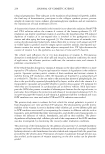
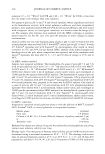
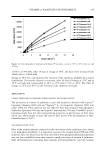
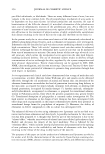
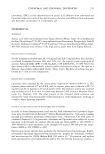
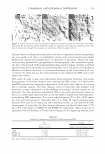
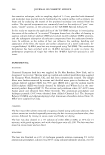
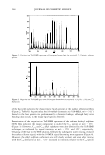
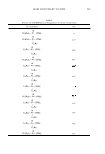
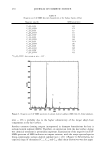
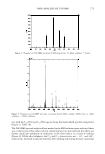
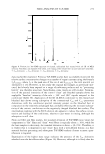
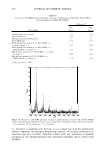
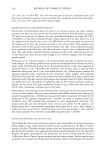
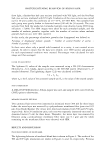
HAIR ANALYSIS BY ToF-SIMS 267 minutes, at 20°C and with a hair:liquor ratio of 1 :25. The hair was gently agitated in the bleach bath. After bleaching, the hair was rinsed in excess water and air dried. INCROQUAT BEHENYL 18-MEA (IB 18-MEA) The SLES-cleaned hair and bleached hair were treated with a 2% IB 18-MEA solution at 30°C for five minutes at a hair:liquor ratio of 1:50. The hair samples were then rinsed in water and air dried. This procedure was repeated twice and the samples were finally air dried. Another set of IB 18-MEA samples was prepared as above but with additional pre-cleaning in a 2% SLES solution, over five minutes, followed by rinsing in excess water prior to the IB 18-MEA treatments. ALKYLAMIDOPROPYL ETHYL DIMONIUM ETHOSULFATE (I 18-MEA 40) The related I 18-MEA 40, derived from 18-MEA, treated samples were similarly pre pared as described for the IB-18-MEA samples. ToF-SIMS ANALYSIS The ToF-SIMS spectra were obtained under static conditions using a PHI 7000 instru ment with a reflectron analyzer, a Cs+ ion source (8 KeV, pulse length 50 ns), and a pulsed electron flood source (50-70 eV) for charge compensation. The operating pressure was less than 5.33 µPa (4 x 10-s torr). For each sample analysis, a total primary-ion dose of fewer than 1 x 10 12 ions cm-2 was used, which lies well below the threshold level of 1x10 13 ions cm -2 for static SIMS (10). The hair fibers were mounted by stretching them over a sample stub and then fixing them by using a standard ring-clamping arrange ment. Both positive and negative ion spectra were acquired from an area of 250 µm x 250 µm in the mass range of m/z = 0-1000. The data presented is based on duplicate/ triplicate measurements, with the fibers analyzed at the same position along the fiber shaft. ToF-SIMS analyses of the surfactant/conditioner films were obtained by air drying the liquid sample on clean aluminium foil and analyzing as previously described. RESULTS AND DISCUSSION ToF-SIMS analysis of the "as received" European brown hair revealed significant surface contamination (Figures 1, 2). In the positive-ion ToF-SIMS spectrum there was clearly evident a series of cationic quaternary ammonium conditioner species present with the general formula (R) 2 N+ (CH3)2 (Table I). In addition, silicone contaminants at m/z = 133 + , 14r, 2or, 221 +, and 281 + were also detected in the lower mass range. Similarly, the negative-ion ToF-SIMS spectrum indicated the presence of silicone (m/z = 223 -), with additional anionic alkyl sulphate surfactants detected at m/z = 265 -, 293 -, and 321 -, which can be assigned to the C 12 , C 14 , and C 16 derivatives, respectively (Figure 2). The presence of these additional surface species is obviously of concern since many fundamental studies may be adversely affected by these normally undetected contami nants. Therefore, it may be advisable that the hair be pre-cleaned and examined by ToF-SIMS prior to use. Nevertheless, in this study the negative-ion ToF-SIMS spectrum

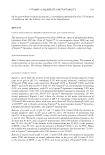
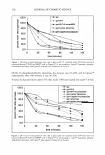
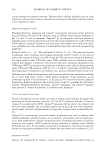
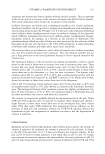
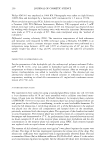
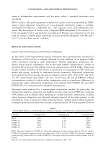
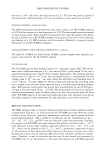
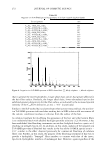
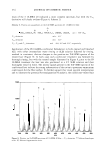
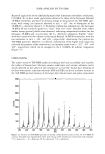
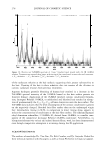
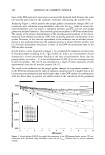
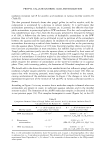
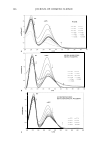
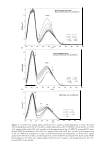
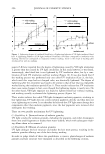
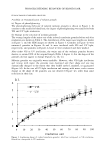
268 JOURNAL OF COSMETIC SCIENCE 600-1----___JL_ __ ----'------'-----......_--___._------r 500 400 200 550 600 Figure 1. Positive-ion ToF-SIMS spectrum of European brown hair (as received). *, Cationic softener species. 700 600 500 § 400 300 □ 200 100 m � m m � m � � � � Figure 2. Negative-ion ToF-SIMS spectrum of European brown hair (as received). *, Lipids. +, Silicone. D, Surfactant. of the hair still indicates the characteristic lipids present at the surface of keratin fibers (Figure 2, Table II). In particular, the 18-methyl eicosanoic acid (18-MEA, m/z = 341 -) bound to the hair protein via predominantly a thioester linkage, although fatty ester bonding also occurs, is the major lipid species detected. Examination of the negative-ion ToF-SIMS spectrum of the sodium dodecyl sulphate (SDS) film indicates the major component is indeed the C 12 species at m/z = 265- (Figure 3). However, C 14 and C 1 6 alkyl sulphates were also detected by the ToF-SIMS technique, as indicated by signal intensity at m/z = 29r and 321 -, respectively. Cleaning of the hair in the SDS solution, followed by subsequent water rinsing, reduced the surface silicone signal, with the 18-MEA signal becoming more apparent (Figure 4). However, the alkyl sulphate surfactants are still clearly evident and even after rinsing with the C1 6 derivative at m/z = 321 - increased in intensity relative to the C 12 species
Purchased for the exclusive use of nofirst nolast (unknown)
From: SCC Media Library & Resource Center (library.scconline.org)