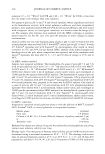
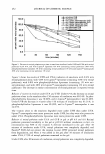
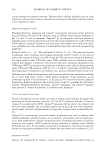
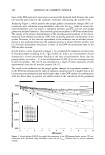
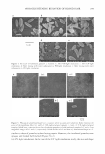
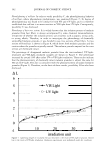
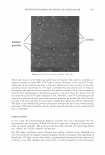
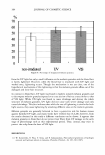
PHOTOLIGHTENING BEHAVIOR OF BLOND HAIR 295 from light, a further four had cross sections irradiated with VIS light, and the final four had cross sections irradiated with UV light. Irradiation of the cross sections was carried out for 20 units under dry conditions (at 25 ° -35 ° C, 20-30% RH). Two samples from each group were gently shaken in deionized water (100 ml) for 30 seconds. The cross sections from both the washed and unwashed samples were observed using SEM (mag nification: x 7,000). Ten SEM images were taken for each unwashed sample, and the number of melanin granules, together with the number of cavities where melanin granules had run out, were then counted. In this study, the percentage of melanin granules that disappeared was defined as: Percentage of disappeared melanin granules = Number of cavitiesl(Number of cavities + Number of granules) x 1 00 In those cases where only a partial solid remained in a cavity, it was counted as one granule. In order to ensure that the data were reliable, over 1000 cavities and granules for each experimental condition were counted. Percentages were calculated for each image and then averaged. COLOR MEASUREMENT The lightness (L) values of the samples were measured using a CR-300 chromameter (Minolta Co., Ltd., Osaka, Japan) according to the CIELAB system (illuminant C, 2° standard observer). The lightening degree (6L) was calculated as follows: i0-.L = Lt-LO where L0 is the L value of the untreated sample and Lt is the value of the treated sample. SEM EXAMINATION A JSM-6330F SEM CTeol Ltd., Tokyo, Japan) was used, and samples were coated with Au (200A.) prior to observation. MELANIN G RANDLE EFFUSION Two untreated hair tresses were immersed in deionized water (300 ml) for three hours before the water layer was removed by a polycarbonate membrane filter (pore size 0.05 µm Toyo Roshi Kaisha). The tresses were dried and irradiated with VIS and UV light, respectively. After 20 irradiation units, each tress was separately immersed once more in deionized water (25 ml) for three hours. Thereafter, the water layer was removed by filtration using a polycarbonate membrane filter (pore size 0.1 µm) and the solids remaining on the membrane filters were observed with SEM. RESULTS AND DISCUSSION PHOTOLIGHTENING OF BLOND HAIR The lightening behavior of irradiated blond hair is shown in Figure 1. The results of the VIS and UV light irradiations are shown in Figures la and lb, respectively. Previous

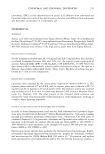
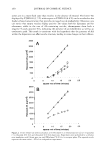
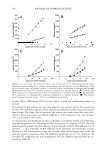
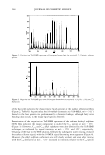
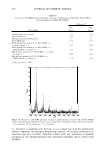
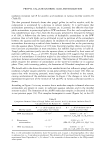
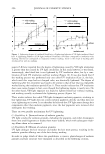
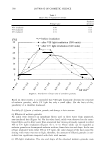
296 �L 6 5 4 3 2 0 -1 JOURNAL OF COSMETIC SCIENCE a --+- with washing - - s - - without washing shing irradiation unit 20 30 �L 6 5 4 3 2 0 -1 b --+- with washing - - s - - without washing irradiation unit ashing Figure 1. Lightening degree of irradiated blond hair. a: Lightening behavior of VIS-light-irradiated blond hair. b: Lightening behavior of UV-light-irradiated blond hair. Solid line corresponds to irradiation with washing. Dotted line corresponds to irradiation without washing. Circle is the result of washing after irradiation but with no washing. papers (5 ,8) have reported that the degree of lightening caused by VIS light irradiation is greater than that caused by UV light irradiation. In this study however, it was found, interestingly, that blond hair is not lightened by UV irradiation alone, but by a com bination of both UV irradiation and hair washing (Figure 1 b). It was also found that if the washing process was performed only once after UV irradiation (Case 2), the hair, which until this stage had not changed color, was drastically lightened. The degree of lightening after this treatment was found to be similar to that of hair that was repeatedly washed during the irradiation period (Case 1). These results indicate that UV irradiation does cause some changes to hair, even though the lightening degree is nearly zero. On the other hand, VIS-light exposure was found to lighten blond hair without washing, and washing actually accelerated the lightening process (Figure la). These results indicate that while VIS light decomposes melanin pigments, resulting in hair lightening, UV light does not attack melanin pigments directly and thus does not cause lightening on its own. It can therefore be believed that UV light must damage hair components other than melanin pigments, since the hair pigments were removed after subsequent hair washing. There are two possible mechanisms for UV lightening: (1) Possibility A: Denaturalization of melanin granules UV light attacks the melanin granules, excluding the pigment, and either decomposes them into small fragments or makes them water-soluble, which with subsequent wash ing allows them to be removed. (2) Possibility B: Effusion of melanin granules UV light damages the hair structure and makes the hair more porous, resulting in the melanin granules effusing out of the hair during washing. In order to judge which of these two possibilities is correct, photochanges of melanin granules and hair structure were examined as described in the following sections.
Purchased for the exclusive use of nofirst nolast (unknown)
From: SCC Media Library & Resource Center (library.scconline.org)