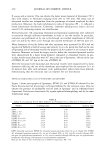
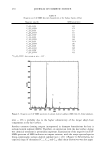
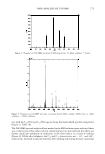
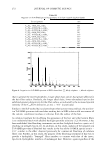
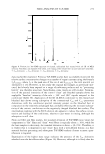
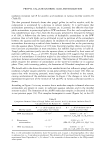
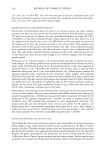
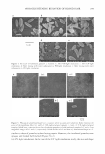
PHOTOLIGHTENING BEHAVIOR OF BLOND HAIR 301 Conversely, in the case of UV light irradiation, effusion of the melanin granules oc curred, but no noticeable damage to their structure was observed. It is well known that UV light damages hair proteins (3 ,4, 14). Because the irradiation time was short in this experiment (20 irradiation units), hair damage was not recognizable in the appearance and feel of the hair. However, as one can see in Figure 66, after UV-light irradiation of 20 irradiation units followed by rinsing with water, the internal hair structure had already been damaged. These cracks were found to be much bigger than the melanin granules, and therefore some of the melanin granules were able to pass through the cracks. This, therefore, indicates that UV light destroys the peripheral structure of the melanin granules and thereby enables some part of the granules to be washed out of the hair fibers (possibility B). From SEM observation only, we cannot see whether effused melanin granules are actually intact or partly denaturalized even though they seem to keep their original shape. However, based on the fact that hair irradiated with UV light was lightened once after rinsing in water, we can say that at least some pigment component of melanin granules was effused out. DIFFERENCE IN PHOTOLIGHTENING BEHAVIOR BETWEEN BLOND HAIR AND ISOLATED MELANIN GRANULES As mentioned above, blond hair is lightened by VIS light much faster than by UV light. Conversely, isolated eumelanin is lightened by both VIS and UV light to a similar extent. There are three possible reasons for these inconsistencies in photosensitivity. (1) Possibility C: Contribution of pheomelanin. Blond hair contains both eumelanin and pheomelanin (9,10). Hair color is considered as resulting from their total amount, their relative proportion, their location, their aggre gation condition, and their degradation (10,15). The difference in the photosensitivity between eumelanin and pheomelanin has been studied by many researchers, but their conclusions vary. Based on the comparison between red and brown hair, Wolfram and Albrecht (16) reported that pheomelanin is more resistant than eumelanin to photo degradation. Conversely, Hoting et al. (5) studied black and light-brown hair, and reported that eumelanin has a better photoprotective effect on hair than pheomelanin. From the studies on the photoreaction of pheomelanin granules isolated from red hair, it was discussed that pheomelanin is degraded by UV light more easily than eumelanin (17-19). Thus, the photosensitivity of pheomelanin caused by VIS and UV light has not yet been clarified. If pheomelanin is more sensitive to and more easily lightened by VIS light than UV light, it will be natural for blond hair to be lightened by VIS light faster than by UV light, even though the photosensitivity of eumelanin is similar for both types of light. (2) Possibility D: Denaturalization of isolated melanin If eumelanin granules are denatured during the isolation process, they may show a different behavior from those of intact granules. (3) Possibility E: Absorption of UV light by hair protein In nature, melanin granules exist inside hair, mainly in the cortex. Therefore, light goes through hair protein, such as the cuticles and cortex, prior to reaching the melanin granules. It is possible the UV light is attenuated when it reaches the melanin granules. It is therefore feasible that melanin granules, which are located inside the hair, are lightened less than isolated granules by UV irradiation.

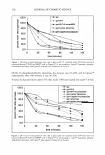
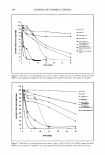
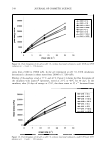
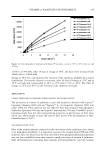
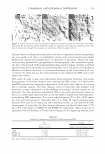
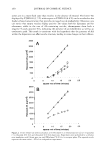
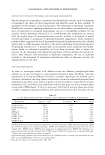
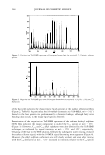
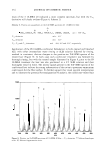
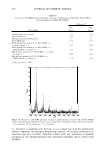
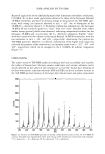
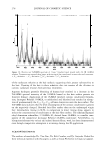
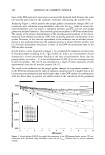
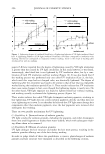
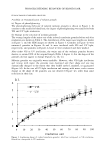
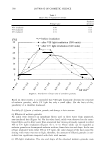
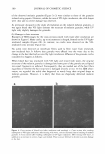
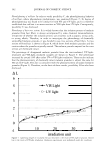
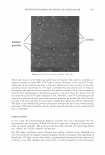
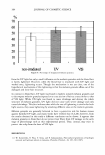
302 JOURNAL OF COSMETIC SCIENCE Photolightening of red hair. In order to verify possibility C, the photolightening behavior of red hair, where pheomelanin predominates, was examined (Figure 7). Its degree of photolightening was found to be similar for both VIS and UV light, and it is therefore established that red hair is no more sensitive to VIS light than UV light. Consequently, possibility C was dismissed. Photochange of hair cross sections. It is widely known that the isolation process of melanin granules from hair fibers is always accompanied by some chemical denaturalization, irrespective of whether the isolation process uses enzymes such as papain, strong acids, or strong alkalis. Therefore, in order to investigate the photochange of chemically unmodified melanin granules, it was decided to use cross sections of hair fibers. A cross section of blond hair is shown in Figure 8, which shows both melanin granules and the cavities where the granules originally existed. The melanin granules exposed on the cross section are chemically intact. The percentage of disappeared melanin granules from the non-irradiated, UV-light irradiated and VIS-light-irradiated samples are shown in Figure 9. The percentage increased by around 10% after either UV or VIS light irradiation. These results indicate that the photosensitivity of chemically intact melanin granules is almost the same for VIS and UV light. This fact is consistent with the photosensitivity of isolated melanin granules (Figure 2). Therefore, on the basis of these results, possibility D has also been dismissed. �L 6 5 --+- VIS Light 4 - o - UV light 3 2 1 0 -1 irradiation unit Figure 7. Lightening degree of irradiated red hair. Solid line is the result of VIS-light irradiation. Dotted line is the result of UV-light irradiation. Irradiation experiments were performed under dry conditions.
Purchased for the exclusive use of nofirst nolast (unknown)
From: SCC Media Library & Resource Center (library.scconline.org)