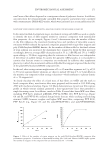
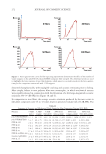
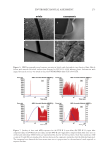
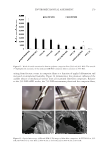
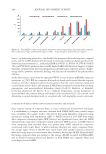
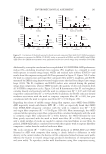
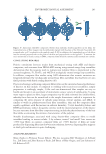
269 Enviromechanical Assessment were mounted in a film tension clamp and equilibrated at 20% RH for 3 hours prior to testing. Then, the humidity was raised from 20% to 75% RH in discrete 5% RH steps, wherein samples were conditioned at each humidity level for 90 minutes prior to stepping to the next isohume. At each isohume, the steady-state viscoelastic properties, including E′, loss modulus (E″), and tan δ (E″/E′) at 26 ± 1°C, were documented. The following dynamic methodology was applied: initial static force =1 g auto tension =120% frequency =1 Hz strain =0.075%. Typical sample sizes for uniaxial DMA testing were ca. 8 × 8 × 0.7 mm. DVS: MOISTURE REGAIN OF FILM-FIBER COMPOSITE FILMS Moisture management of composites was studied by DVS. A small section of composite film (8–10 mg) was loaded into the sample chamber of a TA Instruments Q5000 SA. Samples were then subjected to the identical humidity rate protocol listed in the “DMA-RH: Critical Humidity and Viscoelasticity of Film-Fiber Composites” section, in which the films were equilibrated at 20% RH for 180 minutes prior to increasing the humidity from 20% to 90% RH at 0.5% RH/min. All runs were performed at 26 ± 1°C. The mass regain of the films was used to assess relative film hygroscopicity. DSC-RH: THERMAL PROPERTIES OF HUMIDITY-EQUILIBRATED NEAT FIXATIVES A TA Instruments Q2000 DSC with aluminum Tzero hermetic pans and lids (TA Instruments) was used to assess the humidity-dependent T g values of hydrated fixatives. Neat polymer films were prepared as described in the “AED in Conjunction with Mechanical Analysis of Fixative-Fiber Composites” section. The dry films were subsequently crushed with a mortar and pestle into powders and weighed into open DSC pans. The samples were then placed in a Model 5503 Electro-Tech Systems environmental chamber and equilibrated for 72 hours, which was done to achieve steady-state water regains at 26°C using three different humidity setpoints (25%, 50%, and 75% RH). Finally, all hydrated samples were hermetically sealed in DSC pans within the climate-controlled environment. The DSC-RH methodology involved heating from −50° to 130°C at 10°C/min. Standard DSC using perforated aluminum lids was completed to assess the dry T g ,which was evaluated by heating neat polymers from −20° to 220˚C at 10˚C/min. The second heat results were reported as the dry T g .IMPACT TESTING OF NEAT FILMS A falling dart test was used to assess the impact toughness of films under the abrupt application of a fixed load. Fixative films were fabricated by pouring highly concentrated polymer solutions (i.e., 10% (w/w)) into custom silicone-caulk walled glass troughs to produce dried-film thicknesses between 1.5 and 2.0 mm. A custom falling dart device (GS Robotics LLC, Green Brook, NJ, USA) was used to direct a pointed 68-g stainless-steel tipped dart to the surface of the film from a height of 7.0 cm (1.04 m/s). The resultant film damage was evaluated by tallying the number of cracks emanating from the point of contact and measuring the length of each crack. The ambient testing conditions were 48 ± 3% RH and 24 ± 2°C.

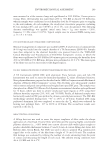
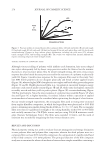
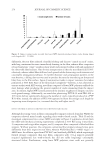
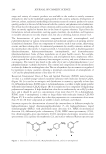
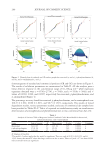
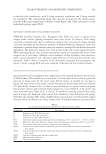
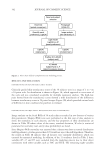
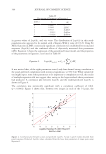
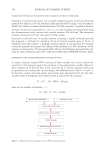
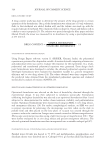
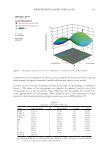
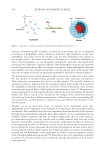
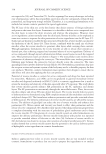
270 JOURNAL OF COSMETIC SCIENCE TENSILE TESTING OF COMPOSITE FILMS Although viscous yielding of polymer welds inhibits crack formation, hair tresses shaped into styles subsequently fail by slower creep processes unless the fixative has the intrinsic elasticity to resist excessive plastic flow. In tensile strength testing, the stress versus strain response describes brittle fracture processes and/or the resistance of a polymer to plastically yield (18). Figure 3 models stress responses for the composite films used in this study. Very low MW brittle polymers do not dissipate plastically and break at lower applied strains (Figure 3A), whereas higher MW elastoplastics are tougher and break after greater elongation (Figure 3C and E). Highly plasticized films (e.g., viscoplastics) excessively dissipate energy and more easily stretch under tension (Figure 3B and D), while some elastoplastic materials reversibly stretch and then yield via perfect plastic (Figure 3F) or strain-hardening (Figure 3G) flow mechanisms. Since the stress response of a polymer may resemble Figure 3A when dry and Figure 3G at higher humidity, viscoelastic balance within a spectrum of applied enviromechanical stresses must be considered when optimizing the design of a hair fixative. For our tensile strength experiments, the rectangular films used in testing were sectioned from surplus film-fiber composites, in which the larger films were plasticized at 90% RH prior to trimming into smaller oblong blocks of film (ca. 8 × 8 × 0.7 mm). The rectangular films were then re-equilibrated overnight at the testing humidity (either 50% or 90% RH) and carefully mounted in a TA.XTplus texture analyzer using TA-96-B miniature tensile grips (Texture Technologies Corp.). The films were extended 1.0 mm/s, and the work of extension was recorded by integrating the force-versus-distance curve. RESULTS AND DISCUSSION Physical property testing was used to evaluate fracture propagation and energy dissipation in neat polymer films and polymer-fiber composites, wherein the dried polymer mass in a composite film is at least 90% (w/w). By comparison, the composition of a rigidly styled head of hair likely contains 1% (w/w) polymer. The principal objective of the film composite study was to examine the release of mechanical stresses from simple assemblies containing a Force or Stress A E Elongation orStrain D B YS G F C UTS BS Figure 3. Fracture profiles of strained fixative-fiber composite films: (A) hard and brittle (B) soft and tough (C) hard and tough (D) soft and weak (E) hard and strong (F) ductile with plastic flow and (G) ductile with strain-hardening. Changes in slope indicate plastic deformation, including the yield stress (YS), ultimate tensile strength (UTS), and breaking strength (BS). The overlay was adapted from internal Ashland Inc. reports containing empirical tensile strength results.
Purchased for the exclusive use of nofirst nolast (unknown)
From: SCC Media Library & Resource Center (library.scconline.org)