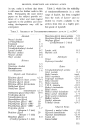
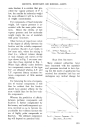
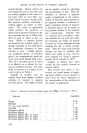
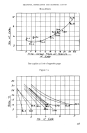
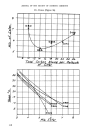
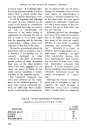
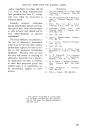
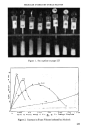
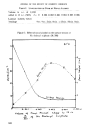
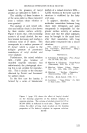
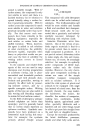
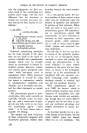
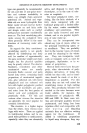
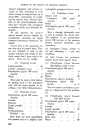
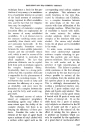
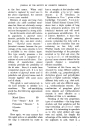
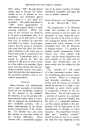
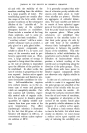
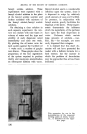
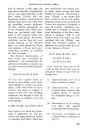
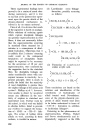
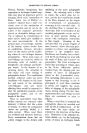
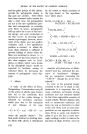
JOURNAL OF THE SOCIETY OF COSMETIC CHEMISTS are recorded in Table 5. In Figures 3A and 3•3 the volume of an ester required for homogeneous solution at various temperatures is recorded and the volumes required for mixing at 10øC are plotted against the number of carbon atoms in the ester molecule. It will be seen from Figures 3A and 3B that the blending power of the esters varies inversely as the molecu- lar size. Mono-esters of low molecular weight are most efficient (but too volatile for use in cosmetics) whereas butyl and amyl stearates are relatively poor blending agents. Con- sidering blending action with vola- tility, ethyl laurate is probably the best product. Isopropyl myristate is clearly better than butyl stearate. With the di-esters, however, the situation appears to be different, and an optimum number of carbon atoms seems to exist. Compounds in the range of dibutyl sebacate (2 ester groups + 16 carbon atoms) and diethyl sebacate (2 ester groups + 14 carbon atoms) are most efficient. The position of dibutyl oxalate may, however, present an anomaly and it may, for example, be found that the lower adipate esters (e.g. diethyl or dibutyl adipate) are more efficient blending agents for the White Oil-Castor Oil system than the sebacate esters. investigation of these esters is not yet complete. The White Oil-Castor Oil system is not strictly representative of the formulations encountered in cos- metics although it is a typical hydro- carbon oil-vegetable oil system. It may be significant, however, that the newer esters, viz. isopropyl myristate and diethyl sebacatc, which are tending to replace butyl stearate do appear as better blending agents when examined by the method described. (Continued on Page ,119) Figures 3,• and 3B (Page,s' 117 and 118) The lower graphs in each. figure plot tht, te•nperature of rnisciMlitv of a mixture of 10 mls, each of White Oil and Castor Oil with increasing amount• o• ester. The temperature of miscibility w•th no ester present was 71' 5øC. Frmn tim I o•er ographs the volume of ester required to just produce a homogeneous solt•lion al 1{) C was determined. In the upper graphs in each, figure' this latter value is plot'ted against the number of carbon atoms in the ester. A•nAc: amyl acetate AmS: amyl stearate BuA: butyl aceta•:c BuL: butyl laurate DOA: dioctyl adipatc DOS: dioctyl sebacate EtA: ethyl acetate EtL: ethyl laurate Key BuS: b•tyl stearate DBO: dibutyl oxalate DBS: dibutyl sebacatc DES: diethyl sebacate ElM: ethyl myristatc IPM: isopropyl myristate IPP: isopropyl palmirate OcA: Octyl acetate O.O.: octyl ottoate 116

SOLVENTS, HUMECTANTS AND BLENDING AGEN'I',q Mono-Esters See caption at foot of opposite page Figure 3 A do 26' 20 /.5 117
Purchased for the exclusive use of nofirst nolast (unknown)
From: SCC Media Library & Resource Center (library.scconline.org)