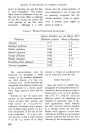
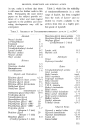
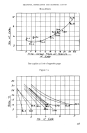
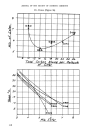
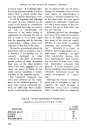
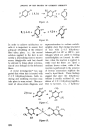
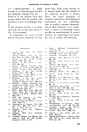
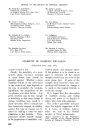
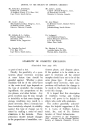
JOURNAL OF THE SOCIETY in loss of water. It is perhaps signi- ficant that moisture transfer is always slower from a cream system than from the aqueous humectant alone. It will be apparent that although the aspect' of water retention by the cream is one feature of a humectant this ingredient also plays an import- ant role in conditioning the behaviour of the cream during its application by retarding the rate of loss of water so as to allow ample time for spreading and by reducing or preventing "rolling" due to poor adhesion of the film to the skin. Glycerol is pre-eminent among the humectants used in cosmetics and it is doubtful if its position can be seriously challenged by other materials in this field. It possesses greater powers of water absorption than most of the other products which have been suggested for use (these are shown in Table 6) and under normal conditions is readily available in the requisite quality. The humectant employed does exert some influence on the consis- tency of the finished product. In some cases creams containing gly- cerol are stiffer than those contain- ing the various glycols as humectants OF COSMETIC CHEMISTS but no general rule can be given. Change of humectant thus involves some degree of reformulation to maintain a standard consistency but, on the other hand, for some special applications alternative humectanta are useful where creams of thin con- sistency but yet of high mlids con- tent are required. Although glycerol has advantages over many of the alternative humect- ants in its higher moisture absorp- tion, many of the latter are equally effective or even better in assisting spreading and preventing "roll- ing". Generally it is found, in addition, that the glycols give rise to more rapid "vanishing" on appli- cation presumably because their lower hygroscopicity, high evapora- tion rate and, in some cases, better skin penetration compared with glycerol. It is also frequently noted that in vanishing cream formulations alternative humectants fayour the earlier development of "pearli- Bess" Although the toxicity of ethylene glycol and its polyethers is open to suspicion the small amounts- of humectant e m p 1 o y e d (usually 5-10%) renders them less dangerous TABLE 6. WATER ABSORPTION OF HUMECTANTS (Equilibrium Absorption at 70% R.H. & 25oc.) Humectant Ethylene õlySol ......... Glycerol ............ Sorbitd ......... Butylene gls • 1 ......... % weight absorption 9O 55 36 11.5 120

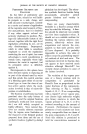
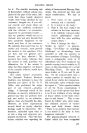
SOLVENTS, HU•IECTANTS AND BLENDING AGENTS unless cumulative in action and the U.S. Food & Drug Administration find quantities less than 5% accept- able even when the humectant is ethylene glycol. Recently, however, triethylene glycol, polyethylene glycol and buty- lene glycol have been acknowledged as skin irritants and should not be used indiscriminantly as glycerol substitutes •3. The main difficulty encountered i• the use of alternative humectants arises from the fact that their relative performance appears to vary accord- ing to the particular formulation employed. Practical tests are thus the only safe means of selecting an alternative humectant for a particu,.- lar application but there is evidence to show that propylene glycol and sorbitol alone or in combination can be successfully applied as alter- natives. •REFERENCES See for example N. S. Peel, Soap Perfumery • Cosmetics, 1950, 23, 1013, 1130. See for example Parsil & Whiteacrc, Drug • Cosmetic Industry, 1950, 66, 516. 3. Hall, Proc. Sci. Sect. T.G.A. (through S.P.C., 194't, 17, 513). 4. Schimmel Briefs Feb., 1950 (through Drug & Cosmetic Ind., 1950, 66, 576). 5. B.P., 548, 329. O. A m e r, Manuiacturing Chemist, 1949, 20, 544. 7. E. S. Lower, American Per[umer, 19•t9, 53, 121. 8. B.P., 629, 102. 9. E. Chadwick & G. Pears, Soap, Per[umery C• Cosmetics, 1950, 23, 257. 10. R. W. Moncrieff, "Les Fixateurs en Parfumerie ". La Parfumerie Modernc. P.M. No. 14, 1949. 11. R. G. Harry, "Modern Cosmetico- logy" Leonard Hill, 2nd Edn. 1944. 12. Soap, Per/umery & Cosmetics, 1946, 19, 465. 13. Fette u. Seifen, 1950, 52, 423. The a, uthors would like to acknowledge' •he facilities provided for the prepara- tion of this paper by British Industrial Solvents Ltd. 121
Purchased for the exclusive use of nofirst nolast (unknown)
From: SCC Media Library & Resource Center (library.scconline.org)