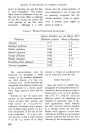
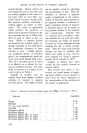
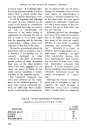
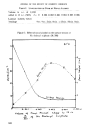
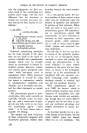
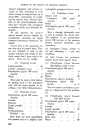
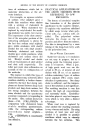
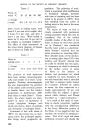
JOURNAL OF THE SOCIETY OF COSMETIC CHEMISTS j ected to leaching out and the film to water absorption. The former effect leads to brittleness of the dry film and the latter effect to softening of the film during the period the water persists in the film after immersion. Although it is well- known that the water-solubility of most plasticisers is low, it may not be generally recognised that the inverse solubility (water in plasti- ciser) is usually much higher as shown in Table 2. TABLE 2. WATER/PLASTICISER SOLUBILITIES Plasticiser Approx. Solubility. gm. per 100 gm. 20øC Plasticiser in Water Water in Plasticis•r Triacetin 6.7 5.3 Dimethyl phthalate 0.31 1.5 Diethyl phthalate 0.06 0.6 Dibutyl phthalate 0.04 0.4 Diamyl phthalate 0.03 0.4 Dioctyl phthalate 0.01 0.15 Di-methoxyethyl phthalate 0.30 ...... -•. 4 _ Tricresyl phosphate 0.01 - -0- 3 The water-resistance may be improved by. including a small amount of an auxiliary plasticiser, e.g. butyl stearate or a wax, e.g. carnauba wkx. As the products are compatible with cellulose nitrate only in the presence of a solvent plasti- ciser, large amounts must not be used. Solvents are also the main com- ponents of nail varnish removers. Active solvents like acetone and butyl acetate are frequently employed, sometimes with a propor- tion of high-boiling solvent, to pre- vent redeposition of the film by sol- vent evaporation. It is also com- mon practice to add a small amount of an oil, e.g. castor oil or butyl stearate to reduce or ameliorate the loss of natural fat from the nail. EOSIN SOLVENTS Since the advent of soluble dyes, principally tetrabromofluorescein (al- ternatively known loosely as eosin or bromo-acid or by its U.S. designa- tion of D. & C. Red No. 21) as an effective means of imparting an indelible or permanent stain in lip- stick applications, much research has been directed towards selection of a suitable solvent for this dye. Earlier work app. ears to have been restricted to the field of conventional cosmetic materials .but this has' been followed by the development of sol- 108

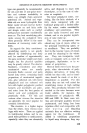
SOLVENTS, HUMECTANTS AND BLENDING AGENTS vents formerly unknown in cosmetic formulations. The ideal solvent must possess certain definite properties other than merely being a good solvent for eosin. It should be compatible with the majority of lipstick ingredients and preferably act as a plasticiser for the mass. It must be non-toxic and non-irritant, it should neither evaporate nor unduly modify the consistency of the product. It appears that two main factors are involved in the extent and rapidity of staining of the skin by dyestuffs--the concentration of dis- solved dye being one factor and the skin-penetrating action of the solvent being the other. The concentration factor implies the use of a solvent of sufficient power to maintain the dye present in a lipstick in soluble form and since skin - penetration is primarily a diffusion process the size of the solvent molecules becomes a critical factor. For rapid permeation by the solvent there is thus a limit in molecular weight and a compro- mise has to be made between the rate of penetration and rate of evaporation of the solvent since the latter affects the shelf-life of the stick. The evidence now available to corroborate the allergic reactions due to eosin o.r its associated impurities 2 favours the use of efficient solvents since these permit a reduction in the amount o.f soluble dye required and ensure that it is evenly distributed in a uniform film on application rather than as dispersed particles which involve local areas of high dye concentration. The most common media em- ployed as dye solvents in the past have been castor oil and butyl stearate in combination. The solu- bility of eosin in each liquid is so small that they can hardly be classed as eosin solvents. With the normal amounts of soluble dye used it is evident that the greater part must be present in the dispersed rather than the dissolved state. Although castor oil is incompatible with hydrocarbons and requires a blend- ing agent for successful inclusion it imparts such advantages that it has become a classic component of modem lipsticks. It is almost essen- tial therefore that any solvent employed must either be an efficient blending agent for castor oil and hydrocarbons or must be capable of replacing it entirely. Butyl stearate, although an excellent emollient, could usefully possess a wider range of compatibility. Its low solvent power for eosin and the readiness with which it exudes even under temperate conditions tend to make it a rather doubtful asset. The investigations of Hall 3 led to the conclusion that the solution of the problem of eosin solvents rests "in the field of short chain aliphatic alcohols, ethers or combined groups" and other investigators 4 have suggested glycerol and glycol derivatives containing one or more free hydroxyl groups as suitable media. Evaluation of such products confirms the effectiveness of the alcohols, ethers and glycols but the 109
Purchased for the exclusive use of nofirst nolast (unknown)
From: SCC Media Library & Resource Center (library.scconline.org)