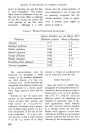
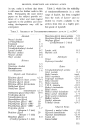
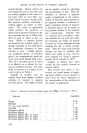
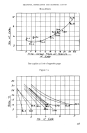
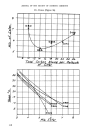
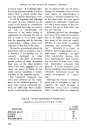
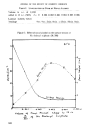
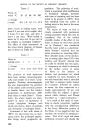
JOURNAL OF TIlE SOCIETY OF COSMETIC CHEMISTS Temp. of water øC. % change in work TABLE 2. 20 35 60 80 100 0.0 1.0 1.0 -7.3 -17.9 After 1 hour in boiling water, wool loses 0.2 per cent of its weight after 2 hours 0.3 per cent, and after 8 hour• 1 per cent. Wool boiled in water for 14 days lost 36 per cent of its sulphur as hydrogen sulphide 22. The effect of these treatments on the stress/strain diagram of human hair is shown in Table III: TABLE 3. Hours in boiling water 1 2 4 8 % change in work -14.4 -14.6 -18.0 -25.0 The products of wool hydrolysis have been studied chromatographi- cally and consist of at least 3 poly- peptides. Partition chromatography has also demonstrated the presence of the amino acids normally present in keratin fibres, but the relative proportions in hydrolysates differ from those in whole fibres 2ø. Chem- ically, the above results are inter- preted in terms of hydrolysis of cystinc disulphide linkages, acid amide side chains, fission of peptides and disruption of hydrogen bonds. Treatment of hair with steam at 100øC. for short times has no dam- aging action, but prolonged applica- tion brings about progressive de- gradation. The yellowing of 'wool, which is associated with' modification of disulphide linkages, increases with time of steaming and has been stated to be greater at 100øC. than that resulting from the action of boiling water or dry heat at the same temperature. The action of water on hair is closely .connected with permanent waving processes which will now be considered. One of the earliest scientific studies of the effect of hot water or steam on wool was can'ied out by Harrison •a who considered that the water acted as a plasticiser, while Shorter •4 believed that the steam exercised an annealing effect. More detailed study of the mechan- ism of setting dates from 1933 when Astbury and Woods •* showed that set could be divided into two types, i.e. temporary set which is destroyed by the further action of steam on fibres in the absence of tension, and permanent set, which is unaltered by such treatment. It was also found that when a stretched wool fibre is steamed under tension for 2 minutes, followed by release in steam, the fibre contracted to a length approximately 30 per cent smaller than the original, a pheno- menon which Astbury and Woods described as "super-contraction" As a result of this study of varia- tions in elastic properties, together with the accompanying differences in the X-ray diffraction pattern of the fibres, it was suggested that two reactions• are involved in setting pro- cesses. First of all, rapid side chain hydrolysis occurred and should the 166

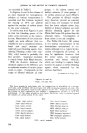
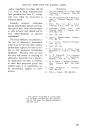
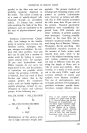
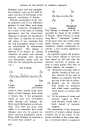
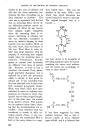
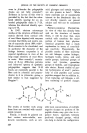
IaROPERTIE• OF fibre be released •t this stage, the long chain molecules (polypeptides) coil up and supercontraction of the fibre results. Parallel with this breakdown reaction, re-formation of linkages takes place and when link- age rebuilding exceed::• hydrolysis the fibre remains permanently set in the elongated state. When wool fibres are pre-treated with dilute alkali or with reagents which com- bine with amino groups, the second, rebuilding, reaction does not occur during steaming of the stretched fibres, e.g. when steamed at 50 per cent extension a 50 per cent super- contraction occurred on releasing the fibre in steam. The chemical interpretation of these events was commenced by Speakman•% who assumed that the preliminary breakdown reaction was associated with the cystine disulphide linkages: R.S.S.R--R.SH + R.SOH KERATIN FIBRES been deaminated with nitrous acid, or whose amino groups had been blocked by reaction with benzoqui- none. Finally, it was shown that fibres cannot be set in acid media. Optimum setting occurs at about pH 9 when the duration of treatment is some 30 minutes. Speakman con- cluded that in solutions of this pH value hydrolysis of the fibre disul- phides is adequate, while in acid solutionsl basic side chains are fully combined with acid. Phillips 27 sug- gested that secondary reactions of sulphenic acid groups could give rise to new linkages as folo•vs: R.CHa.SOH--R.CHO + H•S R.CHO + R.NH•-- R.CH=N.R+H:O. From what has been said so far it will be seen that in this work on permanent setting we have the fol- lowing facts: The fact that reagents which arc known to cause fission of the disul- phide linkages of cystine, e.g. bisul- phires, cause wool fibres to super- contract, was given a•-4 evidence in support of this view. The rebuilding mechanism was thought to occur by condensation of sulphenic acid and amino groups: R. SOH + R. N H•--R. S. NH. R + H•O Here again it was found that attain- ment of permanent set was pre- vented and supercontraction follows on steaming wool fibres which had (i) (2) (3) (4) Supercontraction and t•et of fibres stretched in steam. Supercontraction o f stretched fibres treated with reagents known to rupture the disulphide linkage in cys- fine. Prevention of set by treating wool fibres with reagents combining with amino groups. Occurrence of maximum set in fibres boiled in solutions of pH 9.2. 167
Purchased for the exclusive use of nofirst nolast (unknown)
From: SCC Media Library & Resource Center (library.scconline.org)